 Wow! eBook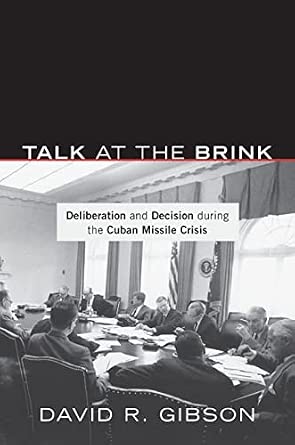
Talk at the Brink: Deliberation and Decision during the Cuban Missile Crisis Illustrated Edition
Author(s): David R. Gibson (Author)
- Publisher: Princeton University Press
- Publication Date: 22 July 2012
- Edition: Illustrated
- Language: English
- Print length: 256 pages
- ISBN-10: 9780691151311
- ISBN-13: 0691151318
Book Description
Editorial Reviews
Review
From the Inside Flap
“The ping-pong match known as the Cuban missile crisis of October 1962 is reinterpreted in this brilliant, analytic exposé. David Gibson sheds landmark new light on the terse diplomacy between Kennedy and Khrushchev. His research is prodigious. Highly recommended!”–Douglas Brinkley, Rice University
“Some phenomena are so important, so consequential, that they are worth putting under a microscope. If true for the cells of a human being, why not apply another kind of microscope to the crisis conversations skirting the edge of global thermonuclear war? That is what Gibson has done, giving us a renewed sense of indeterminacy about the whole event. It takes a rare kind of historical sociologist to find this extra depth of understanding.”–Philip Zelikow, University of Virginia, coauthor ofEssence of Decision: Explaining the Cuban Missile Crisis
“In Talk at the Brink, Gibson has established himself as one of sociology’s leading conversational analysts. Drawing on actual audio recordings, he offers us a fly-on-the-wall perspective on the deliberations among Kennedy’s inner circle during the Cuban missile crisis. Remarkably nuanced, this is microsociology at its best.”–Eviatar Zerubavel, Rutgers University, author ofThe Elephant in the Room: Silence and Denial in Everyday Life and Ancestors and Relatives: Genealogy, Identity, and Community
“This book makes a major intellectual and scholarly contribution to our understanding of human behavior. I predict that it will be much cited and lead to significant shifts in the way scholars and the lay public think about the Cuban missile crisis in particular and decision making and leadership in general. The book’s strongest lesson is how open and nonlinear important decisions can be.”–Jane Mansbridge, Harvard University
“Talk at the Brink is an important book for sociologists, political scientists, linguists, historians, and theorists of conflict resolution. Analyzing John F. Kennedy’s taped deliberations during the perilous days of the Cuban missile crisis, Gibson persuasively argues that talk has its own prerogatives and rules and that these things matter in how decisions get made. Extremely lucid and illuminating.”–Robin Wagner-Pacifici, author ofThe Art of Surrender: Decomposing Sovereignty at Conflict’s End
From the Back Cover
“The ping-pong match known as the Cuban missile crisis of October 1962 is reinterpreted in this brilliant, analytic expose. David Gibson sheds landmark new light on the terse diplomacy between Kennedy and Khrushchev. His research is prodigious. Highly recommended!”–Douglas Brinkley, Rice University
“Some phenomena are so important, so consequential, that they are worth putting under a microscope. If true for the cells of a human being, why not apply another kind of microscope to the crisis conversations skirting the edge of global thermonuclear war? That is what Gibson has done, giving us a renewed sense of indeterminacy about the whole event. It takes a rare kind of historical sociologist to find this extra depth of understanding.”–Philip Zelikow, University of Virginia, coauthor of Essence of Decision: Explaining the Cuban Missile Crisis
“In Talk at the Brink, Gibson has established himself as one of sociology’s leading conversational analysts. Drawing on actual audio recordings, he offers us a fly-on-the-wall perspective on the deliberations among Kennedy’s inner circle during the Cuban missile crisis. Remarkably nuanced, this is microsociology at its best.”–Eviatar Zerubavel, Rutgers University, author of The Elephant in the Room: Silence and Denial in Everyday Life and Ancestors and Relatives: Genealogy, Identity, and Community
“This book makes a major intellectual and scholarly contribution to our understanding of human behavior. I predict that it will be much cited and lead to significant shifts in the way scholars and the lay public think about the Cuban missile crisis in particular and decision making and leadership in general. The book’s strongest lesson is how open and nonlinear important decisions can be.”–Jane Mansbridge, Harvard University
“Talk at the Brink is an important book for sociologists, political scientists, linguists, historians, and theorists of conflict resolution. Analyzing John F. Kennedy’s taped deliberations during the perilous days of the Cuban missile crisis, Gibson persuasively argues that talk has its own prerogatives and rules and that these things matter in how decisions get made. Extremely lucid and illuminating.”–Robin Wagner-Pacifici, author of The Art of Surrender: Decomposing Sovereignty at Conflict’s End
About the Author
Excerpt. © Reprinted by permission. All rights reserved.
Talk at the Brink
DELIBERATION AND DECISION DURING THE CUBAN MISSILE CRISISBy David R. Gibson
Princeton University Press
Copyright © 2012 Princeton University Press
All right reserved.
ISBN: 978-0-691-15131-1
Contents
List of Illustrations and Excerpts……………………………………..ixPreface……………………………………………………………..xiChapter 1 Introduction: Talk in Time of Crisis…………………………..1Chapter 2 The Future in Thought and Talk………………………………..24Chapter 3 The ExComm………………………………………………….49Chapter 4 The Response………………………………………………..74Chapter 5 The Blockade………………………………………………..109Chapter 6 The Deal……………………………………………………135Chapter 7 Conclusion………………………………………………….159Appendix A Timeline of Events and ExComm Meetings………………………..167Appendix B Dramatis Personae…………………………………………..175Appendix C Conversation-Analytic Transcribing Conventions…………………177Appendix D The Audio Recordings………………………………………..181Notes……………………………………………………………….183Bibliography…………………………………………………………203Index……………………………………………………………….213
Chapter One
Introduction
TALK IN TIME OF CRISIS
The course of history sometimes hinges on what happens when people talk. On the night of August 4, 1789, amid rumors of peasant unrest, clerics and nobles in the French National Assembly enthusiastically renounced their feudal privileges, overturning the old regime and establishing equality before the law. On October 13, 1962, Vatican II opened with a dramatic challenge to conservative Curia control over the proceedings, paving the way for sweeping church reforms. On the evening of January 27, 1986, NASA engineers teleconferenced with their contractor counterparts and decided to go ahead with the launch of the Challenger space shuttle, which broke apart seventy-three seconds into its flight the next day.
Though it is easy enough to find such examples, sociologists are deeply uncomfortable with the idea that events of historical importance are dependent on the vagaries of talk and gesture, or indeed on any local, small-scale occurrence (such as the assassination of a president or the failure of a would-be terrorist to explode a car bomb in Times Square). Surely one reason is that sociologists specialize in identifying the structural and cultural determinants of significant trends and transformative events, such as the gradual expansion of state power and social revolutions, and claims that the course of history is decided by a telephone conversation or chance encounter pose an implicit challenge to such efforts. Another, more practical, reason may be that sociologists rarely have good microlevel data, and as we know from the history of behaviorism in psychology, if you do not have good information about what is happening inside the black box the easiest thing is to assume that it cannot be anything important.
Let us use the term microcontingency to refer to the idea that the course of history may sometimes hinge on small, localized events, including but not limited to face-to-face interaction. Microcontingency is closely related to the so- called butterfly effect, according to which a butterfly’s decision to fly in one direction or another on one side of the world could, in principle, measurably affect the weather on the other side of the world after a long enough wait, given the right conditions. Randall Collins has offered a particularly powerful argument against the existence of butterfly effects in human affairs, offering a three-pronged attack. First, he says, while particular events are sometimes important, the structural forces that endow such events with this importance would have worked through some event eventually, even if the one in question had turned out differently. For example, a military battle may mark the turning point in a war, but that does not mean that the tide would not have turned otherwise, for battles are lost when resources are overextended and sooner or later the fact of overextension will become apparent on the battlefield, although weather or tactical brilliance may postpone the inevitable. “The chances of military defeat grows—if not in one place, then in another; if not in one year, then a few years or decades later.” Collins also uses the example of Hitler, suggesting that Germany was ripe for some such militant, right-wing leader, and would have found it even had this failed artist not risen to power.
Second, Collins says, even when something happens that is genuinely transformative yet not inevitable, robust long-term trends always reassert themselves, though for the space of decades things may look very different than they might have. “A victory at Teutoburger Wald might have extended the Roman Empire 30–50 years; a Nazi victory at the Battle of Britain would have shaped the history of 1940–1980 or thereabouts, but increasingly thereafter events would converge toward the larger macro patterns of actually observed history.” (For those of us who can only hope to live on the order of decades, this is a difference that matters.)
It is Collins’s third argument, however, that I am most interested in. As a microsociologist famous for arguing that face-to-face interaction is foundational to all else, Collins certainly believes that talk (and the nonverbal behavior that accompanies it) matters. But he does not view that as being incompatible with an essentially deterministic worldview, arguing that the occasions for interaction are socially provided, and further, that the course of a given encounter is determined by the emotional and symbolic currents that run through it. Indeed, Collins takes this all the way down to the level of individual thoughts: “What an individual thinks is sociologically explainable, not merely in the aggregate in terms of general categories that persons use, but in the particular sequence of thought down to the level of a particular thought event.” In this way Collins severs microcontingency, to which he is not wholly opposed, from the conclusion that is often drawn from it, that this introduces some significant degree of indeterminacy into the sociological equation.
The idea that what happens in face-to-face interaction is influenced by prior conditions is not novel, even if Collins’s claim that the details of talk, and indeed the details of thought, are sociologically predetermined is bolder than average. We find a similar argument in Diane Vaughan’s highly regarded book on the Challenger disaster. Vaughan painstakingly reconstructs the structural and cultural context for the decision to launch the space shuttle in spite of warning signs that the crucial O-rings might not withstand the extreme pressure and temperatures involved, arguing that the decision was the joint product of a can-do engineering culture, political pressures to launch, and structural impediments to the sharing of information. Yet in the end the decision was actually made in the course of a teleconference of NASA and contractor engineers. Not wanting to see her causal edifice undermined by any suggestion that the meeting could have gone otherwise, Vaughan claims that “all participants’ behavior was scripted in advance by … cultural imperatives,” and that, as a result, “it is unlikely that the decision they reached could have been otherwise.”
This claim is interesting because, in a sense, Vaughan is compelled to make it given the nature of her argument. Yet the information she has about this teleconference, based on congressional testimony and interviews, seems to point decisively in the opposite direction, away from a scripted performance with an inevitable outcome to a chaotic encounter that was perpetually on the verge of unfolding differently than it did. In particular, key people could not be located in time; there was difficulty sharing charts between the three teleconferencing sites; some people had trouble hearing and being heard over the speakerphones; and individual words and sentences had an inordinate impact even as some things that could have been said in support of scrapping the launch were not.
What is the alternative to such an argument, which acknowledges that encounters matter only to minimize their independent importance? In Theorizing the Standoff, Robin Wagner-Pacifici offers one approach, focusing on moments of acute uncertainty when conflicting interpretations and incommensurate scripts run afoul of each other, resulting in a precarious impasse that, lacking a successful effort at translation and mediation, is apt to be decided by the preponderance of firepower. Microcontingency is thus given center stage, with multiple possibilities held in suspension yet subject to sudden and possibly bloody resolution given the smallest misstep.
My approach is somewhat different. With Wagner-Pacifici I share the conviction that neither microcontingency nor the fluid, improvised, and underdetermined nature of face-to-face encounters spell the end of sociological analysis, but rather its beginning. However, the nature of my historical case and the record it left behind allow me to go much further in dissecting the encounters in question (at least on one side of the crisis) to examine their internal cogs and springs, and to see how these were set in motion by events in the world and in turn geared back into them. One of my claims is that if history is contingent on what people say, what people say is contingent on the operation of a conversational machinery that, from moment to moment, allows some ideas to be expressed and developed while others are prevented from surfacing. While that machinery does not guarantee any particular outcome, when an outcome is not guaranteed for other reasons—for instance, by virtue of vested interests and overwhelming power differences—it can assume tremendous, even decisive, importance.
The Cuban Missile Crisis
Scholars of the Cuban missile crisis are not modest about its historical importance. “The Cuban Missile Crisis was the most dangerous event in human history,” begin Munton and Welch. At 9:00 a.m. on October 16, 1962, President John F. Kennedy was informed that a U.S. spy plane had photographed Soviet nuclear missiles on the island of Cuba. After several days of deliberation, on October 22 Kennedy went on national television to announce the discovery of the missiles, and the imposition of a blockade (euphemistically referred to as a “quarantine”) starting on the twenth-fourth. On the twenty-sixth, after several days of maneuverings at the UN and waffling at the blockade line five hundred miles from Cuba, Khrushchev offered, in a personal letter to Kennedy, to withdraw his missiles in return for a U.S. pledge not to invade the island. The next morning Khrushchev made a second offer, this one public, which tied removal of the Russian missiles to the removal of NATO (but U.S.-controlled) nuclear missiles in Turkey. Several hours later Kennedy responded: the United States would pledge not to invade Cuba in return for the removal of Soviet missiles and would enter into talks about other disarmament issues at a later date. Through a back channel, however, Kennedy offered a partial concession on the Turkish missiles, promising that they would be withdrawn within a few months of the peaceful end of the crisis, on the condition that this part of the deal be kept secret. The next morning, Khrushchev accepted.
This is a skeleton history of the crisis, seen as a kind of ping-pong match between Kennedy and Khrushchev. Broaden the picture a bit and one encounters the massive mobilization of military might, particularly on the U.S. side; Kennedy’s triumph at winning the support of the Organization of American States for the blockade on the twenty-third; Adlai Stevenson’s famous revelation of the photographic evidence to the UN Security Council on the twenty-fifth; Turkey’s adamant rejection of any deal that traded away its missiles; the downing of a U-2 plane over Cuba on the twenty-seventh and the accidental incursion of another U-2 into Soviet airspace earlier the same day; and Castro’s fiery challenges to the United States and eventual apoplexy at what he saw as Khrushchev’s betrayal (see appendix A for a timeline). Widen the net a bit further still to capture more recent revelations and one finds alarming evidence of error and near-disaster, including tense encounters between the U.S. Navy and nuclear torpedo-carrying Soviet submarines, a U.S. estimate of the number of Soviet personnel on the island that was off by a factor of eight, and tactical nuclear weapons aimed at the Guantanamo Bay Naval Base that U.S. military brass naively counted as defensible.
The Cuban missile crisis has contingency written all over it insofar as there were so many ways in which it could have gone differently. Most frightening was the possibility of nuclear war. Even if we allow that neither Kennedy nor Khrushchev desired Armageddon, there was a serious possibility of gradual escalation (e.g., if the Russians had used tactical nuclear weapons against invading U.S. forces), or misunderstanding (e.g., regarding the meaning of the U-2 incursion into Russian airspace), or accident, or a rash decision by some hot-headed officer on the ground to fire a missile—whether a Russian officer under bombardment by American planes in Cuba or an American officer under fire by Soviet planes in Turkey. Even short of nuclear war, the crisis could have turned out differently had the United States backed down and the Soviets felt empowered to take West Berlin, or if U.S. allies (especially in Latin America) had decided that the United States could not stop the Soviet advance and changed their allegiances so as to be on the winning side. Collins might be right in saying that such things do not matter in the long run, and liberal democracy might eventually have prevailed regardless, but the world in which we live now might have looked very different, and for a long time to come.
Of course, the outcome of the crisis depended most of all, or at least most straightforwardly, on the decisions made by Kennedy and his counterpart in Moscow. From one theoretical perspective, both the decisions that led up to the crisis and those that led out of it can be seen as rational, with the two leaders concerned primarily about advancing national interests, first among them security. But this is history in hindsight and ignores the fact that for much of the crisis no option seemed better than the others vis-à-vis this seemingly straightforward goal. That is, while it is easy to say that the two superpower leaders acted rationally given that a nuclear war—and indeed, virtually any bloodshed whatsoever—was averted, it is wrong to conclude that what seems “rational” in retrospect was clearly so to anyone at the time.
Leaders may deliberate in solitude, but President Kennedy chose a different course. Within three hours of learning about the missiles on the sixteenth, Kennedy had assembled his top advisers in the Cabinet Room. This group, which met daily, and sometimes more than once a day, throughout the entire crisis, was eventually named the Executive Committee of the National Security Council, or the ExComm. It was the discussions of this group that shaped Kennedy’s understanding of the options and the risks associated with each, subject to all of the rules and procedures for talking in groups.
The ExComm
The ExComm consisted of members of Kennedy’s cabinet, their immediate subordinates, the director of the Central Intelligence Agency, the chairman of the Joint Chiefs of Staff, and a number of other top-level advisers. (A list of ExComm members, along with some other people important to the meetings, is in appendix B.) The ExComm discussed a wide range of topics, including the U.S. response to the Soviet provocation, the interpretation of the photographs, plans for additional surveillance, the number of sorties needed for each variation of the air strike, questions from the media, goings-on at the United Nations, covert action in Cuba, plans to evacuate dependents from Guantanamo Bay, and many other things besides. (See appendix A for the sequence of topics discussed in each meeting.)
The ExComm’s role was advisory, in that the president was not obligated to follow his advisers’ advice, and it does not appear from the audio recordings or official minutes that the group conducted formal votes. Given that, one might justifiably wonder whether the ExComm’s deliberations actually shaped Kennedy’s perceptions and ultimate decisions. To this, two responses can be given. First, it seems unlikely that Kennedy would have spent around twenty hours with his advisers during the most significant crisis of the Cold War simply for the sake of appearances, especially given his concern early in the crisis that the ExComm’s work remain a secret. Second, the decisions that Kennedy made over the course of the crisis grew directly out of those deliberations: most of his advisers converged on the blockade as an initial response and Kennedy selected that; when it came time to exercise the blockade most of his advisers favored letting ships through and that is what happened; and his advisers were essentially unanimous in recommending that Kennedy accept Khrushchev’s offer to withdraw the missiles in return for a U.S. pledge not to invade the island, which is what Kennedy did, in spite of misgivings that led him to offer a further concession (involving the withdrawal of NATO missiles from Turkey) through a secret back channel. At each stage Kennedy seemed unsure of what to do, and at each stage his decision was fitting given the drift of the conversation—what I will refer to as the group’s “discursive state”—at the time it was made.
(Continues…)
Excerpted from Talk at the Brinkby David R. Gibson Copyright © 2012 by Princeton University Press. Excerpted by permission of Princeton University Press. All rights reserved. No part of this excerpt may be reproduced or reprinted without permission in writing from the publisher.
Excerpts are provided by Dial-A-Book Inc. solely for the personal use of visitors to this web site.


