Wow! eBook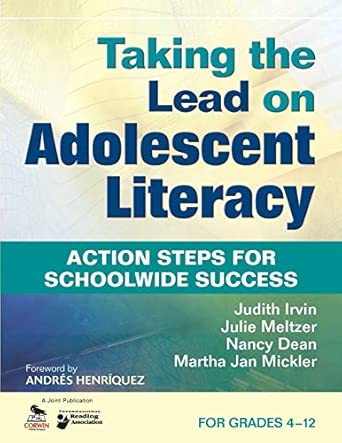
Taking the Lead on Adolescent Literacy: Action Steps for Schoolwide Success
Author(s): Judith Irvin (Author, Editor), Julie Meltzer (Author), Nancy Dean (Author), Martha Mickler (Author)
- Publisher: Corwin
- Publication Date: 26 Feb. 2010
- Edition: 1st
- Language: English
- Print length: 248 pages
- ISBN-10: 1412979803
- ISBN-13: 9781412979801
Book Description
Editorial Reviews
Review
About the Author
Judith Irvin is a professor at Florida State University in Tallahassee, Florida, and the executive director of the National Literacy Project, a nonprofit organization dedicated to improving middle and high school literacy. Her repertoire includes chairing the research committee for the National Middle School Association for six years and serving on the Commission on Adolescent Literacy of the International Reading Association.
She has written and edited numerous books, chapters, and articles on adolescent literacy―most notably Reading and the High School Student: Strategies to Enhance Literacy (with Douglas Buehl and Ronald Klemp, 2007), Strategies for Enhancing Literacy and Learning in Middle School Content Area Classrooms (with Douglas Buehl and Barbara Radcliffe, 2007), and Teaching Middle School Reading (with James Rycik, 2005).
Judith recently completed two books as a result of a project funded by Carnegie Corporation of New York: Taking Action on Adolescent Literacy: An Implementation Guide for School Leaders (with Julie Meltzer and Melinda Dukes, ASCD, 2007) and Meeting the Challenge of Adolescent Literacy: Practical Ideas for Literacy Leaders (with Julie Meltzer, Martha Jan Mickler, Melvina Phillips, and Nancy Dean, 2009). She is a speaker and consultant to school systems and professional organizations throughout the nation. Judith spent eight years as a middle and high school social studies and reading teacher.
Julie Meltzer, PhD, is Senior Advisor for Research, Strategy, and Design at Public Consulting Group’s Center for Resource Management (PCG-CRM) in Portsmouth, New Hampshire. She is responsible for the design of consulting services related to 21st Century Teaching and Learning, Response to Intervention (RtI), and Literacy and Learning. As director of theAdolescent Literacy Project at the LAB at BrownUniversity, she developed the Adolescent Literacy Support Framework showcased on the Knowledge Loom Web site and was on the development team for the Council of Chief State School Officers’ (CCSSO) Adolescent Literacy Toolkit. A sought-after keynote speaker, author, reviewer, conference presenter, andworkshop leader, she seeks to empower educators to apply promising research-based practices to support the literacy development and learning needs of students. Julie is a coauthor of Meeting the Challenge of Adolescent Literacy: Practical Ideas for Literacy Leaders (with Judith Irvin, Martha Jan Mickler, Melvina Phillips, and Nancy Dean, 2009), and Taking Action on Adolescent Literacy: An Implementation Guide for School Leaders (with Judith Irvin and Melinda Dukes, 2007). She is also the author of Adolescent Literacy Resources: Linking Research and Practice (2002), and articles that have appeared in Educational Leadership, Phi Delta Kappan, Principal Leadership, In Perspective, and other educational publications. She brings substantive experience as a teacher, teacher educator, and leadership coach to her work in the areas of systemic school improvement, capacity building, and design of professional development services and materials. Julie and her colleagues work with schools and
districts throughout the country.
Nancy Dean, EdS, is Professor Emerita at the P.K. Yonge Developmental Research School, University of Florida, Gainesville, Florida. During her 39 years in education, she has taught middle and high school English, special education, reading, debate, social studies, English for speakers of other languages, and Advanced Placement English. She is also an experienced literacy coach and curriculumspecialist. Committed to school literacy reform and meaningful professional development, she has worked extensively with teachers and school leaders in urban and rural schools throughout the United States. She is an associate director of the National Literacy Project and a lead presenter for that organization. In addition, she is a national consultant in secondary literacy and literacy leadership and director of Leadership Through Reading, a cross-age tutoring program.
Nancy is the author of Voice Lessons: Classroom Activities to Teach Diction, Detail, Imagery, Syntax, and Tone (2000); Discovering Voice: Voice Lessons for Middle and High School (2006); and the Writing Intervention Kit for High School (2008). She is also coauthor (with Candace Harper) of Succeeding in Reading: A Complete Cross-Age Tutoring Program (2006), and Meeting the Challenge in Adolescent Literacy: Practical Ideas for Literacy Leaders (with Judith Irvin, Julie Meltzer, Martha Jan Mickler, and Melvina Phillips, 2009).
Martha Jan Mickler, PhD, is currently a private consultant specializing in adolescent literacy. Sheworks with administrators and teachers in classroom and seminar settings with the focus on developing literacy leadership and helping teachers integrate literacywithin academic and fine arts content areas.
She has held a variety of leadership positions in education, including Supervisor of Secondary Reading (Pinellas County, Florida); Principal, Fairyland Elementary School (Walker County, Georgia); Supervisor of English and World Languages and Director of Teaching and Learning (Chattanooga Public Schools,Tennessee); and Director of Music Therapy (New Jersey Neuropsychiatric Institute, Princeton, New Jersey). She was also a resource teacher at Fairyland School and a piano instructor and performing artist for Cadek Conservatory (Chattanooga, Tennessee). Martha Jan has been active in many professional organizations, including the National Council of Teachers, serving as President of theTennessee Council of Teachers from 1997 to 1999. She serves on the Editorial Review Board for the Journal of Adolescent and Adult Literacy and has coauthored a book on literacy leadership: Meeting the Challenge of Adolescent Literacy: Practical Ideas for School Leaders (with Judith Irvin, Julie Meltzer, Melvina Phillips, and Nancy Dean, 2009). Her published articles have appeared inmany periodicals, including the Journal of Special Education, Classroom Leadership, Spelling Progress Quarterly, and Computers, Reading, and Language Arts.