Wow! eBook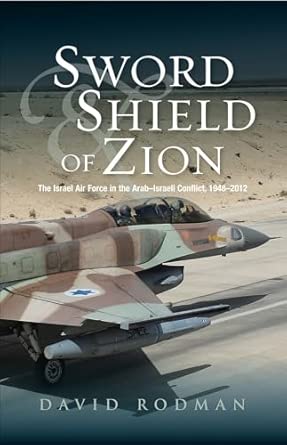
Sword & Shield of Zion: The Israel Air Force in the ArabIsraeli Conflict, 1948-2012 Hardback Edition
Author(s): David Rodman (Author)
- Publisher: Liverpool University Press
- Publication Date: 15 April 2013
- Edition: Hardback
- Language: English
- Print length: 144 pages
- ISBN-10: 1845195833
- ISBN-13: 9781845195830
Book Description
Editorial Reviews
Review
About the Author
Excerpt. © Reprinted by permission. All rights reserved.
Sword and Shield of Zion
The Israel Air Force in the Arab–Israeli Conflict, 1948–2012
By David Rodman
Sussex Academic Press
Copyright © 2014 David Rodman
All rights reserved.
ISBN: 978-1-84519-583-0
Contents
Acknowledgments,
List of Abbreviations,
List of Illustrations,
Preface,
Introduction (Part I): Israeli National Security and Airpower,
Introduction (Part II): Israeli Airpower and the Arab-Israeli Conflict,
1 Airpower and Maneuver Warfare: The Israel Air Force in the 1967 and 1973 Wars,
2 Airpower and Attrition Warfare: The Israel Air Force in the 1969–70, 2006, and 2008–9 Wars,
3 Airpower, Counterinsurgency, Special Operations, and Humanitarian Operations: The Israel Air Force between Arab-Israeli Wars,
4 An Airborne Revolution in Military Affairs: Unmanned Aerial Vehicles in Israel Air Force Service,
5 Ground-based Air Defense and Space-based Reconnaissance: Other War-related Responsibilities of the Israel Air Force,
6 The Infrastructure of the Israel Air Force: Bases and Squadrons,
Conclusion: The Past and Future Contributions of Airpower to Israeli National Security,
Appendix: The Historical Evolution of the Israel Air Force’s Fighter-Bomber Inventory,
Notes,
Select Bibliography,
Index,
CHAPTER 1
Airpower and Maneuver Warfare: The Israel Air Force in the 1967 and 1973 Wars
The 1967 Six-Day War and the 1973 Yom Kippur War began quite differently for the Israel Air Force (IAF). During the opening day of the Six-Day War, on the basis of a meticulously planned and exhaustively rehearsed operational plan, which it refined and updated in the three weeks prior to the outbreak of hostilities, the IAF assumed the initiative against the air forces of Egypt, Jordan, and Syria, taking them by surprise on the ground. The first few days of the Yom Kippur War, to the contrary, found the IAF scrambling to respond to an Egyptian-Syrian surprise attack against the State of Israel. Though the IAF had carefully planned and thoroughly rehearsed operational plans, in this instance aimed primarily at Arab integrated air defense systems (IADSs) rather than at Arab air forces, the diplomatic and military circumstances prior to the onset of hostilities prevented it from seizing the initiative.
The conditions prevailing at the outset of each war determined the IAF’s performance in the opening phases of these conflicts. In the Six-Day War, the IAF essentially annihilated the combined Arab air forces of Egypt, Jordan, and Syria in a few hours by launching several waves of highly coordinated air base attacks. The virtually complete elimination of Arab airpower — and the concomitant early achievement of air superiority over the battlefields — then left it free to concentrate on other roles in support of the Israeli war effort. During the Yom Kippur War, on the other hand, the IAF did not have the opportunity to secure air superiority over the battlefields early in the conflict, because the Israel Defense Forces (IDF) high command insisted that it fly close air support (CAS) and interdiction sorties on behalf of hard-pressed land forces. With sustained operations against Arab IADSs not an option — and with these systems subjected only to intermittent and hesitant IAF strikes — they exacted a significant toll on Israeli aircraft at modest cost to themselves during the first few days of the war.
The immense victory scored by the IAF against the Arab air forces during the Six-Day War, followed by the equally impressive triumph registered by IDF land forces against the Egyptian, Jordanian, and Syrian armies, has created the distinct impression that airpower played an overwhelming role in that victory. Contrariwise, the early setback suffered by the IAF at the hands of Arab IADSs during the Yom Kippur War, coupled with the much longer period of time that it took the IDF to defeat the Egyptian and Syrian armies in comparison to the Six-Day War (almost three weeks versus less than one), has created the distinct impression that airpower did not make a major contribution to the Israeli victory.
Admittedly, these impressions seem valid upon first reflection. With Arab air forces quickly eliminated as a threat both to Israel proper and to IDF land forces, the IAF participated extensively in the ground battles on the Sinai (Egyptian), Judean and Samarian (Jordanian), and Golan (Syrian) fronts during the Six-Day War, inflicting substantial damage on Arab armies on particular occasions. The long lines of burned out Egyptian army vehicles in and around the Sinai passes serve as mute testimony to this fact. The IAF’s inability in the Yom Kippur War to neutralize the Egyptian and Syrian IADSs, especially in the early phase of the conflict, hindered its capacity to support the IDF’s land forces. That the Egyptian army could move tens of thousands of troops and thousands of vehicles across the Suez Canal during the first days of the war with only minor losses caused by the IAF serves as eloquent testimony to this fact.
A careful examination of the relative contribution of Israeli airpower to the 1967 and 1973 war efforts, however, reveals a far less clear-cut, much more complex tapestry. Though its significant contribution to the IDF’s victory in the Six-Day War is undeniable, the IAF did not win the war for Israel. Nor can the IAF’s performance in the Yom Kippur War be deemed the principal reason why it took the IDF so long to defeat its Arab opponents. Its initial problems with Arab IADSs notwithstanding, the IAF played a rather substantial role in the IDF’s triumph.
Perhaps the best means with which to gauge the actual contribution of Israeli airpower to the Israeli war efforts in the 1967 and 1973 wars is to compare the IAF’s performance in each of its four main combat roles — air superiority, CAS, interdiction, and strategic attack — as well as in each of its four ancillary, “noncombat” roles — troop transport, casualty evacuation, logistical support, and reconnaissance — across both wars. But it is first necessary to describe in broad strokes the IAF’s accomplishments (or lack thereof) in each war, so that its relative performance can be judged accordingly.
A Summary of IAF Activity in the 1967 War
Following three weeks of fruitless diplomacy to resolve an Arab-Israeli crisis that had erupted as a consequence of border tensions between Israel and Syria, the Israeli government gave the IDF a green light to commence operations against the Egyptian armed forces in early June 1967. The IAF immediately launched Operation Focus, a full-scale preemptive strike on the Egyptian air force that had been planned and practiced for years.
Attacking at an unusual time — well after dawn — and from an unexpected direction — largely from west to east — the IAF caught the Egyptian air force completely unprepared for battle. In a multiwave assault that employed nearly its entire inventory, the IAF continually struck 18 air bases in the Sinai and in Egypt proper throughout the first day of the fighting according to a predetermined ranking of targets that gave priority to the destruction of long-range bombers and frontline interceptors. Moreover, the air bases themselves were thoroughly worked over in repeated bombing and strafing runs, and the IAF also struck some of Egypt’s radar stations.
Operation Focus devastated the Egyptian air force. Israeli figures record the destruction of approximately 300 aircraft, including the entire long-range bomber fleet and most of the frontline interceptor fleet. Many of the air bases were rendered more or less inoperative, because IAF aircraft had cratered their runways and demolished their facilities, and the Egyptian air force possessed only a rudimentary repair capability. The Egyptian air force, in sum, had been reduced to a mere shadow of its former self in terms of aircraft, air bases, and command and control (C2) infrastructure.
The Syrian, Jordanian, and Iraqi air forces responded to the IAF’s assault on the Egyptian air force by initiating a number of small-scale air attacks against Israel. These strikes caused no appreciable damage, but they did alert the IAF to the potential threat posed by these air forces. The IAF, therefore, embarked on a concerted campaign of air base attacks against them. It promptly and repeatedly struck eight air bases in Syria, Jordan, and Iraq as part of Operation Focus.
The results were much the same as those registered in the Egyptian portion of the operation, though on a considerably smaller scale. The IAF destroyed about half of the Syrian air force, including many of its frontline interceptors. Jordan lost almost all of its combat aircraft, and Iraq lost a number of planes. All together, the IAF destroyed about 90 Syrian, Jordanian, and Iraqi aircraft. Air bases were again pummeled to the point where they became unserviceable, with runways cratered and facilities smashed beyond easy repair.
While Operation Focus exacted a considerable toll on the IAF, which lost 18 of the approximately 250 combat aircraft (including armed trainers) in its prewar inventory, it was now largely free to support IDF land forces. The IAF’s CAS and interdiction effort got underway in earnest on the second day of the war. Of the 2,591 CAS and interdiction sorties flown by the IAF throughout the war, a mere 268 occurred on the first day. Most of the ground attack sorties throughout the war were interdiction strikes, as the IAF had neither the C2 infrastructure nor an adequate number of the proper type of aircraft (i.e., low- and slow-flying straight-winged platforms) to engage in a high-tempo CAS effort in close coordination with advancing IDF land forces.
On the Sinai front, the IAF typically launched strikes far in the Egyptian rear, gradually working its way back toward an ever-shifting front line. Most of the damage inflicted on the Egyptian army by air attack occurred during its panic-stricken retreat through the central Sinai passes toward the Suez Canal on the third and fourth days of the war. And most of the vehicles destroyed by the IAF were “soft” targets, such as trucks and jeeps, which composed the Egyptian army’s logistical “tail.” Relatively few tanks and other armored fighting vehicles were knocked out by Israeli airpower. The IAF, in other words, did not cause heavy damage to the Egyptian army’s frontline units and operational reserves, the “teeth” that engaged the IDF’s land forces.
The Judean and Samarian front witnessed a similar story, even if the IAF “softened up” this front for the IDF’s land forces to a greater extent at the outset of the fighting. The IAF placed much of its emphasis on interdiction strikes against logistical and infrastructure targets located in the Jordanian army’s rear. While the IAF did not pin down or obliterate the army’s frontline forces, it did scatter or stall at least some units from the operational reserves rushing to the front line, and it did inflict substantial damage on other units retreating back toward Jordan proper. And the IAF probably also prevented an Iraqi expeditionary force from reaching the front. While the IAF most likely had a somewhat greater impact on the ground battles in Judea and Samaria than in the Sinai, it by no means compromised the fighting ability of the Jordanian army.
The situation on the Golan front differed from those on the Sinai and Judean and Samarian fronts in that the IAF flew hundreds of interdiction sorties in the days prior to the commencement of the IDF ground assault against the Syrian army. These air attacks had a negligible effect on the heavily bunkered defensive positions on the Golan — IAF munitions of the late 1960s could not penetrate them — so the impact on the Syrian army’s frontline units turned out to be principally psychological in nature. Interdiction strikes, on the other hand, did disrupt road traffic, inhibiting the capacity of the operational reserves to bolster the frontline positions. Airpower, though, again made itself felt most intensely during the retreat phase of the fighting.
A rather small air force (by major power standards) in 1967, the IAF consequently sought to maximize the number of combat aircraft in its inventory. Hence, its transport and helicopter fleets got the short end of the stick. Yet, the IAF did possess enough assets in these areas to fulfill ancillary roles. It transported paratroopers behind Egyptian lines on at least three occasions and behind Syrian lines on at least one occasion. The IAF also removed wounded soldiers from the battlefields on all three fronts. Logistically speaking, fuel drops allowed a number of hard-charging IDF armored columns to continue virtually uninterrupted their advance toward the Suez Canal. And, finally, the air force carried out regular reconnaissance flights, with combat aircraft serving in a dual role, for both battle-damage-assessment and target-location purposes on all fronts.
A Summary of IAF Activity in the 1973 War
Unlike the Six-Day War, when the IDF had three weeks in which to mobilize and deploy for war, the Yom Kippur War caught Israel by surprise. The IDF’s land forces, particularly the reserve armored divisions that made up the bulk of its fighting power, were neither mobilized nor deployed along the Sinai and Golan fronts. The IAF, on the other hand, which has always been much less dependent on reserve manpower than the land forces, had enough advanced warning of the impending Egyptian and Syrian assault to launch a preemptive strike against their IADSs. The IAF required just a few hours to ready itself to implement Operation Challenge 4 (Sinai front) and Operation Model 5 (Golan front). Under intense American pressure, however, the Israeli government refused to sanction a preemptive strike. The IDF had to absorb the first blow in this war.
The IAF, therefore, never got a genuine opportunity to implement its intricate prewar operational plans to launch massive coordinated attacks against both the Egyptian and Syrian IADSs, which it perceived to be the major obstacles to the attainment of air superiority over the Sinai and Golan battlefields. The IAF did attempt to implement Operation Challenge 4 at the start of hostilities, meeting with initial success, but the IDF high command quickly canceled the operation in order to divert the IAF’s full strength to the Golan front in an effort to prevent a potential Syrian armored breakthrough into Israel proper. Instead the IAF had to make do throughout the war with hastily improvised, piecemeal attacks against both IADSs at times when it had resources available for this task.
Not surprisingly, then, the results of its attacks against the Egyptian and Syrian IADSs proved to be decidedly mixed. On the Sinai front, in a series of combined operations with IDF land forces that had crossed to the Egyptian side of the Suez Canal, the IAF eventually managed to pierce the Egyptian IADS, destroying about one third of its surface-to-air missile (SAM) batteries, opening up undefended flight corridors, but only during the final phase of the war. On the Golan front, in contrast, the IAF could not punch holes in the Syrian IADS, though it thinned out the number of SAM batteries stationed at the front. Emblematic of the IAF’s troubles on this front, a much scaled-down and very short-lived version of Operation Model 5 executed on the second day of the war resulted in the loss of six F-4 Phantom fighter-bombers without leading to the destruction of any SAM batteries. At war’s end, less than 15 percent of Syria’s SAM batteries had been destroyed by the IAF.
If the IAF had a rough time with the Egyptian and Syrian IADSs, which accounted for the majority of the approximately 105–110 Israeli aircraft (including helicopters) lost throughout the war, the same cannot be said of its encounter with the Egyptian and Syrian air forces. It shot down approximately 275–300 Arab aircraft in air-to-air combat for the loss of perhaps 15–20 of its own. Whatever the precise number of losses on each side, the IAF’s Mirage IIIs, Neshers (an indigenously developed version of the Mirage), and Phantoms reigned supreme over Arab MiG-21s, MiG-19s, MiG-17s, Su-7s, and Su-20s in air battles throughout the war, even on the first day of the fighting, when they not only downed many Egyptian fighter-bombers, but also a substantial number of troop-carrying helicopters trying to drop Egyptian special operations units behind Israeli lines.
Moreover, the IAF flew hundreds of air base attack sorties during the war, mainly against Egyptian airfields, despite knowing that these sorties would destroy only a handful of aircraft on the ground and would close down only a handful of air bases for short periods of time (because Arab air forces had hardened their facilities and improved their repair capabilities after the Six-Day War debacle). It flew these sorties primarily in order to keep both the Egyptian and Syrian air forces and IADSs on the defensive.
(Continues…)Excerpted from Sword and Shield of Zion by David Rodman. Copyright © 2014 David Rodman. Excerpted by permission of Sussex Academic Press.
All rights reserved. No part of this excerpt may be reproduced or reprinted without permission in writing from the publisher.
Excerpts are provided by Dial-A-Book Inc. solely for the personal use of visitors to this web site.