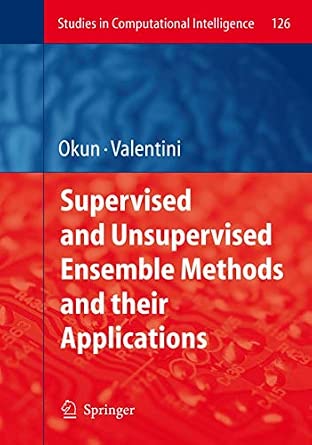
Supervised and Unsupervised Ensemble Methods and their Applications: 126 2008th Edition
Author(s): Oleg Okun
Publisher: Springer
Publication Date: 18 April 2008
Edition: 2008th
Language: English
Print length: 196 pages
ISBN-10: 9783540789802
ISBN-13: 9783540789802
Book Description
The rapidly growing amount of data, available from di?erent technologies in the ?eld of bio-sciences, high-energy physics, economy, climate analysis, and in several other scienti?c disciplines, requires a new generation of machine learning and statistical methods to deal with their complexity and hete- geneity. As data collections becomes easier, data analysis is required to be more sophisticated in order to extract useful information from the available data. Even if data can be represented in several ways, according to their structural characteristics, ranging from strings, lists, trees to graphs and other more complex data structures, in most applications they are typically represented as a matrix whose rows correspond to measurable characteristics called f- tures, attributes, variables, depending on the considered discipline and whose columns correspond to examples (cases, samples, patterns). In order to avoid confusion,we will talk about features and examples.In real-worldtasks,there canbe manymorefeatures than examples(cancer classi?cationbasedongene expressionlevels in bioinformatics) or there can be many more examples than features(intrusion detection in computer/networksecurity). In addition, each example can be either labeled or not. Attaching labels allows to distinguish members of the same class or group from members of other classes or groups. Hence, one can talk about supervised and unsupervised tasks that can be solved by machine learning methods. Since it is widely accepted that no single classi?er or clustering algorithm canbesuperiortotheothers,ensemblesofsupervisedandunsupervisedme- ods are gaining popularity. A typical ensemble includes a number of clas- ?ers/clustererswhosepredictionsarecombinedtogetheraccordingtoacertain rule, e.g. majority vote.
Editorial Reviews
From the Back Cover
This book was inspired by the last argument and resulted from the workshop on Supervised and Unsupervised Ensemble Methods and their Applications (briefly, SUEMA) organized on June 4, 2007 in Girona, Spain. This workshop was held in conjunction with the 3rd Iberian Conference on Pattern Recognition and Image Analysis and was intended to encompass the progress in the ensemble applications made by the Iberian and international scholars. Despite its small format, SUEMA attracted researchers from Spain, Portugal, France, USA, Italy, and Finland, who presented interesting ideas about using the ensembles in various practical cases. Encouraged by this enthusiastic reply, we decided to publish workshop papers in an edited book, since CD proceedings were the only media distributed among the workshop participants at that time. The book includes nine chapters divided into two parts, assembling contributions to the applications of supervised and unsupervised ensembles.
The book is intended to be primarily a reference work. It could be a good complement to two excellent books on ensemble methodology – “Combining pattern classifiers: methods and algorithms” by Ludmila Kuncheva (John Wiley & Sons, 2004) and “Decomposition methodology for knowledge discovery and data mining: theory and applications” by Oded Maimon and Lior Rokach (World Scientific, 2005).
 Wow! eBook