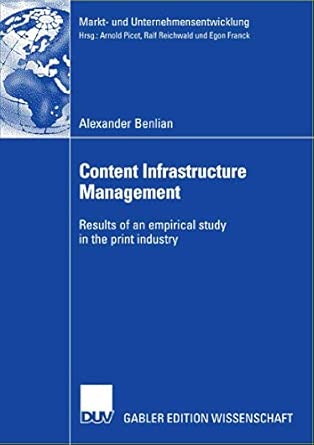
Content Infrastructure Management: Results of an empirical study in the print industry 2006th Edition
Author(s): Alexander Benlian (Author), Prof. Dr. Dres. h.c. Arnold Picot (Foreword), Prof. Dr. Thomas Hess (Foreword)
Publisher: Deutscher Universitätsverlag
Publication Date: 30 May 2006
Edition: 2006th
Language: English
Print length: 267 pages
ISBN-10: 9783835003682
ISBN-13: 9783835003682
Book Description
Information and communication technologies are leading to new forms of collabo- tion and interaction relationships inside and outside of companies. With regard to media companies, this impact is tremendous as resources, products, and processes are virtually immaterial allowing IT to permeate and restructure the entire value chain. However, especially in the print industry, where the impact of digitization on organi- tion designs and business practices is fervently discussed, companies most often realize that the degrees of freedom gained by the emergence of new technologies must be substantiated with rationalistic decision logic. One of the key questions in media companies is the way how and where digital content should be stored to op- mally support primary activities (or core processes). However, state-of-the-art lite- ture in MIS research falls short of giving answers to this question, as hardly the al- cation of hardware, software, or databases has been treated so far – mostly just from one single (or even no) theoretical perspective.
Editorial Reviews
From the Back Cover
Because of the increasing digitization and modularity of content media companies are challenged to exploit the gained degrees of freedom in the management of their most valuable asset. Opportunities abound - reutilizing, bundling and pushing content through diverse media channels leading to higher returns on investment. Although many studies have tackled the problem of properly allocating data, processing power or IT-related decision rights in the past, the topic of media content allocation has been neglected so far.
Taking into account strategic, organizational and technological factors Alexander Benlian explores the question of whether to centralize or to decentralize media content. The findings basically emphasize the need to design publishing organizations that follow certain patterns of congruency and consistency in order to realize greater effectiveness. These observed patterns or invariabilities may provide infrastructure managers with a benchmark against which to reassess the design of their own content allocation configuration. Aligned content infrastructures can be considered to dramatically increase the smoothness of content flows and to enhance production and bundling capabilities.
About the Author
Dr. Alexander Benlian ist wissenschaftlicher Mitarbeiter von Prof. Dr. Thomas Hess am Institut für Wirtschaftsinformatik und Neue Medien der Universität München
 Wow! eBook