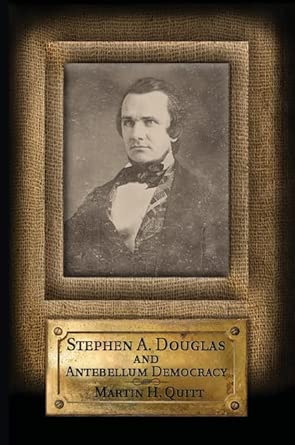
This thematic biography demonstrates how Stephen Douglas’s path from a conflicted youth in Vermont to dim prospects in New York to overnight stardom in Illinois led to his identification with the Democratic Party and his belief that the federal government should respect the diversity of states and territories. His relationships with his mother, sister, teachers, brothers-in-law, other men and two wives are explored in depth. When he conducted the first cross-country campaign by a presidential candidate in American history, few among the hundreds of thousands that saw him in 1860 knew that his wife and he had just lost their infant daughter or that Douglas controlled a large Mississippi slave plantation. His story illuminates the gap between democracy then and today. The book draws on a variety of previously unexamined sources.
Editorial Reviews
Review
‘Martin H. Quitt’s sympathetic but unapologetic biography of Stephen A. Douglas departs from traditional studies of one of the dominant political figures of the antebellum era.’ Erik B. Alexander, Journal of American History
‘In terms of research, the book is marvelous; the author’s intensive labor in secondary sources is awe-inspiring, and he has found new primary sources concerning Douglas’s education, family, and marriage to Adele Cutts.’ James L. Huston, Journal of the Early Republic
‘Martin H. Quitt’s interpretation of Stephen A. Douglas is intriguing, and original.’ Graham A. Peck, Journal of Illinois State Historical Society
‘… demonstrates the enormous potential of political analysis interwoven with cultural and social history. … a fascinating study of the social, cultural, and psychological, as well as ideological origins of Douglas’s fervent belief in the right of (white) local majorities to control their own institutions – that is, in popular sovereignty. Employing manuscript collections, public records, local histories and political documents, Quitt argues that Douglas’ commitment to popular sovereignty predated and transcended his antebellum political and economic interests. … a nuanced analysis of a flawed statesman and the doctrine that defined his career.’ Civil War History
‘Quitt’s perceptive work on this psychologically complex and highly significant politician demonstrates that despite the Little Giant’s failings, we should continue to reckon with him.’ Matthew Norman, Journal of Illinois History
‘By situating Douglas’ political theories within his social milieu and psychological background, Quitt develops a nuanced analysis of a flawed statesman and the doctrine that defined his career.’ Michael E. Woods, Civil War History
Book Description
Demonstrates how Stephen Douglas’s path to overnight stardom in Illinois led to his identification with the Democratic Party.
About the Author
Martin H. Quitt is Professor Emeritus of History at the University of Massachusetts, Boston, where he has served as Dean of Graduate Studies and Vice Provost for Research. He has published books on the history of the family and the colonial Virginia legislature as well as essays in social and political history. His article on English-Indian relations at Jamestown received the Lester J. Cappon Award in the William and Mary Quarterly.
 Wow! eBook