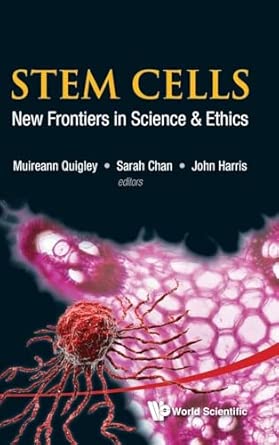
Author(s): Sarah Chan (Editor), John Harris Muireann Quigley (Editor), Muireann Quigley (Editor)
Publisher: Wspc
Publication Date: March 27, 2012
Language: English
Print length: 296 pages
ISBN-10: B00EW6GWSC
Book Description
Fast-moving and ever-changing, stem cell science and research presents ongoing ethical and legal challenges in many countries. Each development and innovation throws up new challenges. This is the case even where new developments initially seem to solve old dilemmas. Sometimes it becomes evident that new science does not in fact solve old problems and, for that reason, the ethical issues remain. In recognition of this, this book presents innovative and creative analyses of a range of ethical and legal challenges raised by stem cell research and its potential and actual application. The editors of this collection have brought together experts from ethics and law to bring fresh perspectives on the use of and research on stem cells. The chapters in this collection range across a number of different issues in the debate on stem cells, from the ethical dilemmas of conducting stem cell research to those of the clinical application of stem cell technology. Each chapter gives an in-depth and comprehensive analysis of the ethical or legal issues at stake. The early chapters give engaging new expositions on the permissibility of using embryos in stem cell research, in particular challenging our views about how we view and ‘construct’ the embryo in debates regarding stem cells. Later chapters move on to actual and potential clinical uses of stem cells and present novel arguments about these.
Fast-moving and ever-changing, stem cell science and research presents ongoing ethical and legal challenges in many countries. Each development and innovation throws up new challenges. This is the case even where new developments initially seem to solve old dilemmas. Sometimes it becomes evident that new science does not in fact solve old problems and, for that reason, the ethical issues remain. In recognition of this, this book presents innovative and creative analyses of a range of ethical and legal challenges raised by stem cell research and its potential and actual application.The editors of this collection have brought together experts from ethics and law to bring fresh perspectives on the use of and research on stem cells. The chapters in this collection range across a number of different issues in the debate on stem cells, from the ethical dilemmas of conducting stem cell research to those of the clinical application of stem cell technology. Each chapter gives an in-depth and comprehensive analysis of the ethical or legal issues at stake. The early chapters give engaging new expositions on the permissibility of using embryos in stem cell research, in particular challenging our views about how we view and ‘construct’ the embryo in debates regarding stem cells. Later chapters move on to actual and potential clinical uses of stem cells and present novel arguments about these.
Editorial Reviews
Review
Select Guide Rating
From the Back Cover
This book provides high quality chapters each of which deals with different aspects of the stem cell debate, each chapter, in itself, giving an in-depth and comprehensive analysis of its own particular issue (ethical or legal). The scope of this book ranges across a number of different issues in the debate on stem cells, from the ethical challenges of conducting stem cell research to those of the clinical application of stem cell technology.
Fast-moving and ever-changing, stem cell science and research presents ongoing ethical and legal challenges in the UK as well as in many other countries. Each development and innovation throws up new ethical challenges. This is the case even where a new development, for example, induced pluripotent stem cells, initially seems to solve old dilemmas. Sometimes it becomes evident that new science does not in fact solve old problems and the ethical issues remain. In recognition of this, this book tackles these issues, old and new. The early chapters bring fresh new perspectives on the permissibility of using embryos in stem cell research, while the later chapters move on to actual and potential new clinical uses of stem cells and present novel arguments about this. The value of this approach is that readers can gain an understanding of the different issues in the stem cell debate from a number of ethical (and legal) perspectives, but in a manner which gives deep and rigorous analysis.
 Wow! eBook