 Wow! eBook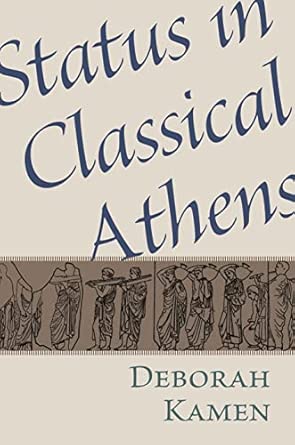
Status in Classical Athens
Author(s): Deborah Kamen (Author)
- Publisher: Princeton University Press
- Publication Date: 9 Jun. 2013
- Edition: 1st
- Language: English
- Print length: 160 pages
- ISBN-10: 0691138133
- ISBN-13: 9780691138138
Book Description
Editorial Reviews
Review
“Kamen offers a brief, sensible, inexpensive, and generally persuasive survey of the spectrum of status in Athens. . . . [K]amen’s well-annotated, sensible survey is an excellent place for scholars and advanced students to start research on any of these groups.”– “Choice”
From the Inside Flap
“This is a very well-researched and important contribution to scholarship. Deborah Kamen’s argument that Athenian civic ideology has obscured the complexity of statuses in classical Athens is persuasive, as is her detailed discussion of each of the status categories. There is great value in having the evidence for all of the status groups presented together in a single book rather than in separate specialized studies. In lucid prose, Kamen carries out this project with clear-sighted precision.”–Sara Forsdyke, University of Michigan
From the Back Cover
“This is a very well-researched and important contribution to scholarship. Deborah Kamen’s argument that Athenian civic ideology has obscured the complexity of statuses in classical Athens is persuasive, as is her detailed discussion of each of the status categories. There is great value in having the evidence for all of the status groups presented together in a single book rather than in separate specialized studies. In lucid prose, Kamen carries out this project with clear-sighted precision.”–Sara Forsdyke, University of Michigan
About the Author
Excerpt. © Reprinted by permission. All rights reserved.
STATUS IN CLASSICAL ATHENS
By DEBORAH KAMEN
PRINCETON UNIVERSITY PRESS
Copyright © 2013 Princeton University Press
All rights reserved.
ISBN: 978-0-691-13813-8
Contents
Preface…………………………………………………………..ixConventions and Abbreviations……………………………………….xiIntroduction Spectrum of Statuses……………………………………1Chapter 1 Chattel Slaves……………………………………………8Chapter 2 Privileged Chattel Slaves………………………………….19Chapter 3 Freedmen with Conditional Freedom…………………………..32Chapter 4 Metics (Metoikoi)…………………………………………43Chapter 5 Privileged Metics…………………………………………55Chapter 6 Bastards (Nothoi)…………………………………………62Chapter 7 Disenfranchised Citizens (Atimoi)…………………………..71Chapter 8 Naturalized Citizens………………………………………79Chapter 9 Full Citizens: Female……………………………………..87Chapter 10 Full Citizens: Male………………………………………97Conclusion Status in Ideology and Practice……………………………109Bibliography………………………………………………………117Index Locorum……………………………………………………..135General Index……………………………………………………..141
Excerpt
CHAPTER 1
CHATTELS LAVES
Although war among the various Greek poleis was common, theGreeks were nonetheless (in principle) averse to the enslavement of theirfellow Greeks (see, e.g., Pl. Rep. 469b–c; Xen. Hell. 1.6.14, Ages. 7.6).1Most chattel slaves, therefore, were of “barbarian”—that is, non-Greek—origin,acquired mainly through Mediterranean trading networks. Inthe archaic period (ca. 630–480 BCE), slaves were primarily Scythiansand Thracians, coming from areas northeast of Greece. After the PersianWars, traders began to acquire more slaves from the east, particularlyfrom those areas (like Caria) near the Greek cities of Asia Minor. And inthe fourth century and into the Hellenistic period (323–330 BCE), slavescame from all over Asia Minor, with the number of slaves from Africaalso increasing. Augmenting these regular supplies of slaves were thosecaptured in war or, less frequently, by pirates or bandits.
For classical Athens, some of our best evidence for the sources of slavesis epigraphic. So, for example, gravestones attest to the various ethnic originsof foreigners living (and dying) in Attica, many of whom were slaves.The Attic Stelai, records of property confiscated from Athenians convictedin the sacrilegious Defamation of the Mysteries and Mutilation of theHerms incidents of 415 BCE, preserve the names of thirteen Thracian slavesand ten Anatolian slaves; and in the funerary and dedicatory inscriptionsfrom the silver mines at Laureion, many of which date to the fourth century,the names of twenty Anatolian slaves and two Thracian slaves arerecorded. The picture we get from inscriptions is complemented by Aristophaniccomedy, which presents slaves of a wide range of ethnicities.
Although the population of chattel slaves was evidently at times quitehigh in Greece, exact numbers are nearly impossible to ascertain. Evenfor classical Athens there is no direct evidence for slave numbers; theclosest we come is Athenaeus’s (third-century CE) account of the censustaken at the end of the fourth century BCE:
Ktesikles, in the third book of the Chronicles, says that in the 117th Olympiad[312–308 BCE], there was a census taken by Demetrius of Phaleron of thoseresiding in Athens, and 21,000 Athenians, 10,000 metics, and 400,000 slaves(oiketon) were found. (Athen. 272c–d)
This passage is quoted nearly every time scholars hazard a guess as tothe number of slaves in classical Athens, but both its meaning and validityare contested. Also often cited by scholars are two other passages:Thucydides’s report that after the Spartan occupation of Dekeleia in 413bce, 20,000 slaves (andrapodon) deserted from Attica (Thuc. 7.27.5), and afragment of Hyperides suggesting that more than 150,000 slaves “fromthe mines and the countryside” be enlisted to fight (fr. 29, Jensen). Drawingcautiously from these ancient accounts of slave numbers, coupled withmodern estimates both of the total population of Athens and of rates ofslave ownership, scholars have proposed a range of estimates for classicalAthens, varying from a low of 20,000 slaves to a high of more than150,000; the most likely number falls somewhere in the middle, representing15–35 percent of the total population. Moreover, these numbers donot remain constant throughout the classical period, but fluctuate: slavenumbers were at their highest immediately before the Peloponnesian War,fell dramatically during the war, and began to increase again afterward.
Orlando Patterson has famously argued that slaves experience aprocess of desocialization and depersonalization, which he refers to as”social death.” In this chapter, I demonstrate some of the ways in whichchattel slaves in Athens were socially dead (their “social status”), inaddition to being deprived of nearly all legal and political rights (their”legal status”). There is no question that slaves were desocialized: inmost cases torn from their natal communities, they were deprived of allfamily and community ties. Chattel slaves were also depersonalized, ina process Igor Kopytoff describes as “commoditization.” Once enslaved,an individual “is stripped of his social identity”—that is, desocialized—”andbecomes a non-person, indeed an object and an actual or potentialcommodity.” In fact, Aristotle calls the chattel slave “animate property”(ktema ti empsukhon) (Pol. 1253b32), and scholars have defined the chattelslave either exclusively or at least in part by his or her status as a piece ofproperty. In this capacity, a slave could be bought and sold, hired out(Xen. Poroi 4.14–16), or bequeathed in a will (e.g., Dem. 27.9). In additionto being conceived of as a possession, however, the slave was alsorecognized as a person (of sorts) with limited legal rights, as we shall see.
Finally, chattel slaves in classical Athens, as in many other slave societies,were almost entirely stripped of honor (time), rendering them the verylowest social and legal status group on the spectrum of statuses. But evenwithin the legal category of “chattel slave,” there existed a large range of substatuses,generally dependent on the type of labor the slave performed (andrelated to this, their economic status). This labor, in turn, was sometimescorrelated with the slave’s ethnicity: so, for example, Thracians and Anatoliansgenerally performed manual labor, Scythians served as policemen-archers,and Phoenicians were at least sometimes bankers and traders(see chapter 2). This correlation did not always hold, however: a strikingexample is the Thracian slave-overseer Sosias, who was wealthy enough tolease 1000 mining slaves from the general Nicias (Xen. Poroi 4.14).
In this chapter, I will focus on the legal and social status of the “basest”chattel slaves—that is, those performing the basest forms of labor,like working in the mines or mills. I will reserve for chapter 2 discussionof what have (rightly or wrongly) been called “privileged” slaves,who exercised greater independence despite their legal status as chattel.
Chattel slaves in Greece had no legal claims to property, either moveableor unmoveable. They also, in theory, had no power over their laboror movement: they performed the tasks that were assigned to them andengaged in no movement that was not mandated by their master ormistress. In practice, this ideal behavior was not necessarily realized:although specific tasks were assigned to slaves, the ways in which theyconducted these tasks were within their control, and many slaves (particularlyin households with few slaves) were “multitaskers” who presumablyhad some degree of control over which tasks they did when, andhow. That said, to the extent that they did not choose their occupations,and did not own the means or fruits of their production, slaves, at leastideologically, had no control over their labor. Slaves’ movement, too,was notionally circumscribed by their masters, and there were certainpublic places from which they were barred, including citizens’ gymnasiaand palaistrai (Aesch. 1.138; Plut. Sol. 1.3). However, the realities ofslave labor necessitated that slaves exercise some autonomy over theirown movements. Take, for example, the labor of domestic servants,which encompassed, among other things, “child-minding, caring for thesick, answering and guarding the door, cooking, woolworking, carryingmessages, fetching water, [and] shopping.” For slaves sent out tothe marketplace to buy food, their task was set but their path probablywas not. Stephanie Camp’s work on geographies of resistance in theAmerican South has illuminated the ways in which slaves can carve outtheir own spaces and movements even while appearing to follow therigid guidelines set out by their masters. Moreover, some slaves (asdiscussed further in the next chapter) were leased out by their mastersto work in the mines or to do other dangerous labor; while this ofteninvolved extremely unpleasant tasks, it also represents a case where theslaves’ movements were, by necessity, not overseen by their immediatemaster.
Chattel slaves were defined at least in part by the fact that, unlikefree people, they had to answer for their wrongdoings with their bodies(somata) (see Dem. 22.55, 24.167). One way in which this manifesteditself was through corporal punishment by their masters, who werepermitted to inflict nearly any form of violence on their slaves. Physicalabuse could take a number of different forms: whipping, flogging,hitting with sticks, fettering, rape, tattooing, and branding. A vividdescription of such violence, apparently written by a young male slave,can be found in a fourth-century lead tablet from the Athenian Agora: “Iam perishing from being whipped; I am tied up; I am treated like dirt—moreand more!” (Ag. Inv. IL 1702, line 4).
Slaves had some, albeit few, protections against extreme violencedirected against them. They could run away to a slave asylum, like theTheseion or the altar of the Eumenides in Athens (Aristoph. Knights1311–12); here they were protected, but rather than being given theirfreedom, they were sold to a new master. There were also some legalmeasures in place to protect the slave. Technically, a master was notsupposed to kill his slave (Ant. 5.47), but if he did, it was unlikely thatanyone would press charges. Nonetheless, a master who killed his ownslave would still want to purify himself, since all bloodshed was thoughtto be a source of pollution (Ant. 6.4; cf. Pl. Laws 868a). If slaves wereharmed by someone who was not their master, their master could bring adike (private suit) for blabe (damages), under which the slave was viewed,legally, as a piece of property that had been damaged. This is the samesuit used if someone hurt your donkey or broke your furniture. If, however,slaves were killed by someone who was not their master, the mastercould file a private suit for murder (the dike phonou) (Isoc. 18.52, [Dem.]59.9). The case was brought, via the Basileus (the “king” archon, one ofthe city’s chief magistrates), to a special court called the Palladion andwas heard along with cases of unintentional homicide of citizens, as wellas the murder of metics ([Arist.] Ath. Pol. 57.3; Dem. 23.71; see also Dem.47.68–73). If a man was convicted of murder at the Palladion, he facedexile (Dem. 23.72; [Dem.] 59.10). Finally, the master, or any other citizenin Athens, could in theory bring a public suit, called a graphe hubreos,against someone who committed an act of hubris against a slave—that is,an assault against the slave’s honor. Many scholars have struggled toaccount for the fact that slaves were included in the law against hubrisdespite their lowly status. Was it that slaves were protected qua vehiclesof their masters’ honor? Was it that they themselves possessed somesmall degree of honor, qua human beings? Was it that the protectionsoffered by the hubris law were simply a byproduct of the burgeoning ideologyof Athenian democratic inclusiveness? The Greeks themselvessuggested (Dem. 21.47–49; Aesch. 1.16–17) that the protection of slaveswas (at least in part) a means of demonstrating how serious the Athenianswere about prosecuting any and all acts of hubris. Since we havevery little evidence for graphai hybreos actually being brought to court onbehalf of slaves,40 the question is perhaps more interesting on an ideologicalthan on a practical level. That is, the fact that slaves could be protectedby this suit implies that, at least by the period under considerationhere, they were conceived of as having some honor—even if it wasonly a small amount, or only by proxy—worth protecting.
In terms of legal personality, the chattel slave had very few rights.Plato’s Kallikles describes slaves as those who, when treated unjustly,cannot defend themselves or anyone else they care for (Grg. 483b). Theycould be neither a plaintiff nor a defendant in court, though a case couldbe brought on their behalf (see above). Legally (as well as conceptually),they were the equivalent of a minor, represented by their master justas a father or other guardian represented his children’s legal interests. Ifslaves incurred a debt, their master was liable, as we see most clearly inthe case of a slave who ran up huge debts running a perfume business forhis master (Hyp. 3). If slaves committed a private offense, their masterwas generally held responsible (Hyp. 3.22; [Dem.] 53.20), though themaster could in turn punish the slave. It may be the case that slaves couldbe directly sued, but our only evidence for this practice cites it in thecontext of saying that it is inappropriate to do so, since (the logic goes)slaves act only on the orders of their masters (Dem. 37.51, 55.31). Forpublic offenses, on the other hand, slaves had to assume liability for theirown actions, and most often the punishment entailed being whipped bya representative of the state. Thus, for example, a slave who became thelover of a freeborn boy was punished with fifty lashes (Aesch. 1.139).
While slaves could not serve as witnesses (martures), their statementscould be elicited by judicial torture (basanos) and used as evidence (seeIs. 8.12 for an explanation). However, although litigants are attestedchallenging their opponents to produce slaves for torture, in almost allcases the challenge is rejected, and there is little evidence of basanos beingcarried out (but see Dem. 37.20–22; Aristoph. Frogs 618–22). As a result,scholars have debated whether basanos ever actually took place. For ourpurposes, however, the “reality” of this practice is less important thanits ideological ramifications; that is, whether or not it was performed,the presuppositions underlying basanos—namely, that slaves were lesserbeings capable of “speaking” only through their bodies—served to reinforcethe slave’s already base status. In certain exceptional cases, slaveswere called upon to offer information (menusis) before a magistrate, presumablywithout torture, in return for which they were given their freedom.After the Mutilation of the Herms and Defamation of the Mysteriesin 415 BCE, slaves were encouraged to give information in exchangefor their freedom (Thuc. 6.27.2; Andoc. 1.12–18, 27–28); slaves wereassured manumission for informing against their masters in cases of sacrilegeor damage to sacred olive trees (hierosulia) (see Lys. 5 and 7); and inPlato’s ideal city in the Laws, slaves are to be freed for informing on thosewho steal treasures or neglect their parents (914a, 932d).
In the course of the fourth century BCE, practical considerations ledto a gradual improvement in the legal capacities of at least some slaves.Probably due to their increased involvement in mercantile affairs, itappears that starting around 350 BCE slaves could bring lawsuits and beprosecuted in certain kinds of commercial suits dealing with importsand exports (dikai emporikai) (see chapter 2). Most likely, the slaves participatingin these dikai were “privileged slaves,” to be discussed in thenext chapter. Legally speaking, however, this right was open to all chattelslaves, even if they were not in a position to exercise it.
Slaves had virtually no rights in the areas of sex and marriage. Femaleslaves in particular were at the sexual disposal of their masters (e.g.,Xen. Oik. 10.12). Slave-prostitutes of lower status (pornai) were whoredout by brothel-keepers, themselves often freedwomen ([Dem.] 59.18;Is. 6.19). Male slaves, unlike male citizens, were banned from pederasticrelationships with citizen boys (Aesch. 1.139; Plut. Sol.1.3). Slaves werenot allowed to marry, but cohabitation with their slave-partners wasoccasionally granted as a reward (Xen. Oik. 9.5; [Arist.] Oik. 1344b17–18).It was, however, most likely only “higher-up” slaves (managersand overseers) who were offered this sort of perk for good service. Childrenborn to female slaves belonged to the master, who could eitherkeep them in his household as slaves or sell them. However, despitethe fact that slave “marriages” and “families” were not legally protected,later epigraphic evidence indicates that slaves themselves may have recognizedrelationships with their slave-partners and children. So, forexample, some inscriptions attest to slaves and former slaves paying forthe manumission of their slave-children, or to “husband”-“wife” pairsbeing freed together.
Social mobility depended greatly on the type of chattel slave. Aslave working in the silver mines of Laureion, for example, not onlywas unlikely to be freed, but also had little chance of attaining a higher-statusprofession as a slave. Domestic servants, on the other hand, werecloser to the category of “privileged slave”—we might call them “semi-privileged”—and accordingly had more opportunities for advancement.If their work was respected, they might be elevated in the householdstatus hierarchy, perhaps rising to the rank of overseer. Moreover, if theyhad a particularly intimate relationship with their owner or their owner’schildren, as was especially the case with wetnurses and male paidagogoi(tutors), they might even be granted their freedom (see chapter 3). Thiswas generally done either upon the master’s death or when the slavewas too old to be of much use in the household. In the case of a nurse,this might be when she could no longer provide wetnurse services orwhen the children of the family had grown up (see, e.g., Dem. 47). Otherfrequently freed slaves are high-class prostitutes (e.g. [Dem.] 59) andattractive slave-boys (e.g. Hyp. 3), both of which groups I would characterizeas at least semiprivileged. Citizenship, unlike manumission, wasa near impossibility for slaves, particularly for the types of slaves whooccupied the lowest rung of the slave hierarchy. We will turn to slaveswho became citizens in chapters to come; these individuals invariablystarted at a “high” level of servitude, often as serving as bankers or performingother duties of a “privileged” nature.
(Continues…)Excerpted from STATUS IN CLASSICAL ATHENS by DEBORAH KAMEN. Copyright © 2013 by Princeton University Press. Excerpted by permission of PRINCETON UNIVERSITY PRESS.
All rights reserved. No part of this excerpt may be reproduced or reprinted without permission in writing from the publisher.
Excerpts are provided by Dial-A-Book Inc. solely for the personal use of visitors to this web site.


