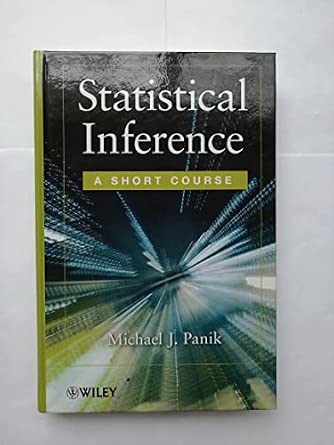
“The book is addressed to courses on probability, mathematical statistics, and statistical inference at the upper-undergraduate and graduate levels. It also serves as a valuable reference for researchers and practitioners who would like to develop further insights into essential statistical tools.” (Zentralblatt Math, 1 August 2013)
“If an undergraduate student seeks a guide that will introduce the basic ideas of statistics, or a lecturer wants interesting life examples and a source of valid intuitions to improve his teaching skills, then this book is a great place to start. . . This book, with its explanations of basic intuitions, its many examples, the easy language, and a minimal requirement for mathematical training, is a good self-contained starting point to prepare one for the jump into those heavier works.” (Computing Reviews, 30 September 2013)
A concise, easily accessible introduction to descriptive and inferential techniques
Statistical Inference: A Short Course offers a concise presentation of the essentials of basic statistics for readers seeking to acquire a working knowledge of statistical concepts, measures, and procedures.
The author conducts tests on the assumption of randomness and normality, provides nonparametric methods when parametric approaches might not work. The book also explores how to determine a confidence interval for a population median while also providing coverage of ratio estimation, randomness, and causality. To ensure a thorough understanding of all key concepts, Statistical Inference provides numerous examples and solutions along with complete and precise answers to many fundamental questions, including:
- How do we determine that a given dataset is actually a random sample?
- With what level of precision and reliability can a population sample be estimated?
- How are probabilities determined and are they the same thing as odds?
- How can we predict the level of one variable from that of another?
- What is the strength of the relationship between two variables?
The book is organized to present fundamental statistical concepts first, with later chapters exploring more advanced topics and additional statistical tests such as Distributional Hypotheses, Multinomial Chi-Square Statistics, and the Chi-Square Distribution. Each chapter includes appendices and exercises, allowing readers to test their comprehension of the presented material.
Statistical Inference: A Short Course is an excellent book for courses on probability, mathematical statistics, and statistical inference at the upper-undergraduate and graduate levels. The book also serves as a valuable reference for researchers and practitioners who would like to develop further insights into essential statistical tools.
From the Back Cover
A concise, easily accessible introduction to descriptive and inferential techniques
Statistical Inference: A Short Course offers a concise presentation of the essentials of basic statistics for readers seeking to acquire a working knowledge of statistical concepts, measures, and procedures.
The author conducts tests on the assumption of randomness and normality, provides nonparametric methods when parametric approaches might not work. The book also explores how to determine a confidence interval for a population median while also providing coverage of ratio estimation, randomness, and causality. To ensure a thorough understanding of all key concepts, Statistical Inference provides numerous examples and solutions along with complete and precise answers to many fundamental questions, including:
- How do we determine that a given dataset is actually a random sample?
- With what level of precision and reliability can a population sample be estimated?
- How are probabilities determined and are they the same thing as odds?
- How can we predict the level of one variable from that of another?
- What is the strength of the relationship between two variables?
The book is organized to present fundamental statistical concepts first, with later chapters exploring more advanced topics and additional statistical tests such as Distributional Hypotheses, Multinomial Chi-Square Statistics, and the Chi-Square Distribution. Each chapter includes appendices and exercises, allowing readers to test their comprehension of the presented material.
Statistical Inference: A Short Course is an excellent book for courses on probability, mathematical statistics, and statistical inference at the upper-undergraduate and graduate levels. The book also serves as a valuable reference for researchers and practitioners who would like to develop further insights into essential statistical tools.
About the Author
MICHAEL J. PANIK, PhD, is Professor Emeritus in the Department of Economics at the University of Hartford. He has served as a consultant to the Connecticut Department of Motor Vehicles as well as a variety of healthcare organizations. Dr. Panik has published numerous journal articles in the areas of economics, mathematics, and applied econometrics.
 Wow! eBook