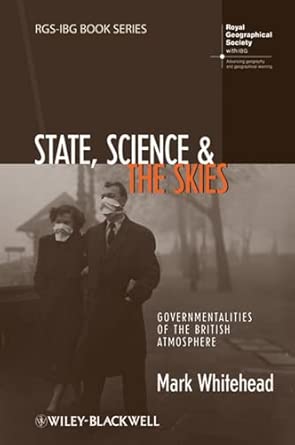
“Mark Whitehead’s 2009 book State, Science and the Skies constitutes a compelling and important contribution to the RGS–IBG Book Series . . . This fascinating book is part of an increasing literature on a much neglected area of study: the role and importance of the atmosphere in our lives (e.g. Jankovic, 2000; Latour, 2003; Strauss and Orlove, 2003; Kessel, 2006; Thornes, 2008) . . . State, Science and the Skies should provide us with an important guide to the geographies of the atmosphere. It is especially helpful in order to cultivate some sense of relief to Sloterdijk’s (2009) emphasis on the air as a means of administering death through environmental means.” (Geoform, 1 September 2012)
State, Science and the Skies is a carefully researched and politically important work. Creatively developing Foucault’s work on governmentality, it shows the complex interrelations of technology, policy and practice. Taking the atmosphere as an object of government, it insists on the essential vertical dimension of the geographies of the modern state.”
―Stuart Elden, Professor of Political Geography, Durham University
“State, Science and the Skies is a superbly crafted synthesis of the making of a modern climatological state. Whitehead follows the expert and the state in their creation of atmospheric government and its aerial responsibilities. Blending a robust historical narrative with thought-provoking analyses of atmospheric lives of boiler attendants, employers, government inspectors and housewives, Whitehead provides an important framework for thinking about the current concerns surrounding climate change and air pollution. State, Science and the Skies is bound to become a major reference in all future discussions about the scientific and political constructions of environmental life in modern Britain and beyond.”
―Vladimir Jankovic, Lecturer, Centre for the History of Science, Technology and Medicine University of Manchester
From the Inside Flap
Contemporary concerns regarding climate change, the destruction of the ozone layer, and increased anxieties of the health risks associated with particulate air pollution, highlight the crucial importance of understanding what is happening in our atmosphere. This timely volume asserts that to comprehend contemporary atmospheric knowledge systems requires an examination of the spatial histories of the sciences and political regimes that have shaped systems of air government.
Focusing exclusively on the UK, the volume weaves together the tales of 19th-century urban smoke observers, early 20th-century visitors to clean-air exhibitions, and modern atmospheric scientists in order to reveal why we know certain things about the qualities of the air we breathe and how this knowledge has shaped collective relations with the atmosphere. In charting this history this volume combines Foucauldian-inspired accounts of the history of government with relevant works on the sociology of scientific knowledge. Utilizing extensive archival materials and informed by scholarly analysis, this groundbreaking work presents the first historical account of the development of a state science of atmospheric pollution.
From the Back Cover
Contemporary concerns regarding climate change, the destruction of the ozone layer, and increased anxieties of the health risks associated with particulate air pollution, highlight the crucial importance of understanding what is happening in our atmosphere. This timely volume asserts that to comprehend contemporary atmospheric knowledge systems requires an examination of the spatial histories of the sciences and political regimes that have shaped systems of air government.
Focusing exclusively on the UK, the volume weaves together the tales of 19th-century urban smoke observers, early 20th-century visitors to clean-air exhibitions, and modern atmospheric scientists in order to reveal why we know certain things about the qualities of the air we breathe and how this knowledge has shaped collective relations with the atmosphere. In charting this history this volume combines Foucauldian-inspired accounts of the history of government with relevant works on the sociology of scientific knowledge. Utilizing extensive archival materials and informed by scholarly analysis, this groundbreaking work presents the first historical account of the development of a state science of atmospheric pollution.
About the Author
Mark Whitehead is a Senior Lecturer in Human Geography at the Institute of Geography and Earth Sciences, Aberystwyth University; and Senior Research Fellow at the City Institute, York University, Toronto. His published works include Spaces of Sustainability: Geographical Perspectives on the Sustainable Society (2006); and The Nature of the State: Excavating the Political Ecologies of the Modern State (co-author, 2007).
 Wow! eBook