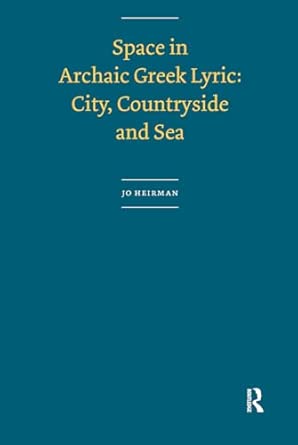
Space in Archaic Greek Lyric: City, Countryside and Sea
Author(s): Jo Heirman (Author)
Publisher: Routledge
Publication Date: 9 Feb. 2014
Edition: 1st
Language: English
Print length: 226 pages
ISBN-10: 9056297007
ISBN-13: 9789056297008
Book Description
From the end of the twentieth century onwards space has become a ‘hot topic’ in literary studies. This thesis contributes to the spatial turn by focusing on space in archaic Greek lyric (7th-5th c bc). A theoretical framework inspired by narratology, phenomenology and metaphor theory is applied to archaic lyric poems in which city, countryside and sea are of importance. Heirman argues that space is predominantly symbolic: the city is a political or an erotic metaphor, the countryside an erotic symbol, and the sea a symbol of danger. He also attempts to connect the symbolism of space with the context of the symposium, in which the lyric poems were performed: city metaphors are linked with sympotic plays of ‘guessing’ the erotic activities in the countryside reveal a projection of erotic fantasies of the symposiasts, and the danger at sea serves to reinforce the cohesion of the sympotic group.
Editorial Reviews
From the Inside Flap
From the end of the twentieth century onwards space has become a ‘hot topic’ in literary studies. This thesis contributes to the spatial turn by focusing on space in archaic Greek lyric (7th-5th c bc). A theoretical framework inspired by narratology, phenomenology and metaphor theory is applied to archaic lyric poems in which city, countryside and sea are of importance. Heirman argues that space is predominantly symbolic: the city is a political or an erotic metaphor, the countryside an erotic symbol, and the sea a symbol of danger. He also attempts to connect the symbolism of space with the context of the symposium, in which the lyric poems were performed: city metaphors are linked with sympotic plays of ‘guessing’, the erotic activities in the countryside reveal a projection of erotic fantasies of the symposiasts, and the danger at sea serves to reinforce the cohesion of the sympotic group. Jo Heirman heeft Grieks-Latijn gestudeerd aan de Universiteit van Gent, is gepromoveerd op Griekse letterkunde onder de supervisie van Professor Irene de Jong aan de Universiteit van Amsterdam en is momentaal werkzaam als research consultant bij Schelstraete & Desmedt in Gent.
From the Back Cover
From the end of the twentieth century onwards space has become a ‘hot topic’ in literary studies. This thesis contributes to the spatial turn by focusing on space in archaic Greek lyric (7th-5th c bc). A theoretical framework inspired by narratology, phenomenology and metaphor theory is applied to archaic lyric poems in which city, countryside and sea are of importance. Heirman argues that space is predominantly symbolic: the city is a political or an erotic metaphor, the countryside an erotic symbol, and the sea a symbol of danger. He also attempts to connect the symbolism of space with the context of the symposium, in which the lyric poems were performed: city metaphors are linked with sympotic plays of ‘guessing’, the erotic activities in the countryside reveal a projection of erotic fantasies of the symposiasts, and the danger at sea serves to reinforce the cohesion of the sympotic group. Jo Heirman heeft Grieks-Latijn gestudeerd aan de Universiteit van Gent, is gepromoveerd op Griekse letterkunde onder de supervisie van Professor Irene de Jong aan de Universiteit van Amsterdam en is momentaal werkzaam als research consultant bij Schelstraete & Desmedt in Gent.
About the Author
Jo Heirman was educated at Ghent University (Belgium), where he obtained a Master’s Degree in Classics in 2008. In 2008 he was appointed as a PhD-researcher for a project of Irene de Jong on ‘Space in Ancient Greek Literature’ at the University of Amsterdam. He has written several articles on space which combine classics and literary theory. By the end of 2012 he will have edited a conference volume on the ideological role of space in ancient and modern literature with Jacqueline Klooster (The Ideologies of Lived Space in Literature: Ancient and Modern, Academia Press Ghent).
 Wow! eBook