Wow! eBook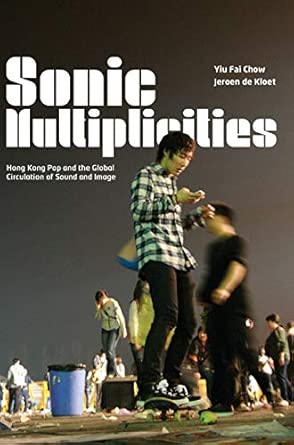
Sonic Multiplicities: Hong Kong Pop and the Global Circulation of Sound and Image
Author(s): Yiu Fai Chow (Author), Jeroen De Kloet (Author)
- Publisher: University of Chicago Press
- Publication Date: 12 July 2013
- Language: English
- Print length: 200 pages
- ISBN-10: 184150615X
- ISBN-13: 9781841506159
Book Description
Sonic Multiplicities is a fascinating book, with essays rich in empirical detail and – captivatingly combining the personal and the theoretical – evocative of the complexities of experience, desire and politics in our perplexingly mobile and entangled world. The book focuses on Hong Kong pop music as part of a translocal, if not global network of flows, providing a starting point for the authors to unsettle received notions of Chineseness, place and identity, of particular importance in a time when we need to come to terms with and resist, the increasingly stifling discourse of 'the rise of China'.
Editorial Reviews
Review
About the Author
Yiu Fai Chow is assistant professor in the Humanities Program at Hong Kong Baptist University.Jeroen de Kloet is assistant professor in the Department of Media Studies at the University of Amsterdam.
Excerpt. © Reprinted by permission. All rights reserved.
Sonic Multiplicities
Hong Kong Pop and the Global Circulation of Sound and Images
By Yiu Fai Chow, Jeroen de Kloet
Intellect Ltd
Copyright © 2013 Intellect Ltd
All rights reserved.
ISBN: 978-1-84150-615-9
Contents
Acknowledgements,
List of Figures and Table,
Introduction: Sonic Multiplicities,
Chapter 1: Me and the Dragon: A Lyrical Engagement with the Politics of Chineseness,
Chapter 2: The Production of Locality in Global Pop - A Comparative Study of Pop Fans in,
Chapter 3: Blowing in the China Wind: Engagements with Chineseness in Hong Kong's,
Chapter 4: Sex, Morality and Cantopop,
Chapter 5: Building Memories - A Study of Pop Venues in Hong Kong,
Chapter 6: Olympic Celebrations and Performative Contestations,
Chapter 7: Music, Desire and the Transnational Politics of Chineseness: Following Diana,
Bibliography,
Index,
CHAPTER 1
ME AND THE DRAGON: A LYRICAL ENGAGEMENT WITH THE POLITICS OF CHINESENESS
Yiu Fai Chow
It was the summer of 1980. During an orientation camp, I, together with hundreds of other University of Hong Kong freshmen, was presented with a choice violent enough to pitch affinity against affinity. We were asked: 'do you consider yourself a Hong Konger or Chinese?' It was the time when the city's political certainty as a British colony evaporated almost overnight, when London was preparing to 'revert' Hong Kong to Chinese rule. After a ritualistic show of hands, the evening ended with a collective singing of the campus hit of the year, the originally Taiwanese song 'Descendants of the Dragon [TEXT NOT REPRODUCIBLE IN ASCII]:
In the ancient Orient, there is a dragon
Its name is China
In the ancient Orient, there are a people
They are all descendants of the dragon
Growing up in its giant footsteps
I have become a descendant of the dragon
Black eyes, black hair, yellow skin
Forever, descendants of the dragon.
('Descendants of the Dragon [TEXT NOT REPRODUCIBLE IN ASCII] 1978)
While these emotional verses chanted the soundtrack for a decade that was to see the conclusion of the Sino-British talks and the preparation for the political handover of Hong Kong, I was transported to a stage where, for the first time in my life, I was summoned to perform my national and cultural identity. It was obviously not enough for me to have black eyes, black hair and yellow skin, I must say it, sing it, perform it. Chineseness, I began to understand, is not merely a biological category but a social performance.
I was born in the 1960s. I grew up in Hong Kong constantly wondering why the 'official' Chinese I learned in school was different from the Cantonese Chinese I spoke with my family; why my mother had to ask someone to write her application letter for a telephone line in English so that the application would be sped up. My first exposure to cultural studies during my university days reframed such bewilderments into more concrete notions of power and contestation.
Alongside a career in the government, I asked a friend of mine who was already releasing pop music to try my lyrical potentials. It was probably a tactical move inspired by the cultural studies belief that, perhaps, I could do something to engage with dominant versions of truth being circulated in the society, that I could give a voice to my bewilderment as an outsider. It was 1988. Four years later, I became even more of an outsider, at least geographically, by moving to the Netherlands. There, I continued my lyric writing and resumed my (academic) studies in popular culture, travelling not only between two localities, but translating between my double role as a cultural studies student and a cultural producer. As a cultural studies student, I learn how to be self-reflexive about the historical consciousness and contemporary conjuncture we inhabit. As a cultural producer, specifically as a lyric writer for commercial music, I thrive as a meaning-maker, moving between the spaces of contingencies and contradictions offered by a playful but potentially mattering site of cultural production.
This chapter is about my experience in this duality. It is, to borrow Carolyn Steedman's metaphor, a journey into the landscape to see myself (Steedman 1986). If a master may brush off ugly lines of power and contestation from a Chinese landscape painting, this journey is to close up onto the small figures spotted here and there, regaining, hopefully, 'a sense of people's complexity of relationship to the historical situations they inherit' (Steedman 1986: 19). I feel the need to ask 'What does it mean by being Chinese?' at a time when nationalistic sentiments, sustained by simple narratives such as the 'upsurge of the grand state' or the Beijing Olympic Games 2008, have been increasingly employed not only to organize national cohesion but also to feed in global diasporic longing for a perceived homeland. Such celebration of Chineseness conflates with a crucial ideological shift during the 1990s, when the Chinese Communist Party replaced its legitimizing ideology from communism to a market-driven nationalism (Barmé 1999; Gries 2004; Hughes 2006). It is this more recent, legitimizing version of Chineseness constructed during the process of China's de-imperialization, national unification and modernization that I am engaging with. While contemporary popular culture is one of its major construction sites (Barmé 1999; Dai 2001), such Chineseness is historically predicated on the 'universal chauvinism' sustained by the structure of the Han-centred 'Us' versus the rest as 'Other' (Chen 2006; Gries 2004; Hughes 2006).
At the same time, popular culture offers opportunities and moments for resistance, subversion and critique (Fiske 1989). A central theme of this chapter is to resist simplicity, to resist certain political or ideological attempts to simplify and nullify complexity into certain dominant narratives – by mobilizing the autobiographical 'I', in this case, embodied in the duality of cultural studies student/producer. This chapter is therefore about contestations of interpretation, between the personal and the official. As Steedman puts it, 'Personal interpretations of past time [...] are often in deep and ambiguous conflict with the official interpretative devices of a culture' (Steedman 1986: 6). In that sense, this chapter is not meant to attempt a historical account of the power relations between Hong Kong and mainland China through the lens of pop music. It is more my own remembering of what I have done and what I have failed to do, with all the possibilities of resistance to and complicity with dominant narratives. This account favours 'the messy, subjective life of the historical agent rather than his/her more "objective" accomplishments or conditions', a shift from 'fact to the experience of fact' (Pollack 1998: 18). My purpose is to stake a singularizing claim of identity through critical personal self-reflexivity. 'Singularity' here suggests that this is not intended to be generalizable to other people's experience; this reflection is of this time, in the spaces I occupy, relevant primarily to the dual role I have and hopefully to our critical understanding of 'Chineseness'. In Chapter 3, we will move beyond the autobiographical approach and discuss another contestation exercise of Hong Kong's pop music with hegemonic Chineseness, in the site of a particular music genre: China Wind. In Chapter 6, we continue to investigate Hong Kong's alleged co-production of hegemonic Chineseness in the case of Olympic songs.
Nationalistic songs
Songs like 'Descendants of the Dragon' are not rare in Hong Kong's pop music tradition: from the anthemic, heroic-sounding songs and sentimental, folkish ballads, generally known as minzu gequ, in 1970s and 1980s, to what I would call the neo-minzu gequ reinvented in trendier R&B or rap numbers during the turn of the century. The difficulty in translating minzu to English is noteworthy. Minzu generally denotes 'the people', with an emphasis on lineage, more than race, which, however, tends to conflate with 'the nation'. In the standard English-Chinese dictionary used in mainland China, the entry 'nationalistic' is given two Chinese equivalents: nationalistic (guojia zhuyi), and people-listic (minzu zhuyi). While minzu gequ is often refined in the mainland Chinese musical context into the 'ethnic' and the 'nationalistic' – with the purpose of, respectively, preserving and promoting the 'ethnic minorities' and the 'nation', those minzu gequ that secure public airplay in Hong Kong are predominantly of the second type.
Although never really dominant in the local pop scene, these nationalistic songs appear frequently enough to carve out their own genre in a market otherwise monopolized by 'love songs'. This unusual cultural phenomenon, however, has attracted rather limited academic interest. In an edited volume on Hong Kong popular lyrics, Mei-kwun Cheung discusses the role these songs play in constructing a sense of home and nation prior to the handover in 1997 (Cheung 1997). Wai-chung Ho (2000) charted the tides of nationalistic and anti-nationalistic songs in the local pop scene to review the sociopolitical relations between Hong Kong and Beijing. For me, the power of minzu gequ lies in its tendency to privilege a particular performance of Chineseness by the tactic of excluding the marginal, be they foreign (mostly imperialistic) enemies or domestic dissidents, as well as the possibility of cultural resistance it offers.
The term minzu gequ, a common genre marker in music sites and shops in mainland China, has become a discussion item during the official CCTV Youth Singing Contest 2006. One of the adjudicators, the classical vocalist Jiang Dawei, noted the decreasing ethnic (minzu) element and suggested changing the term minzu gequ to Chinese songs (zhongguo ge). In a related report posted on the CCTV site, the writer Zhang Liqiang (2006) comments: 'How we are going to deal with the term minzu gequ may be controversial [ ... but minzu gequ] possesses the core element of our nation's musical culture development – Chineseness'. This is, in short, the predicament I am situated in when I, as a professional lyricist, am commissioned to work on projects that would force me to walk into the dangerous stadium of minzu gequ and do a performance of Chineseness. Informed by my understanding of power and resistance, should I take a bow and go? Or, is it possible to masquerade in a line or two and intervene in my own manner? I tried. In 1980 I sang a minzu gequ; by 2004 I penned one.
Another approach
I was (and still am) intrigued, and troubled, by the role such nationalistic songs might play in the construction of Chineseness, especially in connection with the so-called re-nationalization process of Hong Kong (Erni 2001). More specifically, the concern here is how certain Chinese texts (song lyrics) might be deployed to frame Chinese history and identity in the narrow terms of nationalism, thereby confining the possibility of defining Chineseness in other terms such as gender, class or regional spaces (Callahan 2006). While thinking how to theorize on the relation between Hong Kong's popular culture and issues of Chineseness, I was reminded of the danger of theoreticism (Hall 1996; Wright 2003) not so much in cultural studies but in myself. What possible contribution could my theorization make when many of my scholarly colleagues have been delivering valuable works in a similar vein (Abbas 1997; Chow 2000; Lee, G. 2002)? And, ultimately, what possible contribution? To what?
I thought I had one answer to offer: me and my lyric writing. For almost two decades, I have been writing lyrics for Cantopop (or Cantonese pop songs) in Hong Kong, and more recently, also in Mandarin or Putonghua, for the Greater China market. Instead of launching a third-person study on minzu gequ, I think it should be more my take to investigate: how 'I' have been dealing with issues of Chineseness through the pop lyrics I have created? More specifically, how this 'I' – someone growing up in colonial Hong Kong, now living 'overseas', in short, someone who can never take Chineseness for granted and whose Chineseness is never taken for granted – seeks to reclaim my speaking position on what is Chinese, and resist dominant, exclusive versions of Chineseness through acts of lyric writing?
Before embarking on such an inquiry, I want to elaborate on two points, which make my preference for an autobiographical approach more than a preference. First: as Wright argues, 'an autobiographical approach is employed precisely to be specific and in the attempt to avoid the pitfalls of overgeneralization and the authority of authenticity' (Wright 2003: 805). Such pitfalls seem to be particularly pertinent in discussions on Chineseness, where collective experiences are often overgeneralized and authenticated into collective identity. Scholars in area or sinological studies, in particular, are prone to speak in such collective terms of Chinese identity and culture. In mainland China, as Callahan observes, academics have also been making their case for 'Chineseness', by essentializing and collectivizing values, traditions and culture (Callahan 2005). It should be more appropriate, I believe, to speak as me, insisting on my individual experience, whose singularity is meant to wrestle with the collective. The singularity is to relieve Chineseness of 'pretensions to a "master narrative"' to become a 'somewhat humbler quilt of many voices and local hopes' (Pollock 1998: 18).
Second: I want to take up Meaghan Morris' (1997) question 'What do cultural studies do?' If academic writing is meant to intervene in reality and to express any discontent to that reality, so is creative writing. As both a cultural studies student and a cultural producer, I often wonder how I am supposed to make a difference in the 'real world'. Far more often, however, I would wonder if it is possible at all. If strategies of engendering cultural studies as praxis would include empirical research and performative acts (Wright 2003: 816), this very inquiry should serve as an interface between the two. This chapter is a chronicle of how I, a lyrics writer, try to write what I have read from cultural studies into a cultural product. It is also an occasion to interpellate me, a cultural studies student, to read the product back into cultural studies. As Chua Beng Huat reminds us, 'The life of a consumer product is very short' (Chua 2003: vii). My wish is to show how cultural studies may matter to such a short life, first of all, by giving birth to at least certain cultural products, and, in the final analysis, in resurrecting such cultural products from their consumerist existence into more endurable knowledge. This is the cultural studies student and cultural producer collaborating to try to understand what cultural studies do.
Re-nationalization I: Descendants of the dragon
If there is something from my childhood and adolescent years that remains a chief concern in my writing, it is the tactics of dealing with and dealing in dominant cultures that are so characteristic of living in Hong Kong. These are the tactics of those who do not have claims to territorial propriety or cultural centrality.
(Chow 1993: 25)
When I grew up in the 1960s and 1970s, English and Mandarin songs dominated my life. For a long time, I was served a daily diet of school anthems and Christian hymns, all in English. Sometimes we would also practise Chinese songs, in Mandarin, probably from a pre-war, pre-communist China. Again, very occasionally, we would also learn songs that must have been translated because the tones of Cantonese lyrics did not correspond to the notes of the melody, as required by the Cantonese listening habit. It was, in short, silly to sing in Cantonese. And I was growing into the hierarchy of languages and cultures, of the 'in-between' status of Hong Kong Chinese under British administration. But then, slowly, I opened my eyes to local television dramas and my ears to their theme songs, ushering in a localization process that finally ensured the cultural and market space for Hong Kong pop and a whole new genre defined by its locality and its local tongue: Cantopop.
The localization of pop in Hong Kong was intrinsically political, given its linguistic, cultural and political relationship to Britain and mainland China (Cheung 1997; Ho 2000). It was, however, never really politicized – until the wave of minzu gequ swept over the city by the end of 1970s and early 1980s, precisely the period defined by Deng Xiaoping's concept of 'one country two systems' (introduced in 1978), the Sino-British negotiations and the signing of the Sino-British Joint Declaration (1984). For the second time in my life, I was wondering how I was supposed to fill in the nationality blank: the word 'Chinese' sounded as unlikely as 'British'. It was during such first moments of transition, of a sudden loss of a voice to articulate ourselves amidst the sovereignty negotiations between two nations, that I heard the city's young men and women start to sing songs such as 'Descendants of the Dragon'. And I was thrust into the dilemma: do I consider myself a Hong Konger or Chinese? Back in 1980, the freshmen of that university year, in a movingly collective voice, articulated and thereby defined ourselves the following way:
Black eyes, black hair, yellow skin
Forever, descendants of the dragon.
('Descendants of the Dragon [TEXT NOT REPRODUCIBLE IN ASCII] 1978)
(Continues...)Excerpted from Sonic Multiplicities by Yiu Fai Chow, Jeroen de Kloet. Copyright © 2013 Intellect Ltd. Excerpted by permission of Intellect Ltd.
All rights reserved. No part of this excerpt may be reproduced or reprinted without permission in writing from the publisher.
Excerpts are provided by Dial-A-Book Inc. solely for the personal use of visitors to this web site.