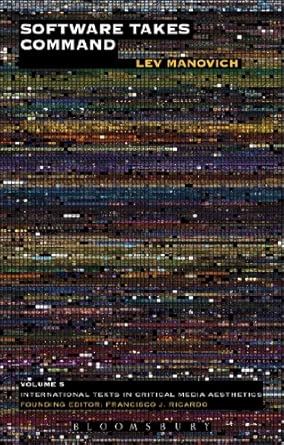
Software Takes Command: Extending the Language of New Media: 5 Int Edition
Author(s): Lev Manovich (Author)
Publisher: Bloomsbury Academic
Publication Date: 29 Aug. 2013
Edition: Int
Language: English
Print length: 376 pages
ISBN-10: 1623567459
ISBN-13: 9781623567453
Book Description
Software has replaced a diverse array of physical, mechanical, and electronic technologies used before 21st century to create, store, distribute and interact with cultural artifacts. It has become our interface to the world, to others, to our memory and our imagination - a universal language through which the world speaks, and a universal engine on which the world runs. What electricity and combustion engine were to the early 20th century, software is to the early 21st century. Offering the the first theoretical and historical account of software for media authoring and its effects on the practice and the very concept of 'media,' the author of The Language of New Media (2001) develops his own theory for this rapidly-growing, always-changing field.
What was the thinking and motivations of people who in the 1960 and 1970s created concepts and practical techniques that underlie contemporary media software such as Photoshop, Illustrator, Maya, Final Cut and After Effects? How do their interfaces and tools shape the visual aesthetics of contemporary media and design? What happens to the idea of a 'medium' after previously media-specific tools have been simulated and extended in software? Is it still meaningful to talk about different mediums at all? Lev Manovich answers these questions and supports his theoretical arguments by detailed analysis of key media applications such as Photoshop and After Effects, popular web services such as Google Earth, and the projects in motion graphics, interactive environments, graphic design and architecture.
Software Takes Command is a must for all practicing designers and media artists and scholars concerned with contemporary media.
Editorial Reviews
Review
The language of new media is embodied and expressed---lent visual and interactive form---through software. Software is the agent of our every digital experience. And software is a quintessentially human artifact. The fact that it is intangible---you can't reach out and touch it---is the least interesting thing about it. This long-researched book, which synthesizes critical theory, human-computer interaction, and media history as well as newer approaches from the digital humanities, allows software to take its place as a commanding element in our conversations about computers, and how we work, play, learn, and create. -- Matthew Kirschenbaum, Associate Professor of English and Associate Director, Maryland Institute for Technology in the Humanities, University of Maryland, US With Software Takes Command, Lev Manovich seeks to answer a central question: 'Why should humanists, social scientists, media scholars and cultural critics care about software?' His answer is a provocative, historically informed book that breaks new ground in digital humanities, in new media studies and in what Manovich defined in his earlier book The Language of New Media, as software studies. Through a theoretical analysis of the computer as cultural metamedium and a probing history of 'media software' such Photoshop and After Effects, among others, this is essential reading for anyone interested in how software has changed how we work, create, and perceive the world. -- Tanya Clement, Assistant Professor in the School of Information at the University of Texas, Austin, US Computers haven't transformed media--they've shattered the very idea of a medium. Lev Manovich connects the dots of software society, from layers in Photoshop to layers of data, interpretation, and meaning. --Martin Wattenberg, Software Artist and Scientist
About the Author
Lev Manovich is the author of Soft Cinema: Navigating the Database (2005), and The Language of New Media (2001) which was described as 'the most suggestive and broad ranging media history since Marshall McLuhan.' Manovich is a Professor at CUNY Graduate Center, a Director of the Software Studies Initiative at California Institute for Telecommunications and Information Technology, and a Visiting Professor at European Graduate School.
 Wow! eBook