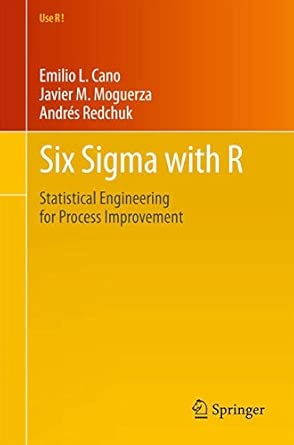
Six Sigma with R: Statistical Engineering for Process Improvement: 36 2012th Edition
Author(s): Emilio L. Cano (Author), Javier Martinez Moguerza (Author), Andrés Redchuk (Author)
Publisher: Springer
Publication Date: 5 July 2012
Edition: 2012th
Language: English
Print length: 314 pages
ISBN-10: 1461436516
ISBN-13: 9781461436515
Book Description
Six Sigma has arisen in the last two decades as a breakthrough Quality Management Methodology. With Six Sigma, we are solving problems and improving processes using as a basis one of the most powerful tools of human development: the scientific method. For the analysis of data, Six Sigma requires the use of statistical software, being R an Open Source option that fulfills this requirement. R is a software system that includes a programming language widely used in academic and research departments. Nowadays, it is becoming a real alternative within corporate environments.
The aim of this book is to show how R can be used as the software tool in the development of Six Sigma projects. The book includes a gentle introduction to Six Sigma and a variety of examples showing how to use R within real situations. It has been conceived as a self contained piece. Therefore, it is addressed not only to Six Sigma practitioners, but also to professionals trying to initiate themselves in this management methodology. The book may be used as a text book as well.
Editorial Reviews
Review
From the book reviews:
“The reviewed book deals with the use of R software within six sigma methodology. … To help a practitioner read this book, the authors conclude each chapter with a summary and further reading, case studies, and practical exercises. … The authors have combined their scientific, technological, industrial, and pedagogical skills so that the reader finds in the book an innovative, rigorous, and economical way to apply Six Sigma methodology to continuous quality improvement.” (Adriana Horníková, Technometrics, Vol. 55 (1), February, 2013)
From the Back Cover
Six Sigma has arisen in the last two decades as a breakthrough Quality Management Methodology. With Six Sigma, we are solving problems and improving processes using as a basis one of the most powerful tools of human development: the scientific method. For the analysis of data, Six Sigma requires the use of statistical software, being R an Open Source option that fulfills this requirement. R is a software system that includes a programming language widely used in academic and research departments. Nowadays, it is becoming a real alternative within corporate environments.
The aim of this book is to show how R can be used as the software tool in the development of Six Sigma projects. The book includes a gentle introduction to Six Sigma and a variety of examples showing how to use R within real situations. It has been conceived as a self contained piece. Therefore, it is addressed not only to Six Sigma practitioners, but also to professionals trying to initiate themselves in this management methodology. The book may be used as a text book as well.
About the Author
Emilio L. Cano is Adjunct Lecturer at the Department of Mathematics at University of Castilla-La Mancha and Research Assistant Professor at the Department of Statistics and Operations Research at University Rey Juan Carlos.
Javier M. Moguerza is Associate Professor in Statistics and Operations Research at University Rey Juan Carlos and member of the Global Young Academy.
Andres Redchuk is Master Black Belt and Research Assistant Professor at the Department of Statistics and Operations Research at University Rey Juan Carlos.
 Wow! eBook