 Wow! eBook
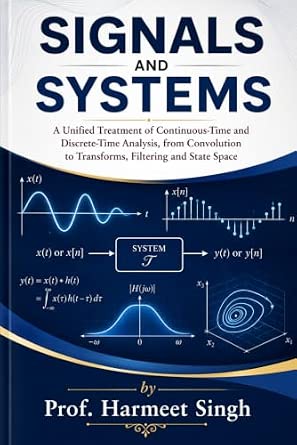
SIGNALS AND SYSTEMS: A Unified Treatment of Continuous-Time and Discrete-Time Analysis, from Convolution to Transforms, Filtering and State Space
Author(s): Prof Harmeet Singh (Author)
- Publisher: Independently published
- Publication Date: 25 July 2026
- Language: English
- Print length: 263 pages
- ISBN-10: B0HBJMQ11W
- ISBN-13: 9798188919801
Book Description
Every engineer who has ever tuned a radio, listened to a heartbeat through a stethoscope, watched a seismograph trace an earthquake, or waited for a photograph to load on a screen has encountered the same two objects: a signal, which carries information, and a system, which acts upon it. The remarkable fact — and the reason a single course can serve electrical engineers, control engineers, computer scientists, physicists and biomedical researchers alike — is that the mathematics describing these objects does not care what the signal physically is. A voltage, a pressure wave, a stock price and a pixel intensity all obey the same algebra of superposition, delay and spectral decomposition.
This book is the outcome of many years of teaching that algebra to undergraduate students who arrive with a solid grounding in calculus and a certain justified suspicion that the subject is about to become abstract. My aim throughout has been to keep the abstraction honest: every transform introduced here is motivated by a question that arises naturally from the previous chapter, and every result is accompanied by a picture. There are seventy figures in this volume and a substantial number of tables, and they are not decoration. In my experience the student who can sketch the pole–zero plot of a system, or draw the overlap of two functions during convolution, has understood something that no amount of symbolic manipulation can supply.
The argument of the book
The book follows a deliberate arc. Part I establishes vocabulary: what a signal is, how elementary signals are built and transformed, and which properties of systems — linearity, time invariance, causality, stability — matter enough to be given names. Part II develops time-domain analysis, where the single most important idea in the subject appears: an arbitrary input can be decomposed into impulses, and the response of a linear time-invariant system is therefore the convolution of the input with the impulse response. Everything that follows is, in a sense, an attempt to make convolution easier.
Part III turns to the frequency domain. The Fourier series decomposes a periodic signal into harmonics; the Fourier transform extends this to aperiodic signals; the discrete-time Fourier transform and the discrete Fourier transform carry the idea into the sampled world; and the sampling theorem explains precisely when the two worlds are equivalent. Part IV generalises further, to the Laplace and z-transforms, which handle growing signals and unstable systems that the Fourier transform cannot reach, and which convert differential and difference equations into algebra. Part V applies the machinery to filter design, state-space analysis, random signals, and a survey of engineering applications.
A note on rigour
I have tried to be careful without being fussy. Convergence conditions are stated where they change the answer — the Dirichlet conditions, the region of convergence, the Nyquist criterion — and are treated more lightly where they do not. The impulse is introduced as the limit of a sequence of ordinary functions, which is honest enough for engineering purposes and can be upgraded to distribution theory later without any of the intuition being discarded. Where a proof would consume a page and illuminate nothing, I have given the argument in outline and referred the interested reader to the specialist literature.
To the student
Work the examples with a pencil. There are more than eighty worked examples in this book, and each one has been chosen because it isolates a difficulty. When you reach the end-of-chapter problems, resist the urge to look for a formula; ask instead which property of the system you are being invited to exploit. The subject rewards this habit enormously.


