Wow! eBook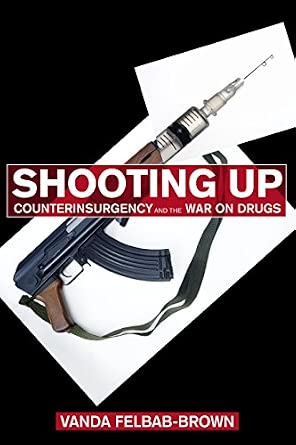
Shooting Up: Counterinsurgency and the War on Drugs
Author(s): Vanda Felbab-Brown (Author)
- Publisher: Brookings Institution Press
- Publication Date: 5 Jan. 2010
- Language: English
- Print length: 260 pages
- ISBN-10: 0815703287
- ISBN-13: 9780815703280
Book Description
Editorial Reviews
Review
About the Author
Excerpt. © Reprinted by permission. All rights reserved.
Shooting Up
Counterinsurgency and the War on DrugsBy Vanda Felbab-Brown
Brookings Institution Press
Copyright © 2009 Brookings Institution Press
All right reserved.
ISBN: 978-0-8157-0328-0
Chapter One
ILLICIT ECONOMIES AND BELLIGERENTS
A story from Afghanistan’s rural south, the region that has been at the core of the Taliban’s effort to regain control of the country, suggests the complexity of the relationship between illicit economic activity and military conflict. Taliban insurgents had hammered up posters offering to protect farmers’ opium poppy fields against government attempts at eradication, with a cell phone number to call if the eradicators appeared. In one village near Kandahar, the villagers caught on to a counternarcotics sting operation in which an agent posed as an opium trader. After his visits to the village to buy opium were followed with raids on the villagers’ crops, the villagers phoned the Taliban. The Taliban instructed them to invite the suspected informant back, captured him, and forced him to call in the police. When the police arrived in the village, the Taliban ambushed them, killing several policemen, including the police chief. The Taliban scored a success against the government and limited its presence in the area. Equally important, this episode fortified the relationship between the local population and the Taliban, even though the village residents had previously shown no pro-Taliban feelings.
The Kandahar story is just one example of how many belligerent groups-whether terrorists, insurgents, paramilitaries, or local warlords-have penetrated the international drug trade and other illicit economies. Realizing that belligerent groups derive large financial resources from such activities, governments have increasingly turned to suppressing illicit economies, not only as a way to curtail criminal activity but also as a strategy to defeat belligerents. Yet often those efforts not only fail to eliminate or significantly weaken belligerent groups but also impede government counterinsurgency/counterterrorism efforts.
Much of U.S. anti-narcotics policy abroad is based on the premise that the suppression of drug production will promote both anti-drug and counterterrorist goals. This book challenges this “narcoguerrilla” premise. I show that, far from being complementary, U.S. anti-narcotics and counterinsurgency policies are frequently at odds. Crop eradication-the linchpin of U.S. anti-narcotics strategy-often fails to significantly diminish the physical capabilities of belligerents. Worse, it frequently enhances their legitimacy and popular support.
DEALING WITH ILLICIT ECONOMIES: A PERVASIVE PROBLEM
Illegal drugs, the predominant focus of this book, are one example of a larger class of illicit goods, services, and economic activities. Other illegal or semi-legal commodities include conflict diamonds, special minerals, weapons, alcohol, wildlife, human beings, human organs, toxic and industrial waste, and components of nuclear, chemical, or biological weapons. Illegal or semi-legal activities include gambling, prostitution, illicit trading in legal goods, document forging, piracy, and maritime fraud. Illicit economies thus encompass economic commodities, services, and transactions the production or provision of which is either completely prohibited by governments or international regimes (or both) or partially proscribed unless their production or provision complies with economic or political regulations, including requirements for special licenses, certification, payment of taxes, and so forth. Such activities tend to be highly lucrative, in substantial part because of their illicitness.
Illicit economies exist in some form virtually everywhere. For example, some part of the illegal drug economy-whether production, trafficking, or distribution-is present in almost every country. The principal drug-growing and drug-refining countries and regions are the Andean countries of Peru, Bolivia, and Colombia; Mexico; Afghanistan, Pakistan, and Central Asia in the Golden Crescent; Myanmar and Laos in the Golden Triangle; and Morocco. Turkey and Hong Kong are crucial refining and transshipment locales. The United States and Canada are major producers of marijuana and methamphetamines. At various times in history, China, Thailand, Lebanon, and Jamaica have also been major producers of illicit drugs.
The book specifically focuses on illicit markets, not markets and resources in general. As distinct from licit markets, illicit markets have several crucial characteristics: they offer very high profits, and because governments and legitimate businesses cannot openly participate in them, outside-the-law actors, such as insurgent groups, can capture a significant share of the market. Crucially, governments frequently feel obliged to destroy the illicit economy, thus allowing belligerents to offer themselves as its protectors and obtain the support of the local population that depends on the illicit economy.
In this book, I discuss a broad range of illicit activities, including illegal logging (Peru, Afghanistan, and Burma); extortion (Colombia); and illegal traffic in legal goods (Afghanistan). However, my primary focus is the interaction between the illicit drug economy and military conflict. Drugs are the main focus because they best epitomize the nexus between crime and insurgency, because drugs are by far the most lucrative of all illicit economies, and because narcoterrorism-rather than “wildlife terrorism,” for example-dominates the attention of policymakers. Former attorney general John Ashcroft gave words to a common view when he said that “terrorism and drugs go together like rats and the bubonic plague. They thrive in the same conditions, support each other, and feed off each other.”
The Organization for Economic Cooperation and Development calculates that as much as $122 billion is spent every year in Europe and the United States on heroin, cocaine, and marijuana. Conservative estimates of the retail value of the global trade in illicit narcotics reach around $300 billion to $500 billion annually. The drug trade is where the money is-both for belligerent groups that exploit the trade and for governments that devote billions of dollars annually to fight the trade, reduce drug consumption at home, and deprive belligerents of drug profits.
The existence of an illicit economy, while almost always closely associated with a criminal organization or syndicate, does not by itself give rise to terrorists, warlords, or insurgents. Yet when belligerent groups penetrate existing illicit economies (or set up new ones), the resulting interaction profoundly affects their means and strategies and even, under some circumstances, their goals and identities. Examples of belligerent groups that have exploited the drug trade include the Taliban and the Northern Alliance in Afghanistan; the FARC (Revolutionary Armed Forces of Colombia), AUC (United Self-Defense Forces of Colombia), and ELN (National Liberation Army) in Colombia; the Shining Path and the MRTA (Tupac Amaru Revolutionary Movement) in Peru; the Real IRA (Real Irish Republican Army) in Great Britain; the KLA (Kosovo Liberation Army) in Yugoslavia; Hezbollah in Lebanon; the PKK (Kurdistan’s Workers Party) in Turkey; and ETA (Basque Homeland and Freedom) in Spain. Appendix A provides a more complete listing of groups.
THE NARCOTICS TRADE AND INSURGENCY: THE CONVENTIONAL VIEW
U.S. government thinking has been dominated by the conventional view of the nexus between illicit economies and military conflict, which starts with the premise that belligerent groups derive large financial profits from illegal activities. Those profits fund increases in the military capabilities of terrorists, warlords, and insurgents and a corresponding decrease in the relative capability of government forces. Consequently, governments should focus on eliminating belligerents’ physical resources by eliminating the illicit economies on which they rely. For example, President lvaro Uribe of Colombia has argued that “if Colombia would not have drugs, it would not have terrorists.” Or as one World Bank official told me, “If we destroy the coca, there won’t be any more war in Colombia.”
The conventional view frequently maintains that whether or not the belligerent groups ever had any ideological goals, once they interact with the illicit economy, they lose all but pecuniary motivations and become indistinguishable from ordinary criminals. In many cases, they partner or merge with drug trafficking organizations. Profiting immensely from the illicit economy, they have no incentive to achieve a negotiated settlement with the government. Aggressive law enforcement-principally through eradication of the illicit economy-thus becomes the government’s only option.
Advocates argue that as an added benefit, eradication will reduce drug consumption in market destination countries, such as the United States. For example, the 2003 International Narcotics Control Strategy Report, issued by the Department of State, states that
the closer we can attack to the source, the greater the likelihood of halting the flow of drugs altogether. Crop control is by far the most cost-effective means of cutting supply. If we destroy crops or force them to remain unharvested, no drugs will enter the system…. Theoretically, with no drug crops to harvest, no cocaine or heroin could enter the distribution chain; nor would there be any need for costly enforcement and interdiction operations.
In short, the conventional government view is based on three key premises: belligerents make money from illicit economies; the destruction of the illicit economy is both necessary and optimal for defeating belligerents because it will eliminate their critical resources; and belligerents who participate in the illicit economy should be treated as no different from criminals who participate in the illicit economy. While this approach is especially prevalent in government circles, it is rooted in academic work on narcoterrorism, exemplified by Rachel Ehrenfeld’s book How Terrorism Is Financed and How to Stop It. The conventional view is also informed by the “greed” literature on civil wars, which focuses on how belligerents profit from conflict; the emerging literature on the crime-terror nexus, which argues that the war against terrorism can no longer be separated from the fight against transnational crime; and the cost-benefit analysis of counterinsurgency, which puts stopping the flow of resources to insurgents ahead of winning hearts and minds.
THE POLITICAL CAPITAL OF ILLICIT ECONOMIES
I argue that the conventional narcoguerrilla view is strikingly incomplete and leads to ineffective and even counterproductive policy recommendations. It fails to recognize that belligerents derive much more than just large financial profits from their sponsorship of illicit economies. They also obtain freedom of action and, crucially, legitimacy and support from the local population-what I call political capital. By supporting the illicit economy, belligerents both increase their military capability and build political support, whereas belligerents who attempt to destroy the illicit economy suffer on both accounts. That insight lies at the heart of my political capital model of illicit economies in the context of violent conflict, which is illustrated and supported by the case studies presented in this volume.
Four factors largely determine the extent to which belligerents can benefit from their involvement with the illicit economy: the state of the overall economy; the character of the illicit economy; the presence or absence of thuggish traffickers; and the government response to the illicit economy.
-The state of the overall economy-whether it is poor or rich-determines the availability of alternative sources of income and the number of people in a region who depend on the illicit economy for their livelihood.
-The character of the illicit economy-whether it is labor intensive or not-determines the extent to which the illicit economy provides employment for the local population.
-The presence or absence of thuggish traffickers and the government response to the illicit economy-which can range from suppression to a laissez-faire approach to legalization-determines the extent to which the population depends on the belligerents to preserve and regulate the illicit economy.
In a nutshell, supporting the illicit economy will generate the most political capital for belligerents when the state of the overall economy is poor, the illicit economy is labor intensive, thuggish traffickers are active in the illicit economy, and the government has adopted a harsh strategy, such as eradication.
The political capital approach is inspired in part by academic critiques of the war on drugs. Like many critics of current anti-narcotics efforts, I believe that the war on drugs is failing both at home and abroad. Aggressive supply-side campaigns have failed to stem the flow of drugs into consuming nations and are impoverishing and radicalizing rural populations in producing nations. However, I extend my critique by focusing on the multiple ways in which the war on drugs can allow belligerents to obtain political capital. In addition, I identify the critical factors that shape the size of their gains.
The political capital model builds on the hearts-and-minds approach to counterinsurgency, which emphasizes the importance of the “legitimacy game” for both insurgents and the government. It is informed by the large and sophisticated literature on peasant rebellions, and it draws on academic studies of the relationship among terrorism, legitimacy, and power. As Conor Cruise O’Brien puts it, “the power of terrorism is through political legitimacy, winning acceptance in the eyes of a significant population and discrediting the government’s legitimacy.” Richard Rubenstein similarly argues, “It is a myth that terrorist groups can be `crushed in the egg’ by cutting off their external sources of supply. It is the local political base that makes the terrorist organization or breaks it. Politically isolated groups turn to banditry or disappear because of political weakness, not from a shortage of materiel.” In order to win the war on terror, governments must respond with policies that deprive belligerents of their legitimacy and consolidate the government’s popular support. The same is true, I argue, of counterinsurgency in the context of an illicit economy.
This model has direct implications for the policy options facing governments. It suggests not only that eradication of illicit crops is unlikely to weaken belligerents severely but also that this strategy frequently is counterproductive, particularly under the conditions outlined above. Eradication alienates farmers from the government and reduces their willingness to provide intelligence on belligerents. Thus, eradication increases the political capital of belligerents without accomplishing its promised goal of significantly reducing their military capabilities. Laissez-faire, on the other hand-tolerating the cultivation of illicit crops during conflict-leaves belligerents’ resources unaffected but may decrease their political capital. Interdiction-interception of illicit shipments, destruction of labs, and capture of traffickers-may be even more effective: it can decrease belligerents’ financial resources without increasing their political capital because it does not directly and visibly threaten the population’s livelihood. But because interdiction, like eradication, is extremely resource intensive and difficult to carry out effectively, it is unlikely to bankrupt belligerents to the point of defeating them. Finally, when feasible, licensing the illicit economy-for example, India and Turkey license opium poppy cultivation for the production of medical opiates-can reduce belligerents’ financial resources and political capital while increasing the government’s.
(Continues…)
Excerpted from Shooting Upby Vanda Felbab-Brown Copyright © 2009 by Brookings Institution Press. Excerpted by permission.
All rights reserved. No part of this excerpt may be reproduced or reprinted without permission in writing from the publisher.
Excerpts are provided by Dial-A-Book Inc. solely for the personal use of visitors to this web site.