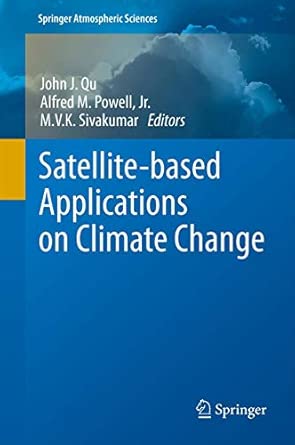
Satellite-based Applications on Climate Change 2013th Edition
Author(s): John Qu (Editor), Alfred Powell (Editor), M.V.K. Sivakumar (Editor)
Publisher: Springer
Publication Date: 4 April 2013
Edition: 2013th
Language: English
Print length: 381 pages
ISBN-10: 9400758715
ISBN-13: 9789400758711
Book Description
Climate and other environmental changes are drawing unprecedented concern and attention from national governments, international organizations and local communities. Global warming has left noticeable impacts on the environment and the ecosystems it supports (including humans), and has important implications for sustainable economic and social development in the future. Satellite observations of climate and environmental change have become an increasingly important tool in recent years in helping to shape the response of international communities to this critical global challenge.
The book presents the latest advances in satellite-based remote sensing of the Earth’s environment – ranging from applications in climate and atmospheric science to hydrology, oceanography, hydrology, geomorphology, ecology and fire studies. Introductory chapters also cover key technical aspects such as instrumentation, calibration, data analysis, and GIS tools for decision-making.
Editorial Reviews
From the Back Cover
Climate and other environmental changes are drawing unprecedented concern and attention from national governments, international organizations and local communities. Global warming has left noticeable impacts on the environment and the ecosystems it supports (including humans), and has important implications for sustainable economic and social development in the future. Satellite observations of climate and environmental change have become an increasingly important tool in recent years in helping to shape the response of international communities to this critical global challenge.
The book presents the latest advances in satellite-based remote sensing of the Earth’s environment – ranging from applications in climate and atmospheric science to hydrology, oceanography, hydrology, geomorphology, ecology and fire studies. Introductory chapters also cover key technical aspects such as instrumentation, calibration, data analysis, and GIS tools for decision-making.
 Wow! eBook