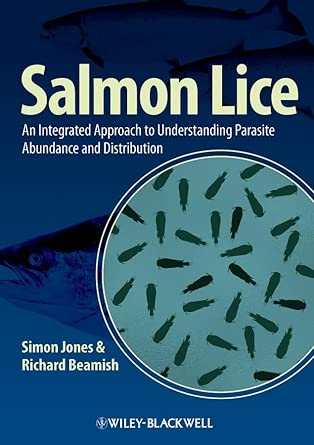
Salmon Lice: An Integrated Approach to Understanding Parasite Abundance and Distribution
Author(s): Simon Jones (Author), Richard Beamish (Author)
Publisher: Wiley-Blackwell
Publication Date: 14 Oct. 2011
Edition: 1st
Language: English
Print length: 360 pages
ISBN-10: 081381362X
ISBN-13: 9780813813622
Book Description
The salmon louse Lepeophtheirus salmonis is adapted to survive in hostile marine environments of the northern hemisphere, including an ability to parasitize several species of salmon. Salmonids are some of the most economically important and sought after fish for human consumption, and louse parasitism has a significant impact both on cultured and wild fish populations. Salmon Lice is a timely collection of the latest research on the cause and spread of lice infestations and management techniques being designed and implemented to combat this issue.
Salmon Lice provides a thorough single volume review of Lepeophtheirus salmonis, the key parasite standing in the way of sustainable and profitable production of salmonid fishes including salmon, trout and charr. Opening with a review of the biology, morphology, life cycle, and larval behavior of the parasite, Salmon Lice proceeds to review the distribution of planktonic larvae of salmon lice, addresses management techniques used in salmonid aquaculture and capture fisheries, provides a practical assessment of the salmon lice issue and explores potential solutions to the problem.
With comprehensive coverage of the biology and distribution of this harmful and ubiquitous parasite, Salmon Lice will be of value to fish health researchers, aquaculture and fisheries professionals, and seafood industry personnel to inform the management of both cultured and wild salmonid populations.
Key Features:
In-depth coverage of a key parasite impacting viability and sustainability of salmonid fisheries and aquaculture
Integrates parasite biology and hydrodynamic models in diverse coastal ecosystems
Provides a practical assessment of the salmon louse issue
Reviews international salmon louse monitoring and management techniques used in salmonid fisheries and aquaculture
Editorial Reviews
Review
Select Guide Rating
From the Inside Flap
The salmon louse Lepeophtheirus salmonis is adapted to survive in hostile marine environments of the northern hemisphere, including an ability to parasitize several species of salmon. Salmonids are some of the most economically important and sought after fish for human consumption, and louse parasitism has a significant impact both on cultured and wild fish populations. Salmon Lice is a timely collection of the latest research on the cause and spread of lice infestations and management techniques being designed and implemented to combat this issue.
Salmon Lice provides a thorough single volume review of Lepeophtheirus salmonis, the key parasite standing in the way of sustainable and profitable production of salmonid fishes including salmon, trout and charr. Opening with a review of the biology, morphology, life cycle, and larval behavior of the parasite, Salmon Lice proceeds to review the distribution of planktonic larvae of salmon lice, addresses management techniques used in salmonid aquaculture and capture fisheries, provides a practical assessment of the salmon lice issue and explores potential solutions to the problem.
With comprehensive coverage of the biology and distribution of this harmful and ubiquitous parasite, Salmon Lice will be of value to fish health researchers, aquaculture and fisheries professionals, and seafood industry personnel to inform the management of both cultured and wild salmonid populations.
Key Features:
In-depth coverage of a key parasite impacting viability and sustainability of salmonid fisheries and aquaculture
Integrates parasite biology and hydrodynamic models in diverse coastal ecosystems
Provides a practical assessment of the salmon louse issue
Reviews international salmon louse monitoring and management techniques used in salmonid fisheries and aquaculture
From the Back Cover
The salmon louse Lepeophtheirus salmonis is adapted to survive in hostile marine environments of the northern hemisphere, including an ability to parasitize several species of salmon. Salmonids are some of the most economically important and sought after fish for human consumption, and louse parasitism has a significant impact both on cultured and wild fish populations. Salmon Lice is a timely collection of the latest research on the cause and spread of lice infestations and management techniques being designed and implemented to combat this issue.
Salmon Lice provides a thorough single volume review of Lepeophtheirus salmonis, the key parasite standing in the way of sustainable and profitable production of salmonid fishes including salmon, trout and charr. Opening with a review of the biology, morphology, life cycle, and larval behavior of the parasite, Salmon Lice proceeds to review the distribution of planktonic larvae of salmon lice, addresses management techniques used in salmonid aquaculture and capture fisheries, provides a practical assessment of the salmon lice issue and explores potential solutions to the problem.
With comprehensive coverage of the biology and distribution of this harmful and ubiquitous parasite, Salmon Lice will be of value to fish health researchers, aquaculture and fisheries professionals, and seafood industry personnel to inform the management of both cultured and wild salmonid populations.
Key Features:
In-depth coverage of a key parasite impacting viability and sustainability of salmonid fisheries and aquaculture
Integrates parasite biology and hydrodynamic models in diverse coastal ecosystems
Provides a practical assessment of the salmon louse issue
Reviews international salmon louse monitoring and management techniques used in salmonid fisheries and aquaculture
About the Author
Richard Beamish is Senior Scientist in the Salmon and Freshwater Ecosystems division at the Pacific Biological Station, Nanaimo, British Columbia, Canada.
Simon Jones is a Research Scientist in Aquatic Animal Health at the Pacific Biological Station, Nanaimo, British Columbia, Canada.
 Wow! eBook