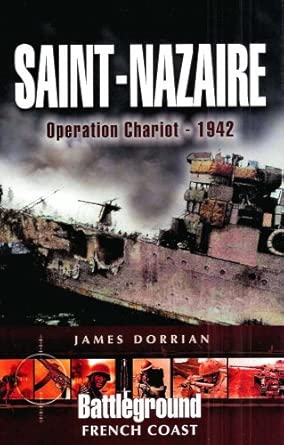
This, my second book on the subject of Operation CHARIOT, is designed to act as a comprehensive guide of equal value both to those who wish only to read about this amazing feat of arms, and to those whose intention it is to one day visit Saint-Nazaire and follow in the footsteps of Colonel Charles Newman’s gallant Army Commandos. Largely based on the personal testimony of the soldiers and sailors who were actually there, the extensively illustrated text is supplemented by essential travel information and a detailed tour encompassing all the primary Commando targets, the CHARIOT memorial and the awe-inspiring U-Boat pens.
As demonstrated by Jeremy Clarkson in his moving documentary ‘The Greatest Raid Of All Time’ – for which I acted as programme consultant – many of the major features of the 1942 battlefield remain to the present day, the giant ‘Normandie’ dock still welcoming some of the largest ships in the world.
Excerpt. © Reprinted by permission. All rights reserved.
Excerpt from Chapter 6: ‘STEEL TIDE RUNNING’
Armed with a Bren gun and stationed amidships on ML 457, `Tiger’ Watson describes the moment when the raiders’ bluff was finally called: `All hell was let loose. The air was suddenly full of the deceptively slow-seeming sparkling arcs of the shells, tracer, explosive and incendiary from the quickfiring Bofors guns. They were coming at us at point blank range. Then the heavier coastal guns joined in but I was not conscious of these bigger shells splashing about us. I was too distracted by all this hostile activity from the north bank to see the Campbeltown lower the German flag and break out the British battle ensign while all our little ships…did the same. But I heard [Lt] Tom Collier’s klaxon giving the order to his bow and stern Oerlikons to fire, and standing with the Bren gun held at the hip, I directed a stream of tracer at the nearest searchlight.’ (Dr W H Watson, MBE., MC: unpublished narrative)
Still in the van of the formation, the gunboat was closing rapidly on the harbour approaches. Completely exposed on her foredeck, Frank Smith and Bill Savage brought their pom pom into action, the deafening noise of its discharge compelling Sub Lieutenant Worsley to vacate his chosen position at Frank Smith’s feet. From their vantage point up on the open bridge, the moment when their world of quiet order suddenly went mad was imprinted forever on the memories of the two Commanders, Newman recalling that: `The noise was terrific – tracer of every colour seemed to pour into our fleet – the Campbeltown’s sides seemed to be alive with bursting shells and on the bridge of the gunboat we could watch the stream of tracer coming towards us and it seemed as if one could just duck below it as it passed overhead!’ (Lieutenant Colonel A C Newman VC: unpublished narrative)
For Ryder, who was painfully aware that their `diversionary’ air-support was nowhere to be seen, it was; `difficult to describe the full fury of the attack that was let loose on each side. …In the MGB we were heading close past the bows of a guard ship, probably one of the German flak ships and not above two hundred yards away. This was our target. She opened fire from the top of her bridge with some light automatic weapon, perhaps we were too low for her other guns to bear, anyhow, she only fired one burst. Our Pom Pom instantly scored a direct hit on the gun position and plastered the ship from end to end. This ship with her light camouflage paint and high structure stood out clear in the searchlights and was easily the most conspicuous ship in the river. As we looked back over our shoulders…we were glad to see the enemy shooting at her and hitting her all over the place.’ (Captain R E D Ryder, VC, RN: unpublished narrative)
The German vessel, which had been clearly visible on aerial photographs, was Sperrbrecher 137, the 996 GRT Botilla Russ, a unit of 2.Sperrbrecherflottille. Armed with one 88mm and several 20mm, cannon, she had the misfortune to be directly in the path of every ship in the fleet each of which, in turn, would pour fire into her as they passed, leaving her seriously damaged and ablaze. Some way behind the gunboat and the striking force of MLs 160 and 270, Campbeltown was also being repeatedly hit as she raced towards the dry dock. Watson, on ML 457, caught a glimpse of her; `Ploughing along, brilliantly lit up by the accursed searchlights, the British battle ensign streaming out over her stern…her sides alive with the flashes of the shells which were hitting her continuously. It was a sight that I shall never forget.’ (Dr W H Watson, MBE., MC: unpublished narrative)
Seemingly trapped within a vortex of fire, Campbeltown was certainly taking a beating. However, as she had already slipped past the outer coastal batteries unseen, and as their limited traverse no longer allowed the Fort de l’Eve guns to bear, the old destroyer was now being peppered with shells the majority of which lacked the weight to inflict any terminal damage. To the watching `Major Bill’ Copland; `it seemed as though every gun on earth had opened fire on us. In immediate reply, our Oerlikon guns aft opened up with their deadly crackle and I yelled to the gun crew and mortar crews ahead to “Let her go”. Almost before I had finished shouting, the first rounds had gone off from the 12- pounder and our mortars. Before the next round was fired by them, I was deafened and thrown about by a terrific explosion which appeared to come almost from my feet. The smoke cleared and looking ahead I saw the mortars and crews intact but the 12-pounder crew had vanished and, directly in front of me yawned a gaping, smoking hole and about two thirds the width of the deck. I thought about two things -“God, what rotten luck” and “Probably 4 inch and marvellous shooting”. How we got through the next thirteen minutes with anyone left alive, will always pass my understanding.’ (Major W O Copland, DSO: unpublished narrative)
 Wow! eBook