Wow! eBook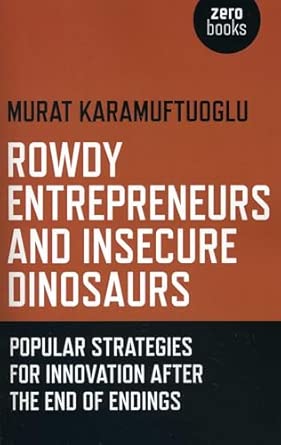
Rowdy Entrepreneurs and Insecure Dinosaurs: Popular Strategies for Innovation After the End of Endings
Author(s): Murat Karamuftuoglu (Author)
- Publisher: Zero Books
- Publication Date: 26 April 2013
- Edition: Illustrated
- Language: English
- Print length: 131 pages
- ISBN-10: 1780992874
- ISBN-13: 9781780992877
Book Description
Editorial Reviews
About the Author
Excerpt. © Reprinted by permission. All rights reserved.
Rowdy Entrepreneurs and Insecure Dinosaurs
Popular Strategies for Innovation After the End of Endings
By Murat Karamuftuoglu
John Hunt Publishing Ltd.
Copyright © 2012 Murat Karamuftuoglu
All rights reserved.
ISBN: 978-1-78099-287-7
Contents
Preface: This is Insane, or Minding the Small Print……………………11. Introduction: Of Passions, Skills, Innovation and New Economy………..72. The Beginnings of the Ends: A Short Archaeology…………………….213. Innovation Lessons for New Economy Entrepreneurs……………………374. Information Arts: Artscience Entanglement………………………….685. The Next Cycle: Onticapitalism……………………………………88(For want of an) Afterword………………………………………….117End Notes…………………………………………………………118
Excerpt
CHAPTER 1
Introduction
Of Passions, Skills, Innovationand New Economy
Innovation and New Economy A Bit of a Sci-Fi Of Heartsand Bones One-Trick Pony Afterlife A Riddle: Skulls andVats, Skyscrapers and Telescopes Quantity Drives QualityOut Everywhere
Innovation and New Economy
This little book is about innovation, specifically innovation in thecontext of postmodern society and postmodern informationeconomy. Postmodernity is characterized in the economic realmwith the rise of information as an economic commodity inaddition to the three fundamental pillars of traditionaleconomies; namely, money, human labor, and raw materials.Informational economies are marked by the displacement, to aconsiderable extent, of industrial production by finance andservice sectors of the economy.
Disembodied information, that is, information extracted fromreal, material contexts and represented as digits in computersand circulated around the globe at the speed of light in digitalcommunication networks is conferred with almost magicalpowers in the current economic and political discourse ofglobalism. All reality according to the dominant postmoderndiscourse is made up of language, representation and information,which can be manipulated, transformed as one wishes,and refracted through the glass screen of telecommunicationmedia before projected back onto the reality to replace it. ‘Morereal than real’ is the reality of the ‘hyperreality’ created bymodern information and communication technologies in thefamous words of media theorist Jean Baudrillard whoseanalysis of the postmodern media world came to replace theolder theories of the bygone TV age of Marshall McLuhan, of’medium is the message’ fame.
According to postmodern theorists we need nothing morethan language and information; we are indeed language andinformation. Life is made of information. Invention andinnovation are thus reduced to language games and combinationsat will of disembodied and decontextualized informationrelieved from all chains that hold it hostage to material reality.
This book argues to the contrary: we cannot innovate by’thinking’ alone. Invention and innovation are not only a matterof language games or information logics; it is more a matter ofmaterial activities and practices. We are not disembodied ether-likecreatures. We live and inhabit a material world within whichall inventions and innovations take place. This book is set to tracethe circulation of people and artifacts, ideas and passions, aroundthe globe, a process that brings about happy inventions andinnovations. Chapter 2 is devoted specifically to the historicalaccount of this process from the birth of the first modern ideas inthe East to the dawn of the Age of Discovery in the West.
The central argument of the book is that joyful, skilled, playfulactivities and practices are the basis of most, if not all, inventionsand innovations. This perspective puts the practice of everydaylife at the heart of invention and innovation. Chapter 3 investigatesthe strategies of invention and innovation of some of the bignames and companies, specifically, Virgin, Microsoft, and Applethat are much loved or abhorred today. The discussion in thischapter highlights the similarities between the way everydayculture and life are produced and the practices that producepopular inventions and innovations.
Chapter 4 continues this line of investigation by looking at thenew forms of art and science experiments that have becomepopular in recent years. The emerging hybrid works of’artscience’ or ‘information arts’ that give physical shape to informationhighlight the importance of skilled, passionate,embodied, material, and practical work in innovation.
Just as ordinary everyday life is the basis of many of the mostuseful and popular inventions and innovations, it is also thebasis of the whole economy. The other main argument of thisbook is that ordinary people and ordinary everyday life – withall its repetitions, passionate amplifications of small differences,and creativity – produces the real economy, and as such ‘populareconomy’, more than ‘political economy’ reduced to productivitymeasures, should be at the heart of economics and economicpolicies.
Chapter 5 puts innovation in the context of the generaleconomy, and speculates about the new forms economicrelations could take in the future popular economy of the people.The chapter concludes by arguing along the lines of the not-very-well-knownbut increasingly relevant French sociologist GabrielTarde (1843-1904), that economics of innovation and theeconomy at large should be understood as ‘the science ofpassionate interests’ of people.
A Bit of a Sci-fi
What would be life like, after the end of all ends, when we flypast all posts: post-modernity, post-humanity, post-everything ina rush? Can we exist without our bodies in a post-human age tocome? Is it possible for the brain to live in a vacuum? Moreimportantly for our purposes here, can we keep invent andinnovate by our brains alone? For the excessively reductionistphilosophy of science of the twenty-first century, the brain in avat, virtual existence without an anchor in the material world,seems to be a possible scenario. I will argue, however, for theimpossibility of it: we cannot exist or sustain with our mindsalone, let alone invent and innovate. Our capacity to act on theexternal world, to change the world, to innovate, depends onbodies as afferent and efferent, sensory and motor, sites of interactionwith the material world. We are not only abstract calculatingor theorizing machines; we also are sensual beings.
Nevertheless, lets indulge in a bit of a sci-fi fantasy of out-of-bodyvirtual existence expounded by Hilary Putnam (1926-), acontemporary American philosopher:
Here is a science fiction possibility discussed by philosophers:Imagine that a human being (you can imagine this to beyourself) has been subjected to an operation by an evilscientist. The person’s brain (your brain) has been removedfrom the body and placed in a vat of nutrients, which keepsthe brain alive. The nerve endings have been connected to asuper-scientific computer, which causes the person whosebrain it is to have the illusion that everything is perfectlynormal. There seem to be people, objects, the sky, etc.; butreally, all the person (you) is experiencing is the result ofelectronic impulses travelling from the computer to the nerveendings. The computer is so clever that if the person tries toraise his hand, the feedback from the computer will cause himto ‘see’ and ‘feel’ the hand being raised. Moreover, by varyingthe program, the evil scientist can cause the victim to’experience’ (or hallucinate) any situation or environment theevil scientist wishes.
Is this a plausible scenario for our future? This and similarthought experiments, from the time of Descartes to the present,have puzzled and continue to puzzle countless generations ofphilosophers and scientists. But, I think, it is the wrong sort ofquestion. Wrong questions attract wrong answers. This is the sortof mistake that causes what renegade philosopher Wittgensteincalls ‘mental cramps’ and ‘philosophical torments’.
For me, the question is not whether the ‘brain in a vat’ couldactually know it is in a vat or not, but what would happen whenthe plug is pulled off from the wall? What would happen whenthe skills we humans have accumulated throughout manymillennia of our evolution have been made redundant suddenly?What would life on earth be like when large portions of thepopulation have been incapacitated for work as a result ofdeskilling? What would the end of the story be like wheneverybody becomes a ‘sales consultant’ (!) or ‘retail representative'(!) in a fast food chain so much so that nobody remembersany more how to cook pasta at home?
Of Hearts and Bones
What would remain of the brain in the vat when the power isturned off? A stockpile of compost? Precisely!! And, reassuringlyso! This is how organic life is renewed on this planet called theearth: one man’s dung is another man’s manure! Every endingnot only has a beginning, but it is a beginning of a newbeginning. A useful trope that will guide our discussions in thisbook.
There is, however, another side to the brain in a vat. We all arein reality a bit like that, that is, brains in a vat, or more to thepoint, biological computing machines that crunch symbols,symbolic representations of the world. We are, in part,’theorizing machines’; constantly contemplating the world. Thesoft machine in our skull constantly bothers us with theories ofwhat the world is and how it should be. But, we have also got inour bodies little bone machines and heart machines; we not onlythink but also sense, feel and affect. We not only theorize aboutthe world but also change it by acting on it. We are also made ofpassions, dreams, habits, and learned skills. Our hearts andbones are repositories of ‘passionate interests’, to use the wordsof long-forgotten sociologist Gabriel Tarde, of integrated skillsand artisanal competencies. While the soft machine seems to bethe throne of rational and theoretical knowledge, the bonemachines and heart machines are where our passions andmanual virtuosities are treasured.
One-Trick Pony
The conundrum we are facing, as the human race, is thefollowing: the ‘organic composition’ of our economies, and ourculture and arts, in short our lives, have been constantlydecreasing for a long time. Organic composition of capital is aterm in political economy that denotes the ratio between constantcapital (all means of production, such as plants and machinery,land and buildings) and variable capital (human power).
True, capitalism is a beast! A particular beast indeed! A one-trickpony is what it really is for the most part. It ticks mainly byextracting surplus value by reducing the cost associated with thehuman labor in the production process. In other words, while thecontribution of the human element decreases in production ofgoods, the mechanical element increases; a strategy which hasbecome particularly conspicuous with the advances made inInformation and Communication Technologies and factoryautomation from the second half of the twentieth centuryonwards. If capitalism had to choose one science to keep for itselfthat would be computer science for this reason. While the weightof the living bodies disappears in the production process, theweight of the dead machines increases. This is the basic formulaof capitalism.
Afterlife
However, there is a small problem! The decrease in the organiccomposition of capital cannot be maintained indefinitely! Inother words, production cannot be totally free of humanelement, as total automation of production would not yield anysurplus value or profits. Why? Simple: while productivityincreases with the decrease in the organic composition, averageprofit per unit of output also decreases as the purchasing powerneeded to buy them decreases on average. Remember that thehuman work force has just been made redundant; nobody is leftto buy our precious goods!
This is the point of no return. Where to head when the plug ispulled off the wall, when the bone machine is broken and theheart machine is torn off? Where to head after the end of allends?
There has been a lot of talk in recent years, and indeedthroughout the known human history, of ‘the ends’. Unlike ourstory of brain in a vat that turned to compost when its plug isunplugged, most religious eschatologies have happy endings, atleast for the faithful and the virtuous. In such scenarios the endof the world is followed by the final judgment that leads toeternal bliss of non-change, of sameness. In heaven nothingreally happens.
Outside of the religious, secular eschatologies have recentlyprophesized similar endings and beginnings. Most famously wehave heard, but not actually seen, the end of History – or moreaptly, ‘His-story’ – declared by Francis Fukuyama, Americanphilosopher and political economist. Similarly, he promised ablissful coexistence of political powers after the downfall of thesocialist world at the end of the 1980s, that is, at least until thenext credit crunch! There are other similar secular eschatologiesand prophecies, though usually with more ambivalent endings:’the end of the art’, ‘the end of science’, ‘the death of author’, toname but a few. The post-modernity, our present state ofexistence (or non-existence depending on your viewpoint), isliterally littered by countless other cadavers.
Outside of the linear eschatologies of the Abrahamic religions,and their secular doppelgängers, there are cyclic eschatologiesthat promise the return of not very much of the same, but reincarnationwith a difference. In such narratives, the binary oppositionis played out not between life and death, but between death andrebirth; every death is followed by rebirth not elsewhere inafterlife but in another life here on this planet. I believe this is amore fruitful way of thinking of our future life on this planet, aswell as our past; a theme that will be explored in Chapters 2 and5.
A Riddle: Of Vats and Skulls, Skyscrapers and Telescopes
If ‘brain in a vat’ is one metaphor that helps us understand ourcurrent state of affairs, the other is that of the skyscraper. Here isa little riddle: What is common between a ‘brain in a vat’ and askyscraper? They both distort our view of reality!
As we mulled over earlier, the soft machine in our skullcogitates about the world and constructs ever-tall theories ofwhat it is and how it should be. It, in fact, constructs a virtualreality, a science fiction, to immerse itself in. This virtual realityconstructed part out of science and part out of fiction acts as thevat of nutrients that keeps the brain alive in the narrative ofPutnam’s ‘brain in a vat’. We, humans, create virtual realities thatmake our existence in this unknown journey called life a littlemore meaningful. But, past a certain point, the harmless-lookingfantasies of our minds create a smoke screen that blurs ourvision. The process is not unlike that of building ever-tallerskyscrapers. The theoretical knowledge that crowns the softmachine is like a skyscraper, in the sense that the taller it growsthe further it takes us away from the ground that sustains us. Asit grows taller and taller, the sight of the ground of reality onwhich it is built is lost. To reality check; bigger and bigger opticalinstruments that bring distant reality nearer are needed, that isuntil our perspective completely loses sight of the big picture. Aswe will see in the next chapter, an inevitable collapse ensues; thetall building imparts more weight than the real estate on whichit is built can carry.
I call this Vertical Epistemic Development or VED, which is’progress’ to most people. The alternative route is to develophorizontally so as to cover more of the ground without losing thesight of reality. This route of development, which I call asHorizontal Ontic Development or HOD is the main theme of thelast chapter of this book.
Science suffers from VED at first hand. The publish or perishethos that infected much of academia in the last decades hasmade sure that too many inconsequential papers are publishedand perish, while acute social problems duck to dodge thetelescopic views from the dizzying heights of theoreticskyscrapers.
Quantity Drives Quality Out Everywhere
I will argue that wherever there is excessive VED, be it ineconomy, art, philosophy, science or technology, there is adecrease in quality at the expense of quantity, which degradesour artisanal competencies and debases our passions. The endresult is a decrease in the overall quality of life for the wholeplanet.
In postmodern thought and philosophy VED manifests itselfas endless play on words and babble, commentaries on commentaries,absolute relativism that removes any hope of meaningfuldebate, political correctness and politics of identity that avoidreal socio-economic issues and problems.
(Continues…)Excerpted from Rowdy Entrepreneurs and Insecure Dinosaurs by Murat Karamuftuoglu. Copyright © 2012 by Murat Karamuftuoglu. Excerpted by permission of John Hunt Publishing Ltd..
All rights reserved. No part of this excerpt may be reproduced or reprinted without permission in writing from the publisher.
Excerpts are provided by Dial-A-Book Inc. solely for the personal use of visitors to this web site.