 Wow! eBook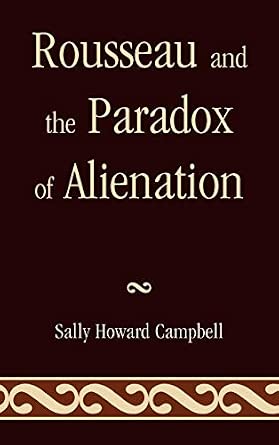
Rousseau and the Paradox of Alienation
Author(s): Sally Howard Campbell (Author)
- Publisher: Lexington Books (UK)
- Publication Date: 1 Mar. 2012
- Language: English
- Print length: 110 pages
- ISBN-10: 0739166328
- ISBN-13: 9780739166321
Book Description
Editorial Reviews
Review
“Campbell’s reading of Rousseau’s key texts makes the case that he is the foundational source of the theory of alienation as it is found in subsequent literature, especially in Hegel and then Marx and Marxian-inspired discourse. Campbell’s explication shows that Rousseau’s psychosocial understanding of man’s dilemma in modern civil life transcends the Marxian focus on economic man. The author says Rousseau’s theory has been overlooked and the significance of his innovative insight neither fully understood nor appreciated. Campbell (Concord Univ.) also sees a clash between Rousseau and Marx: for the former, man’s original nature is asocial at core and for the latter, it is social. For Rousseau, society itself is the conundrum man faces. Campbell says that Marx’s remedy of revolution fails to overcome alienation because it does not resolve the self-alienation that Rousseau locates within man’s inner being. Only The Social Contract’s paradox of alienation overcoming itself (a pre- Hegelian negation of the negation?) can produce synthesis between individual and communal well-being…Summing Up: Recommended.” —Choice Reviews
“Lucidly written and forcefully argued, Campbell makes a compelling case for reading Rousseau as a pivotal figure in the development of modern conceptions of alienation. Rousseau and the Paradox of Alienation convincingly argues for Marx’s debt to Rousseau’s transformation of the concept of alienation.” –Julia Simon, University of California, Davis
“Sally Howard lucidly explores the way the notion of alienation was transformed over the course of modern political thought and finds the key to this transformation in Jean-Jacques Rousseau.” –Christopher Kelly, Boston College


