 Wow! eBook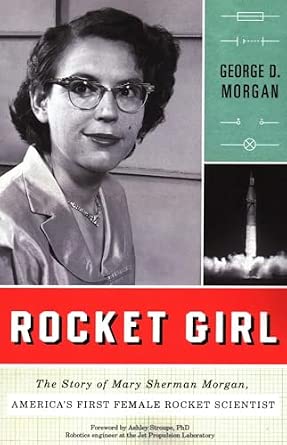
Rocket Girl: The Story of Mary Sherman Morgan, America's First Female Rocket Scientist
Author(s): George Morgan (Author)
- Publisher: G38-Prometheus
- Publication Date: 9 July 2013
- Language: English
- Print length: 334 pages
- ISBN-10: 1616147393
- ISBN-13: 9781616147396
Book Description
AN UNSUNG HEROINE OF THE SPACE AGE—HER STORY FINALLY TOLD.
This is the extraordinary true story of America's first female rocket scientist. Told by her son, it describes Mary Sherman Morgan's crucial contribution to launching America's first satellite and the author's labyrinthine journey to uncover his mother's lost legacy--one buried deep under a lifetime of secrets political, technological, and personal.
In 1938, a young German rocket enthusiast named Wernher von Braun had dreams of building a rocket that could fly him to the moon. In Ray, North Dakota, a young farm girl named Mary Sherman was attending high school. In an age when girls rarely dreamed of a career in science, Mary wanted to be a chemist. A decade later the dreams of these two disparate individuals would coalesce in ways neither could have imagined.
World War II and the Cold War space race with the Russians changed the fates of both von Braun and Mary Sherman Morgan. When von Braun and other top engineers could not find a solution to the repeated failures that plagued the nascent US rocket program, North American Aviation, where Sherman Morgan then worked, was given the challenge. Recognizing her talent for chemistry, company management turned the assignment over to young Mary.
In the end, America succeeded in launching rockets into space, but only because of the joint efforts of the brilliant farm girl from North Dakota and the famous German scientist. While von Braun went on to become a high-profile figure in NASA's manned space flight, Mary Sherman Morgan and her contributions fell into obscurity--until now.
Editorial Reviews
Review
About the Author
Excerpt. © Reprinted by permission. All rights reserved.
ROCKET GIRL
The Story of Mary Sherman Morgan, AMERICA'S FIRST FEMALE ROCKET SCIENTIST
By GEORGE D. MORGAN
Prometheus Books
Copyright ©2013 George D. Morgan
All rights reserved.
ISBN: 978-1-61614-739-6
Contents
Foreword by Ashley Stroupe, PhD...........................................7Chapter 1: This Is a Story.................................................11Chapter 2: Prairie Girl....................................................17Chapter 3: The Raketenflugplatz............................................25Chapter 4: The ABC's of Milking Cows.......................................29Chapter 5: I Have No Idea What You're Talking About........................35Chapter 6: "Mother Does Not Abide Photography".............................43Chapter 7: The Great Escape................................................67Chapter 8: A Little of This, a Little of That..............................79Chapter 9: An Odd Number...................................................95Chapter 10: Hidden Fortress................................................111Chapter 11: A New Kind of War..............................................131Chapter 12: Whitewashed in White Sands.....................................145Chapter 13: Alias Chief Designer...........................................151Chapter 14: Red............................................................161Chapter 15: Politics, Philosophy, Television, and Cush' Sobash'ya..........167Chapter 16: Your Very Best Man.............................................171Chapter 17: Welcome to the Monkey Cage.....................................185Chapter 18: The Mysterious Unknown Propellant Project......................199Chapter 19: Smoke and Fire.................................................221Chapter 20: Don't Drink the Rocket Fuel....................................237Chapter 21: Pusk!..........................................................247Chapter 22: The Dutchman Cometh............................................253Chapter 23: 310 at 1.75 and 0.8615 for 155.................................263Chapter 24: The Law of Unintended Consequences.............................267Chapter 25: Satellite without a Name.......................................273Chapter 26: Wings of the Condor............................................283Author's Note..............................................................295Acknowledgments............................................................297Notes......................................................................299Index......................................................................311
Excerpt
CHAPTER 1
THIS IS A STORY
This is a story about a mother who never talked to her children. Thisis a story about a wife who rarely talked to her husband, thoughthey were married for fifty-three years. This is a story of a woman whodesperately wanted happiness but could never summon the strength toreach for it. This is a story of a woman who had a family that loved her,but who struggled to love them in return. This is a story about a womanwhom people admired but could never get close to. This is a story of awoman who harbored many secrets and lived in daily fear that thosesecrets would one day be revealed. This is the story of a woman whotook those secrets to her grave. This is a story about America's firstfemale rocket scientist.
This is a story about my mother.
Mary Sherman was born on November 4, 1921, on a small farm ina remote corner of North Dakota. There is no record of who was presentthat day, as the Shermans were never great record keepers. On August4, 2004—eighty-two years later—Mary was admitted to the emergencyroom of West Hills Hospital in West Hills, California, with chest pains.Her husband (my father), G. Richard Morgan, was by her side. An hourlater, Mary was dead. There is no record of who else except my fatherwas present, as the Morgans have never been great record keepers.They wheeled her body out of the room, and a nurse collected the possessionsshe left behind: a handful of home-sewn clothing, fifty feet ofclear plastic oxygen tubing, and a plastic bag overflowing with exoticmedications.
That afternoon, my father began calling his children, whichincluded my brother, Stephen (a long-haul trucker), my sister Monica(a draftsman living in Oregon), and my sister Karen (a governmenthealth worker in nearby Orange County). He called me last and askedthat I write Mary's obituary for the Los Angeles Times. I told him Iwould be honored.
I did not expect any challenges writing her obit. Even though mymother always refused to discuss her 1950s top secret Cold War workwith any of her four children, we had learned quite a few things fromeavesdropping on little snippets of conversation between our parentsand their friends. We knew, for instance, that our mother had been arocket scientist, that her work included designing new and exotic rocketpropellants, and that she had made several historical achievements thathelped usher in the Space Age. Taking this obituary assignment mostseriously, I interviewed my father, found out a number of things I neverknew about my mother, wrote the obit, and submitted it to the Times.
I assumed that getting her obituary published would be a slamdunk, given that my mother was the inventor of hydyne—the rocketpropellant that boosted America's first satellite, Explorer 1, into orbit.Her invention had helped rescue America's tarnished reputation in thewake of Russia's launch of Sputnik 1 and 2. It was a significant milestonein the history of America's space program, especially since shehad been the only woman out of nine hundred engineers, and she didn'teven have a college degree.
To my surprise, however, the Times refused to print the obit. Thereason, they said, was that my mother's life "could not be independentlyverified." They said that they had checked the claims in my obitarticle and could not verify any of them.
They could not verify any of them!
That was when I realized my mother's numerous accomplishmentsin the fields of rocketry and aerospace were already turning to dust andwere in danger of being lost to history forever. Apparently no one atNorth American Aviation had been very good at keeping records either,because two years later a former NAA engineer, Robert S. Kraemer,would write a book about the company. He would do it because noone else could. And the reason no one else could write it? According toKraemer, "The professional historians said there was not enough preserveddocumentation for them to write a proper history."
After seven years of working on this project, I can tell you this:Robert Kraemer and those "professional historians" were absolutelycorrect. Historical record keeping in the non-aircraft portions of aerospacehas been abysmal.
My mother had been a devout Catholic most of her life, so the funeralservice was held at St. John Eudes Catholic Church in Chatsworth,California—just a few miles from the home Mary lived in for almostforty years. Despite the fact I wasn't a Catholic, the family agreed thatI should be the one to deliver the eulogy. It was pretty normal stuff aseulogies go—lots of talk about Jesus, the resurrection, heaven. Blah,blah. After the services, all the attendees—about fifty people—satdown for a sunny, outdoor lunch in the church courtyard.
Lining up at the buffet table, I dished up a plate of food and wentlooking for an available seat. I noticed that a number of my mother's formercoworkers were gravitating to a table set off from the rest of the group.
My mother had chosen to share very little information about her lifeas an aerospace engineer. She claimed that her security clearance forbadeher from doing so, but we always suspected there was a lot more to it. Longafter she retired, and most of her work had been declassified, she continuedto enforce those rules of secrecy on herself. She had seen too manyof her friends punished over the years for the smallest of infractions. Mostof her top secret work had been performed in the 1950s—the McCarthyera—and people were afraid. But long after Senator McCarthy was dead,his ghost continued to haunt my mother's soul. So when I noticed theNAA engineering group congregating at a single table and talking overthe "good old days," I knew where I had to set my plate. I was eager tohear a few war stories from these men (and they were all men). I took aseat at their table, took a bite out of my sandwich, and quietly listened.
Not more than two minutes went by, however, before I felt a sterntap-tapping on my right hand. I turned to see the face of a very elderlygentleman sitting across the table, his face wrinkled and folded, likethose canines that win the "ugliest dog" contests. He stopped tapping myhand, using his bony index finger to point straight at my nose. He spoke.
"You need to listen to me, young man."
"Yes, sir."
"My name is Walter. I knew your mother. I worked with her. I'mgoing to tell you something about her you probably don't know. Listencarefully."
"I'm listening." That was the truth.
He looked left and right, as if checking for FBI surveillance, thenstared though my body like it was made of glass.
"In 1957, your mother single-handedly saved America's spaceprogram," he said, "and nobody knows about it but a handful of old men."
"Hm. Okay."
"You need to tell her story," he said. "You need to let people knowthe truth. Don't let her die nameless."
That's when I remembered: the monthly bridge games.
As a young boy, some of my earliest memories were the bridgetournaments hosted in our Reseda, California, home by my parents.At that time, they were both working for North American Aviation—theforerunner of Rocketdyne. It was the place where they had met.Marrying my mother was no small competitive feat for my father,since she was, as I've said, the only woman out of nine hundred engineers.Once a month, about a dozen of those engineers and theirspouses would gather at our home to socialize around the card tables.I would walk amongst those tables, small and anonymous, listeningto phrases such as, "Two spades," "Three hearts," and "We had a fireon the test stand today." Walter, I now remembered, was one of thosebridge-playing engineers.
As he began eating his lunch, I told Walter how I had been unableto convince the Los Angeles Times to publish her obituary. He noddedunderstandingly.
"To get a large city paper to publish an obit the deceased has to befamous—something your mother was not."
Despite being a pioneer in the all-male world of aerospace engineering,and despite a long résumé of important and historical accomplishments,Mary had worked hard at not being famous.
"I do not want to see my name in print. You will not write articlesabout me—not while I am alive."
Those were my mother's words to me just after her eightieth birthdaywhen I had the temerity to suggest it would be a good idea if I wrote a magazinearticle about her historic contributions to American rocketry. WhenI pressed the issue further she became belligerent, even angry. This wasa woman who cared nothing for notoriety, a true anachronism in today'scelebrity-obsessed culture. Mary Sherman Morgan was a woman whoshunned publicity and valued her privacy more than life itself. She hatedcelebrity and detested those who sought after it. To put it another way, shewas the exact opposite of that avid publicity hound Wernher von Braun.
Humility, however, has a downside; its practitioners can be lost tohistory, no matter how great their accomplishments. My final phoneconversation with the editor of the Los Angeles Times obituary departmentgrew heated as she continued to refuse to publish my mother'sobit. When the argument reached a red-faced crescendo, and she continuedto be obstinate, I threatened to take some kind of action.
She replied, "What are you going to do, Mr. Morgan—sue us?"
"Oh, no. I'm going to do something much worse than sue you," Isaid. "I'm going to write a play."
I hung up the phone and immediately opened my laptop. Throughthe magic of theater, I decided, I would accomplish what history, thearmy, NASA, the media, and my own mother had refused to do: I wouldwrite a play and use it to bring Mary Sherman Morgan's accomplishmentsinto the light of day.
This self-imposed assignment quickly turned into a journey—ajourney that would take me to many places as I played detective, trackingdown the small number of former coworkers who were still alive. Theywere all retired, of course—some for decades. When I told them aboutwhat I was doing, they were unanimous in their desire to help.
You need to tell her story. You need to let people know the truth. Don'tlet her die nameless.
In November 2008, the play Rocket Girl opened at Caltech's 400-seatRamo Auditorium, playing to large, enthusiastic audiences. At theend of each performance, mothers and their daughters would come upto me and tell me how inspiring the play had been for them. By thetime the curtain closed on the night of our last performance, hundredsof websites across the Internet spectrum were reporting, talking, andblogging about Mary Sherman Morgan. Mary became the subject of ahistory fair exhibit by a high-school student in Maryland (the younggirl won the state championship with it), a docent at Cape Canaveralbegan incorporating my mother's story into the official tour guide spiel,and theaters around the country began inquiring about producing theplay. And even though the Los Angeles Times still refused to publishher obituary, Mary's name became known to millions almost overnight.
That could have been the end of the story, and in fact I did expectthe responsibility to my mother's legacy to end with the closing of theplay. I had done what Walter had instructed me to do—I had told mymother's story; I had told people the truth. I had made sure she did notdie nameless.
This is a story that should have ended right there. However, theproduction of the play, and the subsequent media attention it garnered,triggered a series of events I could never have foreseen. With the stormof attention that followed the play, we would all soon discover why ourmother had spent her entire adult life refusing to talk about herself orher past. Unbeknownst to me or my siblings, Mary Sherman Morganhad lived her life hiding a number of secrets. The media attention thatfollowed the play became the earthquake that rocked the foundation ofthose secrets and forced them out into the open.
This is a story that should have ended in November 2008. Instead,it was just the beginning.
(Continues...)Excerpted from ROCKET GIRL by GEORGE D. MORGAN. Copyright © 2013 by George D. Morgan. Excerpted by permission of Prometheus Books.
All rights reserved. No part of this excerpt may be reproduced or reprinted without permission in writing from the publisher.
Excerpts are provided by Dial-A-Book Inc. solely for the personal use of visitors to this web site.


