 Wow! eBook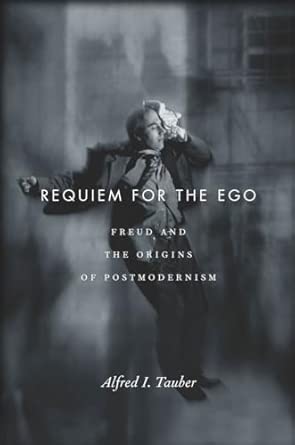
Requiem for the Ego: Freud and the Origins of Postmodernism
Author(s): Alfred I. Tauber (Author)
- Publisher: Stanford University Press
- Publication Date: 18 Sept. 2013
- Edition: 1st
- Language: English
- Print length: 328 pages
- ISBN-10: 0804787441
- ISBN-13: 9780804787444
Book Description
Requiem for the Ego recounts Freud's last great attempt to 'save' the autonomy of the ego, which drew philosophical criticism from the most prominent philosophers of the period―Adorno, Heidegger, and Wittgenstein. Despite their divergent orientations, each contested the ego's capacity to represent mental states through word and symbol to an agent surveying its own cognizance. By discarding the subject-object divide as a model of the mind, they dethroned Freud's depiction of the ego as a conceit of a misleading self-consciousness and a faulty metaphysics. Freud's inquisitors, while employing divergent arguments, found unacknowledged consensus in identifying the core philosophical challenges of defining agency and describing subjectivity. In Requiem, Tauber uniquely synthesizes these philosophical attacks against psychoanalysis and, more generally, provides a kaleidoscopic portrait of the major developments in mid-20th century philosophy that prepared the conceptual grounding for postmodernism.
Editorial Reviews
Review
"This is an important book in the philosophy of science, but it is also an important critique of the history of 20th century philosophy and its relationship to psychology. The blurred lines are here clarified and the denial on the part of philosophy that it was and is in a dialogue with psychology is laid to rest for once and for all."―Sander Gilman, Emory University
"[T]he chief value of [
Requiem for the Ego] . . . is to create a basis for now reconsidering Freud's intellectual accomplishments, as well as the enduring elements of the Enlightenment that may yet prove useful in an era of postmodernism. This book reanimates part of this hidden conversation, without either predictions or prescriptions. Summing up: Recommended."―D.W. Sullivan, CHOICEAbout the Author
Excerpt. © Reprinted by permission. All rights reserved.
REQUIEM for the EGO
Freud and the Origins of Postmodernism
By ALFRED I. TAUBER
Stanford University Press
Copyright © 2013 Board of Trustees of the Leland Stanford Junior University
All rights reserved.
ISBN: 978-0-8047-8744-4
Contents
Preface....................................................................xiAcknowledgments............................................................xviiIntroduction...............................................................11. The Psychoanalytic Ego..................................................242. Prospects of Enlightenment..............................................513. Adorno: Reconceiving the Ego............................................704. Heidegger's Confrontation...............................................875. Lacan's "Return to Freud"...............................................1116. The Désirants: Whither the Ego?.........................................1357. Wittgenstein and the Quandary of Private Language.......................166Conclusion: Reason and Its Discontents.....................................191Notes......................................................................209References.................................................................265Index......................................................................297
CHAPTER 1
The Psychoanalytic Ego
In the final analysis, in its transcendent constructions and its bestphenomenological texts, Freudianism holds deep within it what ourera most lacks. That is undoubtedly the reason—despite its theoreticaluncertainties, contradictions, even absurdities—for its strange success.Psychoanalysis therefore does not belong to the body of the sciencesof man to which it is now attached and from which it will here becarefully dissociated. It is rather, the antithesis of those sciences.—MICHEL HENRY, The Genealogy of Psychoanalysis
Freud conceived a conscious (rational) ego, beyond its outwardengagement with the world at large, as an inward-peering agentexamining a mysterious unconscious. Thus, the mental consists ofan aggregate of conscious and unconscious faculties, of which thelatter dominates, at least in regard to establishing intentionality.Consciousness, the medium by which the ego intuits the unconsciousand "knows" itself, serves as a monitoring system of choiceand action—both conscious and unconscious. As such, the self-consciousI (that which is designated the seat of consciousness)observes (evaluates, assesses) the unconscious other, which in exercisingits own behavior is judged (again, in the Freudian therapeuticcontext of neurosis) as failing rational rules as it follows an agendaunbounded by time or logic. Reason then becomes the ego's facultythat would control the unconscious, but within this constructa fault line appears, and it grows as Freud further developed histheory: Because no neat division between an ego-consciousnessand an unruly and hidden unconscious exists in Freud's maturetheory (Freud 1923a; Tauber 2013), identity becomes a question.To the extent that an other is sought, an ego must relate to someprimordial thing—perhaps an intimate other, but nevertheless notthe self-conscious me yet mine. This problematic "presence" posesthe fundamental Freudian question: "Who, then, is this other towhom I am more attached than to myself, since, at the heart of theassent to my identity, it is still he who agitates me?" (Lacan 2001,p. 130; 2006, p. 436). To address that question, Freud sought todecipher the doppelgänger accompanying the conscious self with aphilosophy of mind, which fulfilled his commitment to a therapeuticscience. That strategy imposed restrictions that he could not predict,or at least he chose to ignore. Unpacking Freud's philosophyof mind illuminates the conceptual infrastructure of his theory andthe tensions within it, of which the most prominent is the problemof representing the unconscious in language alien to its own Logos.
I
To create the odd mosaic of psychoanalytic theory and practice,Freud extrapolated from fundamental tenets of physical science toconstruct the cardinal precept of mental activity: An uninterruptedstream of cause and effect governs all mental functions. While consciousnessexhibits apparent gaps in its sequence of events, Freudspeculated that unconscious causation accounted for these gaps,which was revealed once repression yielded to analytic interpretation.However, since the unconscious mind as he interpreted itsmanifestations did not correspond to the laws of logic and naturalorder found in physical phenomena, how might those mental eventsbe understood in terms of the normative structure seemingly beheldin the world at large? In other words, Freud's theory required thatthe logic he discerned in rational thought (so applicable to observednatural phenomena) also be applied to study unconscious thought.In many ways this was a naïve assumption.
The philosophical genesis of Freud's psychoanalytic theory originateswith Kant's representational conception of mind. As arguedelsewhere (Tauber 2009a, 2010), Freud was in several importantrespects a Kantian, albeit a particular kind of neo-Kantian. In somesense this allegiance is unexpected, given Freud's naturalism andhis positivist aspirations, but consistency is not at issue; an accuratephilosophical description is. To place Freud within this Kantianuniverse reveals important insights into both the particulars ofFreudianism and, directly pertinent to our theme, the later philosophicalcriticism directed against Kant's epistemology that sweptFreudianism along its torrential path.
According to Kant, the human mental structure organizesknowledge of the world, and for that matter our own thought, byits innate cognitive character. He posited the necessary a priorirequirements for human cognition, which included space, time,causality, number, and so forth, as transcendental characteristics(necessary conditions) of the mind, which configure reality throughsuch mental categories. Thus, the noumenon, the thing-in-itself,could not be known as such, that is, unmediated by mental processing.And because Kant's antirealist epistemology asserts thatthe thing-in-itself cannot be known in a first-order way, reality isconstructed (Tauber 2009c) with certain architectonics establishedby a point of view with embedded a priori forms of reason. Theentire enterprise rests on a fundamental separation of self from theworld, and thus a representation or picture of the world is requiredto depict reality—what is known requires a re-presentation to asubject. Thus, the rational faculty, both autonomous and self-critical,serves as the linchpin of Kant's epistemology.
Because all mental activity is mediated as representations, thereis no immediate knowledge of the world. That construction isdetermined not only by the innate cognitive structure of the mindas a perceptive organ but also by social (learned) forms of knowledgethat are framed by linguistic constraints, cultural-historicalparameters, political ideologies, and so on. Once integrated, thesevarious modes of knowing present a particularized picture of theworld and oneself in it. Freud inherited this philosophical understandingand built upon its basic postulates.
According to this Kantian formulation, even knowledge of theself is a representation (e.g., Damasio 1994; Metzinger 2003, 2009).As the subject of experience (as opposed to a Cartesian entity), theself upon its own scrutiny becomes a natural object, and, as such, itis perceived as a phenomenon through sensory faculties organizedby the a priori categories of knowing (e.g., time, number, causality):"I represent myself to myself neither as I am nor as I appear tomyself, but rather I think myself only as I do every object in generalfrom whose kind of intuition I abstract" (Kant 1998 [B 429], p.456). And thus the self-reflexive ego is subject to the same epistemologicalstructure of all knowing: Because the world is not a given,the Kantian ego essentially becomes a representational function orlogical power, one that also becomes a representational relation toitself (a being that possesses only a "self-relation" to itself). Notethat "the transition from a subject of representing to the nominalizedI [the ego] is ... made by the notion of self-reflexivity ... [and]Kant always identifies I-ness with self-reflexivity" (Frank 1997, p.11). So the locution "I think"—from Leibniz to Kant—holds twomeanings: (1) self-reflection of consciousness, that is, self-consciousness;and (2) the representing function of something, that is,perceptual object(s). And here, the nature of Freud's philosophicalconstruction clearly appears as a representational model of mind.
Freud characterized consciousness as a "sense organ for the perceptionof psychical qualities" (1900, p. 615). So the presentationof the unconscious to the conscious sensory faculty (albeit throughcomplex pathways) comprised a metaphorical extension of thebrain's general perceptive qualities (Natsoulas 1984, 1985, 2001),namely, all conscious items are ultimately sensations or associatedwith sensations, and thoughts enter consciousness by "parasitizingsensation" (D. Smith 1999b, p. 417). Simply, the unconscious wouldbe perceived as the ego perceives the external world. However, giventhat the unconscious is not governed by conscious time or causality,how then would this ontologically separated domain register inthe realm of representations? Freud responded to this challenge byclosely following Kantian epistemological principles.
Psychoanalytic theory rests on accepting that the unconsciouscannot be directly known, inasmuch as it follows its own "laws"of cause and temporality and thus, at least from Freud's perspective,fulfills the criteria of a noumenon. Freud treated it as such andreferred to the noumenal character of the unconscious from at least1910, through the metapsychology period (1915b, p. 171; Eriksson2012), until his last writings:
In our science as in the others the problem is the same: behind theattributes (qualities) of the object under examination [the unconscious]which are presented directly to our perception, we have to discoversomething else which is more independent of the particular receptivecapacity of our sense organs and which approximates more closely towhat may be supposed to be the real state of affairs. We have no hopeof being able to reach the latter itself, since it is evident that everythingnew that we have inferred must nevertheless be translated back into thelanguage of our perceptions, from which it is simply impossible for usto free ourselves. But herein lies the very nature and limitation of ourscience.... Reality will always remain "unknowable." (Freud 1940,p.196; emphasis added)
Thus for Freud, the unconscious would be perceived, like nature,indirectly, as a representation—a phenomena recognized by themind's organizing faculties. This capacity assembles perceptionsand synthesizes them through an interpretive function residingin reason. Accordingly, Freud invented a "language of ourperceptions" (i.e., a system of representations) to capturephenomena just as a physicist portrays natural forces.
Freud, following Kant, conceived reality as a product ofmind and nature, for given the constitutive role of the mind increating any knowledge of nature, a cognitive construction ofreality, employing representations, must occur. Truth then is thecorrespondence between those representations and nature. In otherwords, the normative structure of the mind allows an accurate mapto be drawn of reality, which for Freud includes the reality of innermental states as well. So what Kant devised as a philosophy tostudy nature, Freud applied to the psyche; however, whereas Kantdevised a philosophy to ground science and objective truth, Freudrevised notions of human reality, radically. Indeed, psychoanalysismakes a unique contribution to the notion of reality by posing itas obstacle to fantasy and wish, the object of desire (Henry 1993,p. 392; Cousins 2005). And here the psychic calculus becomesoperative, one in which a Janus-like ego peering simultaneouslyinward and outward to satisfy its mandate, mediates reality in twosenses: (1) the traditional facilitation of fulfilling psychic desire; and(2) mediation by defining that reality, which in the psychoanalyticuniverse is the world of possibilities—objects of desire, targets offantasy, opportunities for gratification. Thus, the real is determinedby the meeting of mind with its intentional object, or in the termsof psychoanalysis, fantasy. "Success," at least from this point ofview, is the (maximal) fulfillment of desire in the encounter, and"failure" becomes its frustration. In either case, the real consists ofthe mental and its other, locked together.
Integration of unconscious states sets the ego's vision of theworld, and as libidinal forces find their intentional objects, fantasyand its object meet. But that other holds no final subjective-free status,because the other is conceived and then refracted through thepsychic lens directed (intended) by wish, and then the object transmutesinto various derivative representations. The cathexis maybe attached either to an inner ego object (narcissistic investment)or to an external object of desire: The subjective object, of course,remains resolutely nonobjectified; and the external object itself isalso conceived with heavy emotive components. Consequently, adistinct line between fantasy and the real cannot be drawn, for themind's intention, according to Freudian theory, constructs its realitythrough its own emotional structures and affective requirements.If fantasy dominates, the primary narcissism of the subject thenmust struggle in its rejection of the stimuli of the outside world,or, alternatively, desire seeks its object and reality becomes the sitefor its gratification. Thus, reality emerges as a negotiation betweenfantasy and its obstacle to become an achievement of sorts. Theunconscious—whether lodged in the ego or the id (Freud 1923a)—alienatesthe subject from full acceptance of external reality so thatultimately the subject is the battleground over which reality andfantasy lay their respective claims. In short, the world—the psychicworld—is a reality organized by the mind's intentional desire,mediated by a complex normative rationality coupled to psychicdrives ("emo-reason") and largely perceived subconsciously. Theconscious picture of reality is thus only a superficial gloss of adeeper dynamic.
II
As discussed, Freud's basic philosophical move treats unconsciousideas as objects of scrutiny, albeit mental objects, whichcould be represented by the conscious mind. In other words, heassumed mental states have the same basic epistemological standingof entities and processes found in nature, and so to establish hisscience of the mind, he would apply the same principles establishedfor the scientific study of nature to the unconscious mental life ofhumans. That crucial extrapolation rests on an implicit commitmentto a representational epistemology, whereby the world is trulyknown because of the correspondence of our mental picture or representationsof that world with the world itself. In other words, ourminds mirror reality through the representations we employ (Rorty1979). When Freud modeled the mind, albeit with novel interpretivemethods, he confidently proceeded as if the correspondence of thatrepresentational strategy employed to study exterior nature wouldalso hold for his studies of the psyche.
Freud went to great lengths to show how the dynamics of theunconscious differs from those governing the conscious ego (i.e.,the lack of intelligible notions of time and space; the seeming arationalityand amorality of dreams; the inscrutable disjunctions ofsequences that pass for loss of causality); nevertheless, in the keymetapsychological paper "The Unconscious," he declares thatdespite all distortions relative to reasoned thought, unconsciousdynamics would be treated in the same terms one characterizesconscious thought: "All the categories which we employ to describeconscious mental acts, such as ideas, purposes, resolutions, and soon, can be applied to them [unconscious latent states]" (1915b, p.168). In other words, he made the unconscious discernible in thesame terms used to describe consciousness and thereby claimedan objective status for mental states. So despite the hermeneuticalconnotations of "interpretation," Freud relentlessly presentedhis project as a science, namely, an analysis that objectified unconsciousmotivations and uncovered hidden meanings. And with thiscommitment to positivism, Freud devised a representational language,the métier of science, to "capture" the phenomena: "Thuswe shall not hesitate to treat them [unconscious latent states] asobjects of psychological research, and to deal with them in the mostintimate connection with conscious mental acts" (ibid.; emphasisadded). Let us unpack these assertions.
Conceiving unconsciousness in the semantic tradition firmlyplaces the representations of unconscious drives as ways of thinkingabout them. Indeed, Freud (1915a) recognized that the drives themselvesare never represented as such but appear in the psyche as ideasto which the drives attach themselves. In "The Unconscious," Freudexplicitly addresses the relationship of language (representations)with the unconscious object, where he asserted that the "thing-presentation"cannot become conscious until associated with words,and this step occurs in the preconscious (not the unconscious,which knows no language as such). At the interface of consciousand unconscious mental life, this associative locale, where unconsciousobjects or drives become associated with language, providesthe key link between the sectors of the psyche to offer the coherencerequired for normal mentation.
(Continues...)Excerpted from REQUIEM for the EGO by ALFRED I. TAUBER. Copyright © 2013 Board of Trustees of the Leland Stanford Junior University. Excerpted by permission of Stanford University Press.
All rights reserved. No part of this excerpt may be reproduced or reprinted without permission in writing from the publisher.
Excerpts are provided by Dial-A-Book Inc. solely for the personal use of visitors to this web site.


