Wow! eBook
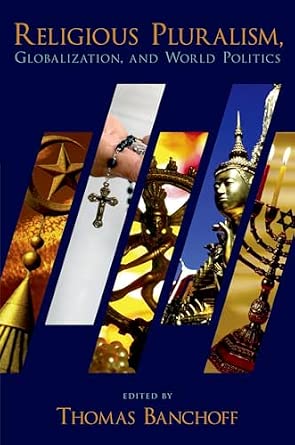
Religious Pluralism, Globalization, and World Politics
Author(s): Thomas F. Banchoff
- Publisher: Oxford University Press
- Publication Date: 26 Nov. 2008
- Language: English
- Print length: 360 pages
- ISBN-10: 0195323416
- ISBN-13: 9780195323412
Book Description
Work on culture and globalization tends to focus on dynamics of reaction or resistance. Religion generally figures as a defensive response to economic and cultural globalization, a way to assert local identities against the international. The book will highlight another dimension of religion and globalization ― the reconstitution of religious communities as transnational actors. Over the past two decades, global migration patterns and modern communicationstechnologies have spawned more active transnational religious communities, creating a powerful force in world politics. In the case of Islam, for example, Satellite TV, the Internet, and the post 9/11 international context have reinforced the idea of the umma, a transnational Muslim community. All threeAbrahamic faiths have always had global identities anchored in faith in one God and universal truth claims. But globalization is driving them ― and other leading traditions, including Hinduism and Buddhism ― to rethink their world-roles in new ways. Yet the international dimensions of religious pluralism have been virtually ignored by scholars. This new religious pluralism is marked by both interreligious cooperation and conflict. Global religious identities have encouraged interreligiousdialogue and greater religious engagement around questions including international development, conflict resolution, transitional justice, and bioethics. At the same time, more intense interreligious competition has contributed to controversy over the meaning and scope of religious freedom ― aninternational norm increasingly prominent in US foreign policy. The book will explore both these dimensions of the new religious pluralism in world politics from a variety of disciplinary perspectives. Among the many distinguished contributors to the volume are Kwame Anthony Appiah, R. Scott Appleby, Robert Drinan, Jean Bethke Elshtain, John Voll, and John Witte. This volume should appeal to scholars and policymakers, as well as being useful for courses in religion and politics andinternational relations.