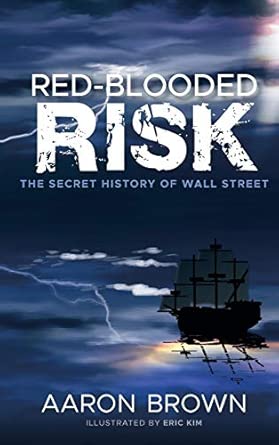
“Wickedly original, one of the most fascinating accounts I have ever seen. A rollicking and highly opinionated read.” (Risk Professional, October 2011)
“No one who reads Red-Blooded Risk: The Secret History of Wall Street will ever again regard risk management as a necessary but unproductive appendage of the financial industry. Other authors have chronicled how quantitative finance influenced investment management, but Aaron Brown has made a compelling case for a far more profound economic impact. . . If Red-Blooded Risk: The Secret History of Wall Street dealt with nothing more than the inadequacy of models used in highly important activities, it would represent a valuable contribution to financial economics. Brown’s book, however, covers a great deal more than econometric malpractice. Probably no other book offers as much insight into the process with so little resort to mathematical notation. Especially valuable are Brown’s discussions of middle-office risk management and value at risk, comparatively recent innovations that are essential to understanding modern financial institutions. Readers of Red-Blooded Risk should be prepared to have many of their assumptions challenged. Red-Blooded Risk is one of the most original and thought-provoking books reviewed in these pages in the past 20 years. No one who reads it will ever again regard risk management as a necessary but unproductive appendage of the financial industry. Other authors have chronicled how quantitative finance influenced investment management, but Aaron Brown has made a compelling case for a far more profound economic impact.”
―Martin S. Fridson, CFA Institute Publications Book Reviews
“Red-Blooded Risk mixes risk history and philosophy nimbly and provides a perspective that can be both refreshing and challenging (often on the same page). While the book is not without weaknesses, it is also brimming with original perspectives and controversial opinions. Those who work in risk management or quantitative finance will enjoy Brown’s story-telling and expert perspectives, even if they do not share his views, while non-quants will find his insights and confessions to be a useful glimpse into the psyche and ethos of an influential group of early quantitative risk takers.
―Roger M. Stein, Research and Academic Relations, Moody’s Corporation, as reviewed in Quantitative Finance (August 6, 2012)
Everyone talks about risk, but few people give serious thought to what risk is. It’s hard to describe it without expressing an opinionwe like things that are innovative, daring, creative, and bold; but those are exactly the same things that are reckless, speculative, risky, and irresponsible.
This book is the story of a group of young math whizzes who unleashed a revolutionone that reshaped our financial system and continues to echo through the halls of government, universities, and corporations today. In the 1970s, disillusioned with the sorry state of quantitative analysis, these young mathematicians (soon to be known as “quants”) invented a new way of looking at probability and set out to prove it in the ultimate testing ground of odds-making: Las Vegas.
Once there, the quants turned conventional wisdom about gambling on its head. People said you can’t beat the house, yet the quants managed to beat blackjack and other casino games. People said you needed a lifetime to learn poker, yet the quants’ aggressive mathematical tactics swept the table against the best players in the world. Then the quants turned to sports betting, overturning the business model and squeezing out local bookies with a global organization that matched bets without taking risk.
Armed with their theories and experience, the quants raised their sights and headed to Wall Street, determined to replicate their success. Finance was a tougher challenge than gambling, but by the mid-1990s, the quants had remade Wall Street as thoroughly as they had remade Las Vegas. That transformation went unnoticed by the bond salesmen and investment bankers who ran Wall Street, as well as by academics, regulators, journalists, and investors; yet these changes caused both the greatest wealth creation event in the history of the world, and the financial disasters we have witnessed in its wake.
There’s more here than just a lesson in recent financial history, however. Brown’s story goes beyond the headlines to explore basic questions of economics, like the meaning of property and the nature of exchange. Along the way, it reveals secrets about the building of the pyramids, the glory of ancient Athens, the force that built the Roman Empire, a world-changing invention from medieval Italy, a secret in a mysterious letter written in 1654 and not decoded until the 1990s, and an essential aspect of the American Revolution left out of history books.
This book will change the way you think about everything from history, risk, and money to vampires, zombies, and tulips. It offers a fascinating and thrilling account of great events that have never before been described in an easily accessible form. There are bold ideas, colorful characters, and, most important, the keys to understanding the modern financial world and how its inner workings affect our daily lives.
From the Back Cover
Everyone talks about risk, but few people give serious thought to what risk is. It’s hard to describe it without expressing an opinion we like things that are innovative, daring, creative, and bold; but those are exactly the same things that are reckless, speculative, risky, and irresponsible.
This book is the story of a group of young math whizzes who unleashed a revolution one that reshaped our financial system and continues to echo through the halls of government, universities, and corporations today. In the 1970s, disillusioned with the sorry state of quantitative analysis, these young mathematicians (soon to be known as “quants”) invented a new way of looking at probability and set out to prove it in the ultimate testing ground of odds-making: Las Vegas.
Once there, the quants turned conventional wisdom about gambling on its head. People said you can’t beat the house, yet the quants managed to beat blackjack and other casino games. People said you needed a lifetime to learn poker, yet the quants’ aggressive mathematical tactics swept the table against the best players in the world. Then the quants turned to sports betting, overturning the business model and squeezing out local bookies with a global organization that matched bets without taking risk.
Armed with their theories and experience, the quants raised their sights and headed to Wall Street, determined to replicate their success. Finance was a tougher challenge than gambling, but by the mid-1990s, the quants had remade Wall Street as thoroughly as they had remade Las Vegas. That transformation went unnoticed by the bond salesmen and investment bankers who ran Wall Street, as well as by academics, regulators, journalists, and investors; yet these changes caused both the greatest wealth creation event in the history of the world, and the financial disasters we have witnessed in its wake.
There’s more here than just a lesson in recent financial history, however. Brown’s story goes beyond the headlines to explore basic questions of economics, like the meaning of property and the nature of exchange. Along the way, it reveals secrets about the building of the pyramids, the glory of ancient Athens, the force that built the Roman Empire, a world-changing invention from medieval Italy, a secret in a mysterious letter written in 1654 and not decoded until the 1990s, and an essential aspect of the American Revolution left out of history books.
This book will change the way you think about everything from history, risk, and money to vampires, zombies, and tulips. It offers a fascinating and thrilling account of great events that have never before been described in an easily accessible form. There are bold ideas, colorful characters, and, most important, the keys to understanding the modern financial world and how its inner workings affect our daily lives.
About the Author
AARON BROWN is risk manager at AQR Capital Management and the author of The Poker Face of Wall Street (Wiley), selected one of the ten best books of 2006 by BusinessWeek, and A World of Chance with Reuven and Gabrielle Brenner. In his thirty-year Wall Street career, he has been a trader, portfolio manager, head of mortgage securities, and risk manager for institutions including Citigroup and Morgan Stanley. He also served a stint as a finance professor and was among the top poker players in the world during the 1970s and 1980s. He holds degrees in applied mathematics from Harvard and in finance and statistics from the University of Chicago.
 Wow! eBook