Wow! eBook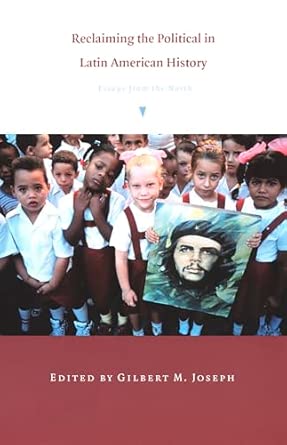
Reclaiming the Political in Latin American History: Essays from the North
Author(s): Gilbert M. Joseph
- Publisher: Duke University Press
- Publication Date: 25 Dec. 2001
- Language: English
- Print length: 400 pages
- ISBN-10: 0822327791
- ISBN-13: 9780822327790
Book Description
Taking careful stock of the state of historical writing on Latin America, the volume delineates current historiographical frontiers and suggests a series of new approaches that focus on several pivotal themes: the construction of historical narratives and memory; the articulation of class, race, gender, sexuality, and generation; and the historian’s involvement in the making of history. Although the book represents a view of the Latin American political that comes primarily from the North, the influence of Viotti da Costa powerfully marks the contributors’ engagement with Latin America’s past. Featuring a keynote essay by Viotti da Costa herself, the volume’s lively North-South encounter embodies incipient trends of hemispheric intellectual convergence.
Contributors. Jeffrey L. Gould, Greg Grandin, Daniel James, Gilbert M. Joseph, Thomas Miller Klubock, Mary Ann Mahony, Florencia E. Mallon, Diana Paton, Steve J. Stern, Heidi Tinsman, Emilia Viotti da Costa, Barbara Weinstein
Editorial Reviews
Review
“The magnificence of this volume lies in Viotti da Costa’s plea for political engagement and intellectual integrity, as well as in the superb scholarship that rises to her challenge. This book will inspire a new generation of scholars and teachers of Latin American history to reengage their work and lives in the new politics and political issues bubbling up around the edges of the neoliberal order of global capitalism.”–Brooke Larson, author of
Cochabamba, 1550-1900: Colonialism and Agrarian Transformation in BoliviaFrom the Back Cover
About the Author
Gilbert M. Joseph is Farnam Professor of History and Director of Latin American and Iberian Studies at Yale University and Editor of the Hispanic American Historical Review. Most recently he has coedited Close Encounters of Empire: Writing the Cultural History of U.S.–Latin American Relations and Fragments of a Golden Age: The Politics of Culture in Mexico Since 1940, also published by Duke University Press.
Excerpt. © Reprinted by permission. All rights reserved.
Reclaiming the Political in Latin American History
ESSAYS FROM THE NORTH
Duke University Press
Copyright © 2001 Duke University Press
All right reserved.
ISBN: 978-0-8223-2779-0
Contents
Acknowledgments…………………………………………………………………………………………………………………………………………………………….viiGilbert M. Joseph, Reclaiming “the Political” at the Turn of the Millennium……………………………………………………………………………………………………….3Emilia Viotti da Costa, New Publics, New Politics, New Histories: From Economic Reductionism to Cultural Reductionism-in Search of Dialectics…………………………………………….17Steve J. Stern, Between Tragedy and Promise: The Politics of Writing Latin American History in the Late Twentieth Century………………………………………………………………32Barbara Weinstein, The Decline of the Progressive Planter and the Rise of Subaltern Agency: Shifting Narratives of Slave Emancipation in Brazil…………………………………………..81Mary Ann Mahony, A Past to Do Justice to the Present: Collective Memory, Historical Representation, and Rule in Bahia’s Cacao Area………………………………………………………102Jerey L. Gould, Revolutionary Nationalism and Local Memories in El Salvador……………………………………………………………………………………………………….138Diana Paton, The Flight from the Fields Reconsidered: Gender Ideologies and Women’s Labor After Slavery in Jamaica…………………………………………………………………….175Greg Grandin, A More Onerous Citizenship: Illness, Race, and Nation in Republican Guatemala…………………………………………………………………………………………205Thomas Miller Klubock, Nationalism, Race, and the Politics of Imperialism: Workers and North American Capital in the Chilean Copper Industry……………………………………………..231Heidi Tinsman, Good Wives, Bad Girls, and Unfaithful Men: Sexual Negotiation and Labor Struggle in Chile’s Agrarian Reform, 1964-73…………………268Florencia E. Mallon, Bearing Witness in Hard Times: Ethnography and Testimonio in a Postrevolutionary Age…………………………………………………………………………….311Daniel James, Afterword: A Final Reflection on the Political…………………………………………………………………………………………………………………….355Contributors……………………………………………………………………………………………………………………………………………………………….365Index……………………………………………………………………………………………………………………………………………………………………..367
Chapter One
The Politics of Writing Latin American History
Gilbert M. Joseph
Reclaiming “the Political” at the Turn of the Millennium
These are unsettled times for historians of Latin America. As the region enters a new millennium in the viselike grip of neoliberalism-a global project which in the name of “flexible” economic choices, “democratization,” and the “rights” of individual investors implements policies that sow insecurity and promote the methodical destruction of collective structures, habits, and forms of sociability-there are few inspirational paradigms for connecting scholarship to action. Indeed, many lament that the state of historical scholarship, teaching, and “the profession” itself has never been more disoriented, fragmented, and contentious (though it is perhaps comforting to know that Alphonse de Lamartine engaged in similar lamentations regarding intellectual life in nineteenth-century France!). We have witnessed the explosion of once-comforting master narratives and have heard celebratory proclamations about the end of ideology and history itself. Recently we have also observed esteemed colleagues on the Left protest “identity politics,” “political correctness,” and the “trivialization” of the research enterprise, bitterly attacking new trends in cultural history and area studies, their voices now barely distinguishable from more-traditional opponents on the Right. Some of these colleagues have gone on to establish a new “Historical Society” to further their pursuit of “objective reality” based upon verifiable hypotheses. Unfortunately, however, much of the “newer” social and cultural history also defangs or expunges the political, fetishizing “experience,” “mentality,” or “identity,” reveling in the “unfixity” of meanings and dissolving the subject and ultimately nullifying agency. Alternatively, others of its practitioners have sentimentalized “resistance” and “agency,” seeing it everywhere and thereby diluting political analysis to the point of irrelevance.
It seems entirely appropriate at this critical juncture, then, to rethink, remake, or reclaim the political in our work-in the sense of elaborating richer, more sophisticated approaches to politics and broader arenas of power. After all, there has never been an abandonment of politics within the historical profession: this is true at the most prosaic level in terms of the continued study of conventional politics, war, and diplomacy among North American historians of both the United States and Latin America. Moreover, politics-and political power-has never been underemphasized in the Latin American context. Historian and political scientist Peter Smith has observed that whereas many North Americans might turn away from politics as an act of rejection based on the assumed “ineffectiveness,” “irrelevance,” or immorality of politics, Latin Americans have no such luxury. The stakes are too high; the conflicts too real. Politics and political action are crucial determinants of everyday existence. Politics entails more than style, image or nuance: “It can be, quite literally, a matter of life and death.”
It is no doubt for this reason that most Latin American scholars did not blithely follow the North American academy down the fashionable road toward social history (and away from political history) in the 1960s and ’70s-or toward cultural studies and postmodernism in the 1980s and ’90s. Fifteen years ago, Brazilian historian Emilia Viotti da Costa pointed out that the “new history” of “experience” and “mentalities” carried with it a serious risk. It gave us “a fragmented picture of … society and often made us lose sight of the interconnections among economic, social, political and ideological institutions and structures.” Viotti da Costa wrote: “In modern societies, even more than in the past, politics is at the center of human life. This centrality of politics is a result of both the incorporation of increasing numbers of people into the market economy and the overwhelming presence of the state in the lives of people. As a consequence of these two processes, which are intimately related, political decisions have come to affect economic and social life in ways never seen before. The life of a peasant in some lost village in the backland, the labor conditions of a worker in a factory, a woman’s status in a society, the opportunities denied or opened to a black person-all depend not only on their own struggle or on the cold logic of the market, but also on decisions taken by those in power…. It is impossible to understand the history of the powerless without understanding the powerful. History from the bottom up can be as meaningless as history from the top down.”
The present volume, composed of original essays by Viotti da Costa and several generations of her North American students, embraces the challenge of writing a social and cultural history of Latin America that is not divorced from power and the political. It is inspired by her belief that we as historians, our scholarship, and our teaching are powerfully shaped by (and involved in the shaping of) political contexts, structures, and forces. The challenge, therefore, is not to retreat back to a more conventional, bounded political history and claim a piece of it; it is, rather, to revisit the political-both as a theme of historical analysis and as a stance for historical practice-and to inquire, to what extent has the political undergone an important transformation as we enter the new millennium? We also need to ask, as Steve Stern does in his essay, “How do we specify the new demands placed by historical and intellectual experience upon the politics of writing and teaching Latin American history?”
In their attempts to contribute to that enterprise, the volume’s authors explore some of the strategic realms in which the political might be studied, as well as the new theoretical and methodological tools that might be employed. In a pair of broad-ranging essays in the book’s first section, “The Politics of Writing Latin American History,” Viotti da Costa and Stern examine how the political has continually been remade in the North since the 1960s, and they present somewhat different views on what the future of “the political” should look like. Viotti da Costa’s contribution, the reworking of an essay criticizing many of the postmodern and poststructuralist trends in recent historiography, is a revealing point of departure for the essays of her students, several of whom, such as Stern and Florencia Mallon, have been leaders in the selective application of recent “posts” and “turns” to Latin American history.
The essays in the second part of the volume-by Barbara Weinstein, Mary Ann Mahony, and Jerey Gould-address how pivotal dimensions of the Brazilian and Central American past are remembered. Sifting through the sedimentation of local and national historiographies, scrutinizing an array of primary documentation and oral testimony, and in Mahony’s case, also exploring local archaeological remains, these authors wrestle with how historical narratives of slavery and emancipation, modernization and backwardness, ethno-racial and national identity-and collective memory itself-are politically mediated, contested, invented, and reinvented.
In part 3, the largest and most diverse section of the book, four younger scholars provide fine-grained studies of how politics (and an expanded notion of the political) informs and intersects with constructions of class, race and ethnicity, gender and sexuality, generation, disease, and the nation in nineteenth-century Jamaica and Guatemala and twentieth-century Chile. These case studies explore new theoretical concepts and methods, and reexamine a variety of conventional wisdoms. Diana Paton contributes an essay in subaltern history as she attempts, on the basis of elite documentation and the fragmentary, state-mediated testimonies of freed black slaves, to explain why former slave women refused to work in Jamaican plantation fields after 1837. Greg Grandin follows with an exploration of disease as an elite metaphor for indigenous society and national backwardness in nineteenth-century Guatemala, which he then relates to the trope of anticommunism in the twentieth century-a discourse which would be used to justify the massacring of 200,000 Mayans during the civil war of the late 1970s and ’80s. Thomas Klubock revisits his earlier research on Chilean copper miners, but this time to examine the role of race and ethnicity, not gender, in connection with nationalist ideologies, class politics, and strategies of social control employed by North American corporate capital. Heidi Tinsman uses both gender and generation to analyze the differential effects of agrarian reform on married women and teen-age girls; in the process, she tells us a great deal about the role that notions of masculinity and sexuality played in Salvador Allende’s attempted socialist transition in Chile. Each author demonstrates that the identities of historical actors are multiple, overlapping, and often contradictory-never static or dichotomous. Thus, race, ethnicity, or sexuality is not the same for men and women, and class, contrary to earlier formulations, does not eliminate ethno-racial, gendered, or generational identities, though it may speak through them with important consequences for collective political action.
In the book’s concluding section, “Historians and the Making of History,” Florencia Mallon examines the everyday political linkages between intellectuals and subaltern groups. She not only focuses on the historical role of local “organic intellectuals” in Chilean indigenous (Mapuche) society, but also explores the evolution of her own interactive and often problematic relationships with the subjects of these communities and with their struggles-past, present, and future. In this essay, we are provided with a bittersweet meditation on the promise and pitfalls of ethnographic and testimonial strategies as the historian attempts to “bear witness in hard [post-revolutionary] times.” In the tradition of her other recent writings, Mallon candidly ponders the need to elaborate different narrative strategies, analytical categories, and modes of argumentation in order to write a multidimensional history of subordinate groups in societies and contexts that no longer rivet the world’s attention. Her ruminations on the complex relationships between historical research, historical memory, and current politics, both collective and personal, synthesize a number of the collection’s crosscutting themes. The volume concludes with a final reflection by Daniel James, Viotti da Costa’s longtime colleague, which locates the significance of these new readings of the political dimension of Latin America’s past in a celebration of her most important work.
A few observations are in order about the goals and parameters of this volume. It seeks to pose timely responses to some of the larger questions currently preoccupying Latin Americanists and scholars in other fields and disciplines, namely: How does politics, broadly construed, articulate with other variables and categories of analysis? How is the political realm mediated through historical memory? And how does a political sensibility influence the writing and teaching we do, and the roles we play in the academy and society? In this sense, the book is meant to stimulate discussion and debate, rather than resolve current disputes. In discussing generational remakings of the political in his contribution, Stern suggests that major theoretical advances have come about through what he calls “reverberations”: “imperfect intellectual conversations, echoes, and trackings across research projects and across specialized fields.” These reverberations give rise to “unplanned convergences” and provide an antidote to the scholarly fragmentation so lamented of late. It was in the spirit of fostering such reverberations that Stern and Allen Isaacman launched the collaboration between Latin Americanists and Africanists that yielded the fruitful volume Confronting Historical Paradigms (1993); it was in the same spirit that my three most recent collaborations were born: Everyday Forms of State Formation (1994), which brought together Mexican revolution scholars and social theorists working on Europe and Asia; Close Encounters of Empire (1998), which prodded Latin Americanist historians and anthropologists north and south of the Rio Grande into dialogue with U.S. foreign relations historians to reassess the multistranded engagement of the United States with Latin America; and the recent issue of the Hispanic American Historical Review (1999), on Mexico’s “new cultural history,” which brought poststructural cultural historians into freestyle combat with their more positivistic antagonists. It is our hope that this volume will trigger similarly useful “reverberations.”
If there is a common denominator in the volume’s essays, it is their prescription for a politics of history writing that is integrative. In their synoptic papers, Viotti da Costa and Stern advocate a dynamic approach to political analysis that engages multiple levels of the world system, embraces both the state and its subjects, and understands that political discourses, symbols, and identities are intimately related to social relations, economic processes, and power. Thus, Viotti da Costa calls for “a synthesis that will avoid all forms of reductionism … (whether economic, cultural, or linguistic), that will not lose sight of the articulation between the micro-and macrophysics of power, that will recognize that human subjectivity is at the same time constituted by and constitutive of social realities.” Arguing along roughly similar lines (though somewhat more partial to post-structuralist trends in the “new cultural history”), Stern defends what he sees as a “partial transition”-“more a matter of emphasis than absolute contrast”-from studies of Latin American “politics and society” to studies of “politics and culture.” Whereas the former “placed a premium on the complex interplays of agency and structure within the unfolding political economy of regions,” the latter “asks how people constructed their political imagination within the [power-laden process] of state formation.” Though their emphases differ, both Viotti da Costa and Stern counsel against a celebration of subaltern agency and emancipation that minimizes questions of power, structure, and hegemony. The contributions that follow Viotti da Costa’s and Stern’s keynote essays represent attempts to harness materialist analysis with “the interrogations of consciousness, constructions of political language, meanings, and authority” by both power holders and subordinate groups that Stern sees as emblematic of the best work of the 1990s on politics as cultural formation.
Thus, these essays move us beyond fruitless current debates about whether we should privilege material or cultural analysis-structure or agency-in our work. Such debates have often had divisive consequences and risk setting back certain fields, particularly Latin American labor history, where some influential practitioners adamantly argue the need to study questions of production and the workplace to the virtual exclusion of other sites and dimensions of working-class life. But as theorists such as Fernando Coronil, William Sewell, Ricardo Salvatore, and Bill Roseberry have persuasively shown, “‘political economy’ and ‘culture’ are ambiguous theoretical categories that refer both to concrete social domains and to the abstract dimensions of any social domain. [An exclusive preoccupation with material analysis] entails a neglect not only of domains outside the economy, but also of the cultural dimension of economic processes themselves” (e.g., the meanings that male and female laborers put on the work they do and the goods they produce). Similarly, an exclusive preoccupation with representation and discourse ignores the material underpinnings of cultural practices. Explicitly in the case of Stern’s, Viotti da Costa’s, and Barbara Weinstein’s essays, more implicitly in the volume’s other essays, the contributors take a stand against segregating material and cultural/discursive analysis-a dichotomy that is itself culturally constructed and rife with political meaning and consequence.
(Continues…)
Excerpted from Reclaiming the Political in Latin American History Copyright © 2001 by Duke University Press. Excerpted by permission.
All rights reserved. No part of this excerpt may be reproduced or reprinted without permission in writing from the publisher.
Excerpts are provided by Dial-A-Book Inc. solely for the personal use of visitors to this web site.