 Wow! eBook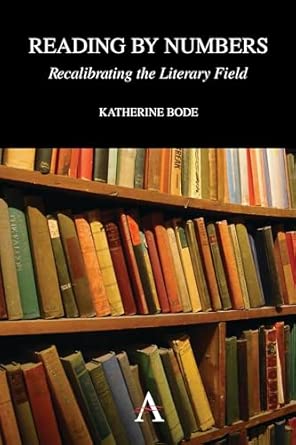
Reading by Numbers: Recalibrating the Literary Field
Author(s): Katherine Bode (Author)
- Publisher: Anthem Press
- Publication Date: 1 July 2012
- Edition: Illustrated
- Language: English
- Print length: 256 pages
- ISBN-10: 0857284541
- ISBN-13: 9780857284549
Book Description
‘Reading by Numbers: Recalibrating the Literary Field’ is the first book to use digital humanities strategies to integrate the scope and methods of book and publishing history with issues and debates in literary studies. By mining, visualising and modelling data from ‘AustLit’ – an online bibliography of Australian literature that leads the world in its comprehensiveness and scope – this study revises established conceptions of Australian literary history, presenting new ways of writing about literature and publishing and a new direction for digital humanities research. The case studies in this book offer insight into a wide range of features of the literary field, including trends and cycles in the gender of novelists, the formation of fictional genres and literary canons, and the relationship of Australian literature to other national literatures.
Editorial Reviews
Review
‘It is not often – or often enough – that one is confronted by a work that has the power to transform a field of study, but this is precisely what Katherine Bode has achieved in her new history of the Australian novel. “Reading by Numbers” is as exciting as it is unsettling and it offers a major intervention in Australian literary history, not least in its power to challenge both sedimented accounts of that history and the methods used to the produce them.’ — Maryanne Dever, ‘Australian Literary Studies’
Review
‘“Reading by Numbers” challenges current practices and theories by drawing on current work in digital humanities and book history to explore a remarkably cohesive digital literary collection. Dr Bode brilliantly demonstrates the power yet contingency and partiality of known methods and theories.’ —Professor Willard McCarty, King’s College London
About the Author
Katherine Bode is Head of the Digital Humanities Hub at the Australian National University, Canberra, Australia.
Excerpt. © Reprinted by permission. All rights reserved.
Reading by Numbers
Recalibrating the Literary Field
By Katherine Bode
Wimbledon Publishing Company
Copyright © 2012 Katherine Bode
All rights reserved.
ISBN: 978-0-85728-454-9
Contents
Acknowledgements, vii,
List of Tables and Figures, ix,
Introduction A New History of the Australian Novel, 1,
Chapter 1 Literary Studies in the Digital Age, 7,
Chapter 2 Beyond the Book: Publishing in the Nineteenth Century, 27,
Chapter 3 Nostalgia and the Novel: Looking Back, Looking Forward, 57,
Chapter 4 Recovering Gender: Rethinking the Nineteenth Century, 105,
Chapter 5 The ‘Rise’ of the Woman Novelist: Popular and Literary Trends, 131,
Conclusion Literary Studies in the Digital Future, 169,
Notes, 175,
Bibliography, 215,
Index, 237,
CHAPTER 1
LITERARY STUDIES IN THE DIGITAL AGE
[T]here is no method, however well adapted to a given science, that literary history can transplant and apply to its own researches. The illusion that this is possible is responsible for much poor and childish work: statistics and charts, evolution of species, and quantitative analysis are processes, methods, and hypotheses excellent in their place, but their place is not literary history.
In the last decade, and especially in the last four or five years, the insistence in this epigraph – that quantitative methods have no place in literary history – has been repeated many times. The fact that this particular passage comes from a book first published in 1922, and intended as a guide for graduate students, should demonstrate that both the application of such methods, and the resistance to them, are of considerably longer standing in debates about literary history than is generally acknowledged. Nonetheless, discussion of quantitative methods has almost certainly never been as heated or as widespread – or as apparent to the majority of literary scholars – as it is today. While there are a number of quantitative approaches to literature, the current debate focuses on Franco Moretti’s work in literary history. As Priya Joshi says, literary scholars have for a long time ‘regarded quantitative analysis with suspicion bordering on contempt’. But in the response to the publication in 2000 of Moretti’s ‘Conjectures on World Literature’, and in 2005 of his book Graphs, Maps, Trees, this contempt has escalated – especially in the American humanities – to an intense stand-off.
The controversy surrounding Moretti’s work is, to a significant extent, specific to it. But this debate also presents important criticisms of quantitative methods that need to be engaged with if such studies are to make a productive contribution to literary history and humanities scholarship generally. This chapter considers three closely related criticisms that have been levelled at quantitative literary research (predominantly at Moretti’s ‘experiments’ in literary history): first, that such approaches reduce the inherent complexity and multiplicity of literature and language to uniform data; second, that quantitative methods make false claims to authoritative and objective knowledge; and finally, that such studies resonate, in problematic and complicit ways, with contemporary institutional discourses, especially neoliberal or economic rationalist managerial practices.
I am not proposing that such criticisms are never applicable to quantitative approaches; like all research practices, these can be applied in varying ways. Nor is this chapter a defence of Moretti’s scholarship. Although his centrality to the debate makes an engagement with his arguments and methods unavoidable – and while I find his work well worth the engagement – some aspects of Moretti’s research justify some of the criticisms that have been made. However, I will argue that reductionism, absolutism and acquiescence to neoliberalism are not intrinsic to quantitative methods. In this chapter I discuss work in book history and the digital humanities that I have found useful in developing my approach to literary historical data. Specifically, I argue that an approach based on book history’s methodological pragmatism regarding the nature and use of data, and the digital humanities’ method of modelling, offers a productive way of integrating empirical data with the paradigm of humanities knowledge as a critical, analytic and speculative process of inquiry. This approach maintains what Donna Haraway calls’ a no-nonsense commitment to a faithful account of the “real” world’, while preserving, in George Levine’s words, ‘a tentativeness that keeps all aspirations to knowledge from becoming aspirations to power as well’.
I Quantitative Method and its Critics
As the criticisms of quantitative approaches to literature are largely directed at Moretti’s work, I will begin with a brief summary of his arguments: both against conventional approaches to literary history and for quantitative methods. For decades, Moretti has argued that a literary history based only on the texts that make up the canon offers no insight into the vast ‘mass’ of literature, and no basis for understanding the causes and processes of literary change. In 1983 he wrote that:
[A]t present, our knowledge of literary history closely resembles the maps of Africa of a century and a half ago: the coastal strips are familiar but an entire continent is unknown. Dazzled by the great estuaries of mythical rivers, when it comes to pinpointing the source we still trust too often to bizarre hypotheses or even to legends.
More recently, Moretti has refined this critique into a specific challenge to the reliance of literary history on detailed textual analysis or ‘close reading’ as the source of historical evidence. He identifies ‘close reading’ – where the ‘representative individual’ defines the ‘whole’, or the ‘one per cent of the canon’ signifies ‘the lost 99 per cent of the archive’ – as a form of ‘topographical thinking’. The main problem with this approach, and the source of what Moretti considers as irrationality, lies in the fact that the ‘rare and … exceptional’ works of the canon are by definition not representative. In taking the canon as its object, literary history fails to consider the ‘banal, everyday, normal’ operations of the literary field and the wider context in which literary change occurs.
For Moretti, the means of overcoming this unrepresentative focus cannot be more reading. The size of the archive renders this potential solution impossible to achieve: even ‘a novel a day every day of the year would take a century or so’ to cover nineteenth-century British fiction. As well as a matter of scale, close reading gives no insight into the workings of the literary system:
[A] field this large cannot be understood by stitching together separate bits of knowledge about individual cases, because it isn’t a sum of individual cases: it’s a collective system, that should be grasped as such, as a whole.
To this end, Moretti offers a paradigm of ‘distant reading’ that deliberately abstracts both the material and textual features of literary works to provide new accounts of literary history based on ‘a specific form of knowledge: fewer elements, hence a sharper sense of their overall interconnection. Shapes, relations, structures. Forms. Models.’ Moretti’s work provides an important statement of the contribution quantitative methods can make to literary history: namely, their potential to represent historical trends and, in so doing, enable a form of analysis that moves beyond the handful of exceptional texts and authors that are repeatedly discussed in literary history. However, and although he is often perceived as such, Moretti is not the only scholar to make these arguments: both his challenge to established practices in literary history and his rationale for quantitative analyses align closely with ideas in book history.
Since the emergence of this interdisciplinary field in the 1980s, book historians have – like Moretti – rejected a canonical approach to literary history and challenged that discipline’s reliance on theory, insufficiently grounded in empirical, historical evidence (what Moretti calls literary history’s basis in ‘bizarre hypotheses’ and ‘legends’). Robert Darnton, for instance, describes the canonical approach to – or ‘great-man, great-book variety’ of – literary history as
an artifice, pieced together over many generations, shortened here and lengthened there, worn thin in some places, patched over in others, and laced through everywhere with anachronism. It bears little relation to the actual experience of literature in the past.
As a substitute for this canonical focus, Darnton recommends that literary scholars ‘work through theoretical issues by incorporating them more thoroughly in more research of a concrete, empirical character’. Darnton’s focus on reception – the ‘experience of literature in the past’ – is characteristic of most work in book history. This signals another connection between such scholarship and Moretti’s analyses in Graphs, many of which treat the reading community as the catalyst for literary development. Other connections include the identification of social history – especially the Annales school – as an important historical and intellectual antecedent, and a focus on literature as a system (or, as book historians tend to call it, a ‘communications circuit’) rather than a collection of individual texts. Finally, and most importantly for the purposes of this chapter, like Moretti, many book historians use quantitative methods to explore this system or circuit. This aspect of book history includes studies that focus on the operations of the publishing industry and the reception of literature in history, as well as an emerging body of work that uses historical data – as this book does – to explore changes and developments in particular literary forms.
In presenting these connections, I am not aiming to minimise the innovation and uniqueness of Moretti’s work. His application of quantitative methods extends well beyond any other work in book history, especially in his use of what might be called textual as well as material or historical data. While the first chapter of Graphs is (as Moretti acknowledges) essentially an exercise in quantitative book history – drawing on historical data to explore trends in book publication, authorship and genre across a range of national fields – the other two chapters are based on datasets created from elements within particular literary texts, such as character, setting, plot and device. From this textual dataset, Moretti produces visual representations (in his words, ‘abstract models’) of what is occurring within the pages of books. In more recent work, Moretti employs quantitative methods to analyse language patterns in much larger groups of texts. These other studies have their own antecedents: Literary Darwinists use textual data, and Moretti’s analyses of language patterns draw on methods developed in linguistics and digital humanities (or humanities computing). But no one else incorporates this range of approaches, or combines them in ways as original and provocative as Moretti. My intention in establishing these connections between Moretti’s work and other quantitative approaches to literature, particularly those of book history, is to signal the relevance of ongoing methodological discussions in these other fields to the current debate about Moretti’s quantitative ‘experiments’ and, in particular, to the criticisms these experiments have received.
The most general of these criticisms is that, in reducing aspects of the literary field to data, quantitative approaches provide and privilege a simplistic view of literature, one that fails to understand – or more pointedly, dismisses and violates – such things as aesthetic value and literary complexity. Discussing Moretti’s analysis of British book titles, Katie Trumpener describes
[t]he designation of a novel as a novel, a poetry volume as poems … [as] alienating, reducing books to mere commodities – a box of salt with the generic label ‘Salt’, a bag of flour announcing itself ‘Flour’ – as if the book’s content (and the irreducibility of authorial style) was virtually irrelevant.
According to Trumpener, such designations – and Moretti’s ‘statistically driven model of literary history’ more broadly – ‘violate the individuality of the text’. Similarly, in a review of Graphs, Robert Tally argues that, in relying on data, the ‘literary historian will overlook, or deliberately elide, the particulars that make the study of literature critical. The practice leads to, and even encourages, generalisations that critics would normally eschew.’ Referring specifically to analyses that use words as data, but also discussing Moretti’s Graphs as a whole, Michael Rothberg asks whether ‘quantitative cultural historians [can] prevent the massification of word-based data from performing a reduction of the inherent polysemy or aporetic nature of the signifier? … Can we quantify without losing the disruptive detail and splitting significations to which we have learned to attend?’
This perception that quantitative analysis will replace complexity with simplistic explanation underpins another criticism of such methods, also made primarily in relation to Moretti’s work: that quantitative approaches make a false claim to absolute knowledge and objective truth. In similar terms to Rothberg, Gayatri Spivak perceives in Moretti’s quantitative experiments an attempt to control the inherent ‘undecidability’ of literary culture by creating ‘authoritative totalizing patterns’ that reduce the complexity of the literary field to simplistic models. However, she identifies the ‘real problem’ with distant reading as its ‘claim to scopic vision’. Such vision – described by Haraway as a ‘god trick’, claiming to see everything ‘from everywhere and nowhere equally and fully’ – asserts a form of knowledge that is transcendent, central, total and true. This charge of false objectivity is probably the most developed aspect of the critiques of Moretti’s work, and I will return to it in detail later in this chapter.
The association of quantitative research with objective knowledge is seen as having major implications for power relations between literary scholars and within the institution of the university. Jonathan Arac describes Moretti’s model of ‘distant reading’ as ‘covert imperialism’ due to the hierarchical difference it creates between ‘readers’ and the ‘global synthesizer, who becomes the maestro di color che sanno (“master of those who know”)’. Similarly, though focusing on the different national locations and languages of these readers, Spivak criticises Moretti’s use of ‘native informants’, predominantly from non-Anglophone literary cultures, to provide ‘close reading[s] from the periphery’ that are amassed at the Anglophone centre. These critics are responding, specifically, to Moretti’s proposal for world literary studies and the implicit hegemony of the English language (and for Spivak, of American nationalism) they perceive in his framing of this agenda. However, similar claims regarding the inequalities between readers and synthesisers could be made of all projects that use the scholarship of others – as I do with the bibliographical work in AustLit – to identify trends in literary history.
More broadly in terms of power inequalities, there is the view that quantitative analyses resonate, and are complicit, with other paradigms that foreground numerical measures, especially the neoliberal or economic rationalist ideology underpinning managerial practices in today’s universities and in capitalist societies generally. Referring to the American academy, James English describes the ascendancy of a ‘naïve or cynical quantitative paradigm that has become the doxa of higher-educational management’. This ‘hegemony of numbers’ favours the social and natural sciences – disciplines that also deploy statistics. Under these conditions, ‘antagonism toward counting has begun to feel like an urgent struggle for survival’ for literary studies. Susan Lever makes a similar argument in relation to the Australian university system, arguing that literary criticism – a practice which requires ‘time rather than money’ – falls between the gaps in terms of gaining funding in an institutional context that values research based on a ‘science model’. Projects that require ‘research assistants, travel, even equipment’, speak to this model in ways that marginalise traditional humanities research: ‘[t]hat’s one reason’, Lever proposes, ‘why cultural history, media studies, “distant reading” are now the fashion’ for literary studies in Australia. The idea that quantitative methods support and institute power inequalities between disciplines relates to a wider argument regarding the oppressive consequences – for society generally – of forms of knowledge based on statistical evidence, numerical data and averages.
There can be no doubt that numbers and statistics are imbued with significant power in modern society, and that much of this power comes from the rhetoric of objectivity and truth surrounding such measures or, as Sally Engle Merry puts it, ‘the magic of numbers and the appearance of certainty and objectivity that they convey’. I strongly agree with many of the scholars above that this rhetoric is employed in contemporary universities to channel and control research, and that this configuring of knowledge is having major negative consequences for the humanities. These institutional factors are perhaps one of the main reasons why Moretti’s work has received so much attention and criticism: he stands, in the American academy, as a symbol of broader changes that are only beginning to be articulated by humanities scholars. It is much easier to criticise an individual than the system as a whole, especially as this is a system that humanities scholars are ensconced within and reliant upon.
(Continues…)Excerpted from Reading by Numbers by Katherine Bode. Copyright © 2012 Katherine Bode. Excerpted by permission of Wimbledon Publishing Company.
All rights reserved. No part of this excerpt may be reproduced or reprinted without permission in writing from the publisher.
Excerpts are provided by Dial-A-Book Inc. solely for the personal use of visitors to this web site.


