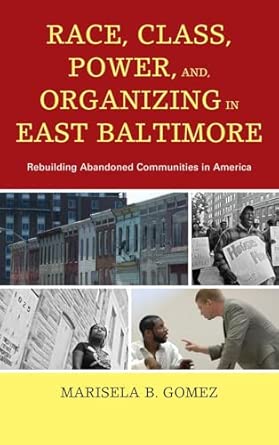
Race, Class, Power, and Organizing in East Baltimore: Rebuilding Abandoned Communities in America
Author(s): Marisela B. Gomez (Author)
Publisher: Lexington Books (UK)
Publication Date: 14 Dec. 2012
Edition: 1st
Language: English
Print length: 300 pages
ISBN-10: 9780739175002
ISBN-13: 0739175009
Book Description
This book examines the historical and current practices of rebuilding abandoned and disinvested communities in America. Using a community in East Baltimore as an example, Race, Class, Power, and Organizing in East Baltimore shows how the social structure of race and class segregation of the past contributed in the creation of our present day urban poor and low-income communities of color; and continue to affect the way we rebuild these communities today. Specific to East Baltimore is the presence of a powerful and prestigious medical complex which has directly and indirectly affected the abandonment and rebuilding of East Baltimore. While it has grown in power and land over the past 100 years, the neighborhoods around it have decreased in size and capital, widening the gap between the rich and the poor. The author offers a critical analysis of the relationships between powerful private institutions like the Johns Hopkins Medical Institutions and government and their intention in rebuilding urban communities by asking the question “How do we determine equity in benefit?” Focusing on a current rebuilding project using eminent domain to displace historical African-American communities, and the acquiring of land for private development, this book details the role of community organizing in challenging these types of non-community participatory rebuilding processes, resulting in the gentrification of urban neighborhoods. The detailed analysis of the community organizing process when families are displaced offers similarly affected communities a tool box for challenging current developers and government in unfair rebuilding practices. The context of these practices highlights the current laws and policies that contribute to continued displacement and disadvantage to poor communities without addressing the rhetoric of the intention of government-subsidized private development. This book examines the effect of such non-participatory and non-transparent rebuilding practices on the health of the people and place.
Editorial Reviews
Review
Avidly exposing the present and ongoing consequences of race, economic, and institutional power inequities that still strangle a historically marginalized urban community, Gomez’s book is a powerfully sobering reminder of the absolute necessity for residents to organize, sustain their own bases of power, and exert their collective vision for the rebuilding of their communities.
I interviewed Marisela Gomez for my Baltimore Magazine article, The Outer Harbor, in early 2006, when she was Director of SMEAC. She impressed me then as a bright and passionate young woman, a rare combination of academic preparation and street smarts. Those qualities shine through in her book.
Marisela Gomez has written an extraordinary book about the confrontation between the fragile and distressed Middle East neighborhood of Baltimore and the city’s most powerful institutions, including the closest neighborhood, Johns Hopkins Medical. Her clear and calm voice guides us through a distressing story of exclusion and expulsion, using the exploration of the harms that process did to help us find a better way to revitalize all American neighborhoods. This book is must reading for everyone concerned with the American city, community development, health and health care, medicine and public health. Five stars!
This book is a compelling example of community research that is sensitive to the intricate ways in which power is exercised. Focusing on efforts to redevelop East Baltimore, the author examines the complicated intersection of the African American community with the power brokers from city government, Johns Hopkins University, and philanthropic foundations. Activist and physician Gomez does a masterful job of telling the story of a neighborhood in trouble and its confrontation with the various parts of the urban growth machine. Middle East Baltimore becomes the site of a struggle between Johns Hopkins and the community over the expansion of the Johns Hopkins medical complex and the proposed development of a biotech research park by the university. Gomez’s focus is on attempts of the East Baltimore community to organize resistance to the “negro removal” planned by Johns Hopkins. The author demonstrates how powerful actors can promote their plans and thwart the efforts of citizens to rebuild their community in a way that works for them. This is a carefully researched account of all the actors in this struggle. In the final chapters, the author demonstrates that other communities have confronted these issues in more humane, transparent, and democratic ways. Summing Up: Highly recommended.
About the Author
Marisela B. Gomez is a community activist, author, public health professional, and physician scientist. She received a BS and MS from the University of New Mexico in Albuquerque, a PHD, MD, and MPH from the Johns Hopkins University. She spent 17 years as an activist/researcher or participant/observer in East Baltimore during and after training at the Johns Hopkins Schools of Medicine and Public Health. Past and current writings address social determinants and health, social capital and urban health, disparities in mental health care in incarcerated populations, disparities in substance use treatment, mental health care in the primary health care setting, community organizing and development, and mindfulness practices in organizing. She spends her time between the city and counties of Baltimore, Maryland.
 Wow! eBook