Wow! eBook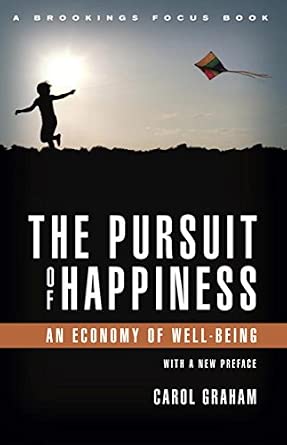
The Pursuit of Happiness: An Economy of Well-Being with a new preface Edition
Author(s): Carol L. Graham (Author)
- Publisher: Brookings Institution Press
- Publication Date: 8 Aug. 2012
- Edition: with a new preface
- Language: English
- Print length: 177 pages
- ISBN-10: 0815724047
- ISBN-13: 9780815724049
Book Description
Editorial Reviews
Review
“As acceptance of social science research on happiness continues to grow, a new question has naturally surged to the fore: Should happiness be a goal of public policy? In this eloquently written celebration of a new science, Carol Graham provides valuable new insight into the pros and cons of this issue.”–Richard A. Easterlin, university professor and professor of economics, University of Southern California
“Since 1776 the ‘pursuit of happiness’ has been the great world question. Here, reflecting on modern survey techniques and results, Carol Graham drills deeper…. [She] is opening up a whole new frontier in economic and social policy.”–George Akerlof, 2001 Nobel Laureate in Economics
“The book is well written and very accessible, and is immaculately researched, avoiding bias and imbalance…. Far from being a ‘dismal science, ‘ Graham provides much reason for optimism for those people involved in this burgeoning field of economics.”– “World Economics”
“With great care and judgment, Graham clearly explains the complexities of defining, measuring, and targeting happiness in economic policy while still urging us to persevere…. A consummate work of scholarship.”–Jeffrey D. Sachs, director of the Earth Institute at Columbia University
About the Author
Excerpt. © Reprinted by permission. All rights reserved.
THE PURSUIT OF HAPPINESS
AN ECONOMY OF WELL-BEINGBy Carol Graham
BROOKINGS INSTITUTION PRESS
Copyright © 2012 THE BROOKINGS INSTITUTION
All right reserved.
ISBN: 978-0-8157-2404-9
Contents
Preface to the Paperback Edition……………………………………………..vii1 Happiness: A New Science…………………………………………………..12 What We Mean by Happiness: A “Theory” of Agency and Well-Being…………………273 Happiness around the World: What We Know…………………………………….624 Adaptation and Other Puzzles……………………………………………….815 GNH versus GNP?…………………………………………………………..106Acknowledgments…………………………………………………………….127Notes……………………………………………………………………..131Index……………………………………………………………………..153
Chapter One
HAPPINESS: A NEW SCIENCE
All citizens are entitled to “life, liberty, and the pursuit of happiness.”
Declaration of Independence of the United States of America, 1776
FOR THE PAST TEN YEARS, I have been studying happiness around the world, in countries as different as Afghanistan, Chile, and the United States. It has been an amazing foray into the complexity of the human psyche on the one hand, and the simplicity of what seems to make us happy on the other. My last book on happiness, published in 2009, ended with a speculative chapter on policy, with the quote above at the top of the chapter. It’s either a sign of my lack of imagination or of the speed with which the current public debates have taken up the topic of happiness that I am now boldly leading off with that same quote and writing an entire book on the topic of happiness and policy. That would have been unthinkable just a decade ago.
In recent years, a number of nations—from remote Bhutan to far less remote Britain, France, China, and Brazil—have begun incorporating measures of happiness into their benchmarks of national progress. Even in the United States, high-level policymakers ranging from the chairman of the Federal Reserve Board to the director of the U.S. Census Bureau have been discussing the merits and de-merits of happiness measures. Not surprisingly, the study of happiness has also captured the attention of the public and is now a constant focus of the media, in the United States and abroad.
What has happened? The study of happiness has moved from the fringes of the “dismal science” and the esoteric realm of the philosopher to the center of vociferous debates among economists. The debates cover the relationship between happiness and income and the extent to which happiness metrics can be used as proxies for utility—the streamlined concept of welfare that underlies most economic models. Is Adam Smith turning over in his grave?
A skeptical view is that this is simply a temporary trend, related to the recession-related realignment of priorities, in which the pursuit of an ever-larger house has been replaced by discussions about the value of things like leisure time and socializing. Yet there are already a number of efforts under way that could result in measures of happiness becoming a part of our economic measures of progress and the subject of our policy debates. Indeed, there is an ongoing discussion among prominent academics—and increasingly among policymakers—about complementing our standard measures of gross national product with national well-being indicators, indicators that can similarly be tracked over time and compared across countries.
In 2008, the Sarkozy Commission—led by a number of prominent Nobel Prize-winning economists and sponsored by Nicolas Sarkozy, the president of France—issued a worldwide call for the development of broader measures of national well-being. While national well-being indicators had been a subject of discussion in the academic community for years, the commission placed them at the center of a much more public debate. Ideological critics dismissed the findings of the commission as a couched attempt by the French to make the U.S. economy look more like their “sclerotic” model: underemphasizing economic growth and overemphasizing leisure. Yet, rather ironically, just two years later, the latest government to place serious emphasis on the measurement of happiness was the conservative government of David Cameron in Britain.
Is all of this a good idea? How can more happiness not be a good thing? And what is this new “science” of happiness all about? What do we mean, for example, when we use the term “happiness”? Do we care about happiness per se or about the pursuit of happiness? Should policymakers be in the business of telling people what will make them happy? And whose happiness do we care about? Do we care about the happiness of isolated individuals? The happiness of nations? Or about happiness in some broader global sense?
In the end, the new and rich debates on happiness and policy, on national well-being indicators, and on measures of gross national happiness, among others, are raising the same fundamental question. How can studies of happiness help us to better evaluate the state of human welfare and well-being, in both the present and the future? The tools introduced by happiness economics provide us with broader measures of well-being than do income data alone, and they allow us to test and attach relative weights to the effects of all sorts of conditions, ranging from environmental degradation and commuting time to crime and unemployment rates to smoking and exercising. They are new and powerful tools for scholars and, perhaps, for policymakers.
Yet introducing broader measures of well-being into the policy arena also raises a host of unanswered questions. Among them is a conundrum raised repeatedly by my research: the paradox of happy peasants and frustrated achievers. While poor people are less happy than wealthy people on average in countries around the world, very poor people often report that they are very happy. In fact, they often report higher levels of happiness than their slightly wealthier counterparts and at times even higher levels than the very rich (miserable millionaires). This puzzle is explained in part by people’s ability to adapt to adversity and related differences in norms and expectations. While better accounting for differences in norms, expectations, and capacity to adapt can enhance our understanding of human well-being, they also complicate comparisons based on well-being data.
My primary objective in this book is to discuss the promise—and potential pitfalls—of delving into the policy realm with happiness research and indicators. In the next chapter, I review the different definitions and conceptions of happiness and provide some examples of how those definitions—such as happiness defined as contentment in the Benthamite sense, or as the opportunity to lead a fulfilling life in the Artistotelian sense—help explain some key relationships, such as that between happiness and income. The definition of happiness also seems to vary across people and societies and thereby helps to explain the paradox of happy peasants and frustrated achievers.
In particular, I focus on the question of whether policy should be concerned with happiness per se—for example, happiness with day-to-day life—or with the opportunity to pursue happiness in the sense of building a fulfilling life, as the quote from the Declaration of Independence at the top of this chapter suggests. In other words, should we be listening to Bentham or to Aristotle as we think about happiness in the policy realm? On what basis—theoretical, empirical, or normative—should we make that decision?
In chapter 3, I review what we know about happiness in the United States and around the world, based on my own research and that of several other scholars (that chapter can be skipped by those readers already familiar with the literature). In chapter 4, I focus on the unanswered questions that are posed by the empirical research and, in particular, the conundrum posed by people’s ability to adapt to a wide range of phenomena, including crime, corruption, poverty, and poor health, and still report being happy.
In chapter 5, I attempt to bring these issues to bear on the policy debate, both in terms of what they imply for our concrete attempts to develop operational measures of well-being and in terms of deeper philosophical questions about which dimensions of human welfare public policy should be most concerned about. Accepting that determining which dimensions of human welfare are most important to policy poses difficulties for both method and economic theory, I believe that the effort to do so will force us to think deeply and productively about what measures of human well-being are the most accurate benchmarks of economic progress and human development.
A NOTE ON TERMINOLOGY
Before we delve into the deeper conceptual questions or even a description of the general approach taken here, it is important to clarify what we mean when we use the terms “happiness,” “well-being,” “subjective well-being,” and “life satisfaction,” among others. They are often used interchangeably in the economics literature, while psychologists take much more care in distinguishing the nuances between them. Meanwhile, the nascent discussion on policy, described in detail throughout the book, is forcing more definitional clarity precisely because the differences in the meaning of these terms could have vastly different policy implications.
While the terms are related, they have distinct meanings. “Happiness” is perhaps the most open-ended and least well-defined of the terms, although it is the one that gets the most public attention and interest. It is also the term that appears in the U.S. Declaration of Independence. A happiness question attempts to gauge how happy people feel about their lives in general. As discussed below, from an empirical research perspective, this question is useful precisely because it does not impose a definition of happiness on the respondents and they conceptualize happiness for themselves.
“Life satisfaction” is a closely related term, and responses to questions about life satisfaction correlate very closely with those to happiness questions. Yet it is slightly more narrowly framed than the term “happiness,” and it correlates a bit more closely with income. It is likely that when people are asked about their satisfaction with their lives, as opposed to happiness in general, they are more likely to evaluate their life circumstances as a whole in addition to their happiness at the moment.
The ladder-of-life question, introduced by sociologist Howard Cantril decades ago and now an integral part of the Gallup World Poll, is also often used interchangeably with the question of happiness as a research tool. However, it is a more framed question in that it introduces a relative component by asking respondents to compare their lives to the best possible life that they can imagine. Not surprisingly, responses to the ladder-of-life question correlate even more closely with income than do either happiness or life satisfaction questions, as most respondents compare their lives to a national or international reference norm.
“Subjective well-being” is a term that encompasses all of the ways in which people report their well-being, from open-ended happiness to satisfaction with different domains, such as work, health, and education, among others. Psychologists in particular conduct separate analyses of each of these domains, comparing the results of each with particular variables of interest. As is discussed throughout the book, the definition on which the analysis is based can result in quite different conclusions, with varying degrees of relevance for policy. “Well-being,” finally, is the most encompassing of all of the terms: it implies an evaluation of human welfare that extends beyond the components that income can accurately capture or measure.
THE ECONOMICS OF HAPPINESS: AN INTRODUCTION TO THE APPROACH
The study of happiness, long the purview of psychologists, is a fairly new venture in economics. Indeed, the research was initially eschewed by the economics profession. Yet there are now literally thousands of articles based on happiness surveys in mainstream journals; panels on happiness abound at economics association meetings; and happiness research was even featured at the 2011 World Economics Forum in Davos, the annual pinnacle of networking for bankers, business people, and finance ministers.
The economics of happiness approach provides us with new tools and data with which to develop measures of welfare that include income metrics but also extend well beyond those metrics. This approach does not purport to replace income-based measures of welfare but instead to complement them with broader measures of well-being. Those measures are based on the results of large-scale surveys, across countries and over time, of hundreds of thousands of individuals who are asked to assess their own welfare. The surveys provide information about the importance of a range of factors that affect well-being; they include income but also highlight others, such as health, marital and employment status, and civic trust.
The new metrics allow us to place relative weights on the cost of things like a lost job, a divorce, various health conditions, commuting time, and even uncertainty. On the other hand, they also allow us to evaluate the benefits of participating in democracy, of being part of a civic organization, and of exercising, among other things.
This approach departs from economists’ standard reliance on revealed preferences as measures of welfare. Put more simply, traditional economic analysis is based on the assumption that information in survey data cannot be believed. Because there are no consequences to what people say, the only credible data come from revealed consumption choices, made within a fixed budget constraint and entailing genuine trade-offs.
Because we cannot look into a man’s soul and find out how happy he really is, traditional microeconomics argues that it is best to judge his happiness from measures based on how he behaves…. The empirical analysis of revealed preferences has produced a number of fairly robust results. Amongst these are that people regularly act as if they prefer to have more than less money. Most people want bigger rather than smaller houses…. The money metric of utility is an offspring of the revealed preferences approach…. We can therefore measure the revealed preference utility associated with a good using the price that an individual is willing to pay for it.
Happiness economics departs from that assumption and uses data derived from surveys—for example, data based on expressed preferences rather than revealed choices. That departure has support from a large body of research in behavioral economics, which has gone a long way in showing how “homo sapiens” departs from the hyper-rational, calculating “homo economicus” that underlies most traditional economic models. Behavioral economics research shows that many choices that consumers—and people in general—make are not rational, preference-maximizing choices. Some reflect loss aversion: individuals tend to value something that they already own much more than can be measured by the amount that they were willing to pay for it in the first place.
The example highlighted in well-known work by Daniel Kahneman—in which individuals would not pay more than $2 for a coffee mug, but once they owned it, refused to sell it for less than $4—comes to mind. Other choices may be driven by norms, addiction, or self-control problems rather than by rational choice. Revealed preferences assess the consumption behavior of the obese or of smokers as the result of rational, welfare-enhancing choices, for example, while the detrimental effects of those choices are immediately obvious to the outside (non-economist?) observer.
Happiness economics, therefore, is especially well-suited to answering questions in areas where revealed preferences provide limited information. For example, revealed preferences cannot fully gauge the welfare effects of particular policies or institutional arrangements that individuals are powerless to change and with respect to which they therefore cannot make a choice or take an action that reveals a preference. Examples include the welfare effects of inequality, environmental degradation, and macroeconomic factors such as inflation and unemployment. Along the same lines, the approach is also especially well-suited to evaluating the relative weights that people place on different public goods. The latter are, by definition, difficult to value by taking the consumption-based revealed preferences approach. Yet happiness or life satisfaction surveys can be used to measure the value that people attribute to, for example, clean air and safe neighborhoods, even though they do not make consumption choices as a means of expressing their preferences (at least short of picking up and moving to a different location, which is a rather daunting choice for many people).
Imagine, for example, a poor peasant in Bolivia who is made very unhappy by inequality or by poor governance. Short of emigrating or protesting, it is difficult to imagine how he or she can reveal a preference. Yet those institutional arrangements may have major welfare consequences that can be observed only through expressed preferences, as captured by survey data. In many of his writings, Amartya Sen criticizes economists’ excessive focus on choice as a sole indicator of human behavior. His capabilities-based approach to poverty highlights the lack of capacity of the poor to make certain choices or to take certain actions. Well-being surveys give us a metric with which we can assess the welfare effects of situations in which choice is constrained or absent altogether.
(Continues…)
Excerpted from THE PURSUIT OF HAPPINESSby Carol Graham Copyright © 2012 by THE BROOKINGS INSTITUTION. Excerpted by permission of BROOKINGS INSTITUTION PRESS. All rights reserved. No part of this excerpt may be reproduced or reprinted without permission in writing from the publisher.
Excerpts are provided by Dial-A-Book Inc. solely for the personal use of visitors to this web site.