Wow! eBook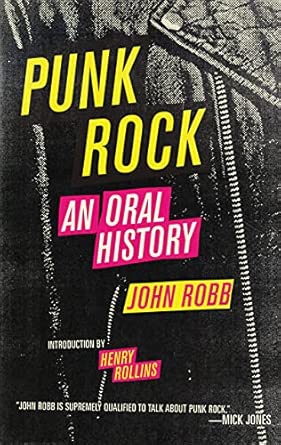
Punk Rock: An Oral History
Author(s): John Robb (Author), Lars Fredriksen (Introduction)
- Publisher: PM Press
- Publication Date: 9 Aug. 2012
- Edition: Illustrated
- Language: English
- Print length: 568 pages
- ISBN-10: 1604860057
- ISBN-13: 9781604860054
Book Description
With its own fashion, culture, and chaotic energy, punk rock boasted a do-it-yourself ethos that allowed anyone to take part. Vibrant and volatile, the punk scene left an extraordinary legacy of music and cultural change. John Robb talks to many of those who cultivated the movement, such as John Lydon, Lemmy, Siouxsie Sioux, Mick Jones, Chrissie Hynde, Malcolm McLaren, Henry Rollins, and Glen Matlock, weaving together their accounts to create a raw and unprecedented oral history of UK punk. All the main players are here: from The Clash to Crass, from The Sex Pistols to the Stranglers, from the UK Subs to Buzzcocks–over 150 interviews capture the excitement of the most thrilling wave of rock ‘n’ roll pop culture ever. Ranging from its widely debated roots in the late 1960s to its enduring influence on the bands, fashion, and culture of today, this history brings to life the energy and the anarchy as no other book has done.
Editorial Reviews
Review
“Its unique brand of energy helps make it a riot all its own.”
—Harp Magazine
“John Robb is a great writer…and he is supremely qualified in my opinion to talk about punk rock.”
–Mick Jones, The Clash
“John Robb is as punk rock as The Clash.”
–Alan McGee
About the Author
John Robb grew up with punk rock in the late seventies forming his own critically acclaimed band, the Membranes, writing his own fanzine and releasing his own records in the DIY spirit of the movement. The Membranes powerful, abrasive, punk rock noise was very influential on the British and European underground and the band toured the world several times before stopping in the late eighties. Robb then went on to write for the music press, being the first person to interview Nirvana as well as coining key phrases like “Britpop.” He then started a new band, Goldblade, who tour the world to this day.
Originally from Washington DC, Henry Rollins fronted the Los Angeles-based punk band Black Flag and is well-known for his hard-hitting writing, music, and acting.
Excerpt. © Reprinted by permission. All rights reserved.
Punk Rock
An Oral History
By John Robb, Oliver Craske
PM Press
Copyright © 2012 PM Press
All rights reserved.
ISBN: 978-1-60486-005-4
Contents
The Contributors,
Foreword by Michael Bracewell,
Foreword by Henry Rollins,
Intro,
1 1950-69: The Roots of Punk,
2 1970-74: Glam Rock and Other Early Seventies Revolutions,
3 1975: I’m Not an Abortion: The Birth of Punk,
4 1976 Part I: Into Chaos,
5 1976 Part II: Year Xerox,
6 1976 Part III: Punk Becomes a Dirty Word,
7 1977 Part I: The Explosion,
8 1977 Part II: In 1977, I Hope I Go To Heaven,
9 1977 Part III: Generation Why,
10 1978: No Map or Address,
11 1979: The Second Wave Peaks,
12 1980-84: Protest and Survive,
Outro,
Acknowledgements,
Picture Credits,
Lyric Credits,
Index,
CHAPTER 1
1950/60: THE ROOTS OF PUNK
Where does punk rock start? 1976? 1975? Does it start with the Stooges, or can we go back to the Stones, to Elvis or further back to medieval times and beyond? There is no doubt that rebel songs have always been with us, from crazed loons singing anti-imperial songs in Roman times to wild-eyed medieval minstrels enlightening the market place with their toothless anti-authoritarian rants. It’s always been with us, that wild spirit, that outsider cry. It’s only recently it’s been with electricity – and louder and wilder.
Punk rock as we know it was a culmination of everything that had gone on in pop before, from the electric filth of hard rock, the wild abandon of the Stooges, the mass media fuck of Elvis, the pure revolution promised by the hippies, the sharp lines of the mods and the sneering rebel shapes of the rockers, to the stomping pop blitzkrieg of glam rock – even the experimentation of prog rock and Seventies underground art rock. Punk didn’t just come from the love of Ziggy Stardust. It came from everywhere: from the Beatles to glam, from Iggy to the Sweet, from pub rock to Captain Beefheart. Punk pulled these strands together and when it all finally coalesced in the UK in 1977 it went straight to the heart of the establishment. The interviews in this book show just howdiverse the backgrounds of the key players were. Everything wild and colourful has been referenced.
For the fashionistas it only lasted a few months, but whilst they were squeezing their lardy hipster arses into the trite (and frankly quite rubbish) New Romantic outfits, punk went underground and re-emerged as the second wave, and a plethora of other punk-influenced scenes from goth to psychobilly to anarcho-punk to 2 Tone, and more besides – a whole bunch of vital music scenes that along with punk rock have become the key influence on all the best modern music and the yardstick by which it is measured.
THE MASS MEDIA F.U.C.K. OF ELVIS
Early Rock’n’Roll and the Birth of the Modern Rebel Song
Penny Rimbaud (Crass: drums and ideology)
I listened to Bill Haley before Elvis, but it didn’t hit me in the way that rock’n’roll hit me later. ‘Rock Around The Clock’ and ‘See You Later Alligator’ seemed like music hall. It didn’t knock me in a physical way, it was much more cerebral – if a kid of twelve or thirteen could be cerebral! I remember pedalling home on my bike with a copy of Bill Haley’s ‘Oh When The Saints’. My brother stopped me by the village pond and he got really cross. He was into jazz. We had a huge row about the fact I was polluting good music.
I went out and bought Elvis the moment it came out. Oddly, all the Teds were really into Bill Haley more than Elvis. Elvis made rock’n’roll sexy and sexual, and it was the first time I realised I was a sexual person.
I was also listening to English jazz, and some American stuff like Gerry Mulligan which was groovy cool stuff. The English stuff like Humphrey Lyttelton was great. Humphrey got a sax and that was considered really wicked and all the trad jazz people ruled him out.
Hugh Cornwell (The Strangiers: lead vocals and guitar)
The first music I liked? I suppose it would have been Cliff Richard. It was a period of discovery and these artists were appearing out of nowhere. The English ones were there, but they weren’t affecting me as much as the Everly Brothers or Buddy Holly around at the same time. So until Cliff came along and had those early hits I don’t think anything touched the American stuff.
I’d already discovered Chuck Berry. I was playing along to his songs. I discovered Chuck Berry through my other brother who had a big record collection of jazz stuff as well. He was into jazz and when he would go out he would tell me not to touch his records, but I would go through them anyway! I discovered Art Blakey, Mose Allison – I was very lucky I had these other siblings who liked these kinds of music I was into at a really early age.
Lemmy (Motorhead: bass and lead vocals)
I saw Little Richard at the Cavern in Liverpool in the Fifties. That was incredible. I was living on Anglesey at the time, so you can imagine how mind blowing that was. Pretty soon I was a bit of a Ted.
Penny Rimbaud
I hung out with some kids at public school. We were the naughty boys that hung out with the bad boys above Burton’s, where the pool table was in Brentwood. There was a terrific tension there with the squaddies and the Teds, and we were the poncey public schoolboys trying to get a bit of action between everyone. It all felt so dangerous and exciting. There was something about the Teds that was really thrilling. They taught me that the world of my father wasn’t the only world.
Charlie Harper (UK Subs: vocals)
As a kid my first kind of passion was early rock’n’roll. All the greats: Elvis, Jerry Lee, Chuck Berry, Bo Diddley. In the Fifties there was the Notting Hill riots going on, and some kids at our school became racists and decided to get rid of their black records, and because I loved Chuck Berry I got a lot of their record collections off them for pennies. I got into people like Larry Williams, things I would never have heard of otherwise – Big Bopper, Jerry Lee Lewis – things like that.
One of the earliest things I bought was an album by Cliff Richard and the Drifters, as the Shadows were called then. When I was fifteen I left school. I was still very interested in music. I decided I wanted to be an artist and go to Paris. I went to Montmartre, where all the artists hang out, to find out that everyone painted with paper knives not a brush. I was completely overwhelmed; I had no skill at all. I loafed around Paris and went to this cafe which had rock’n’roll records. Rock’n’roll was big in France.
Knox (The Vibrators: guitar and vocals)
I saw people like Gene Vincent in Watford – I saw him twice in one of those package shows that go round. I saw Eddie Cochrane when I was about thirteen; that was good. Johnny Kidd and the Pirates were very good. Also Cliff Richard and the Shadows – some of the early stuff was really good. ‘Move It’ was great. It’s a pity they didn’t carry on their direction, the Shadows. ‘Apache’, that’s a great song too.
Glen Matlock (The Sex Pistols: bass. Rich Kids: bass and vocals)
The first music I was into when I was a kid was a pile of old rock’n’roll 78s from my uncle – like Little Richard, Jerry Lee Lewis, some raunchy stuff that sunk in at an early age, and then a couple of years later it was the beat boom, the Kinks, Small Faces and Yardbirds, and that was what really sunk in, that mad over-the-top guitar sound thundering out of the radio really got me.
Everything seemed to revolve round the Small Faces, the moddish kind of thing. I had my moments but I was too young to be a mod – I dabbled with that kind of look, I suppose. To me, the mods were very much a Sixties thing. They were the real thing. When I met Steve and Paul they seemed to be from a very similar kind of background. They were into bands like the Faces and the Who. This was 1973 when I met Steve, Paul and Wally.
Growing up in the Sixties, everything was looking to the future. I’m still waiting for my jet pack and flying cars! It was all Tomorrow’s World back then. There was always that element of modernism. So the songs don’t sound 25 or 30 years old now.
WHEN WE WAS FAB
Beatles, Stones, Mods and More
Kevin Hunter (Epileptics, Flux of Pink Indians: guitar)
At school I was always into pop stuff. My parents took me to see the Beatles but I don’t remember much about it. I was knee high. It was at Margate Winter Gardens early in ’63 – the gig was arranged before they made it big. I remember two shows, including one in the early evening for parents and kids, when the hall wasn’t very full.
I always liked chart singles. The first one I bought was a Hollies single, but I was always getting into stuff with a harsher edge, and I remember getting into Kinks stuff then. I couldn’t tell you what I liked about it.
Lemmv
In 1964 I was in Manchester, dossing around in Stockport and Cheetham Hill. I joined this band called the Rockin’ Vicars. We played all over town – Oldham, Ashton. We used to go to the Twisted Wheel but never played there. We played the Cavern as well, the Manchester one that’s now buried underneath that fucking horrible shopping centre they put there. Manchester was great. It was like Liverpool: there were lots of bands. We knew the Hollies and Herman’s Hermits. We all used to hang around in that guitar shop on Oxford Street, Barretts. We played with Manfred Mann. The Rockin’ Vicars always topped the bill, except once when we played the Free Trade Hall with the Hollies – it’s a long story but our drummer succeeded in being a complete cunt and destroyed the stage under himself and fell into a hole! [laughs] It was a lesson you would have thought he would have profited from but I’m afraid not!
AI Hillier (Punk fan. Member of the ‘Finchley Boys’)
The Beatles had an enormous effect on most people in the mid-Sixties, and they certainly did on me. My mum would religiously drag me down to Jones Bros on the Holloway Road, and after a quick listen on the headphones or snuggle together in a sound booth she would rush to the counter and buy it.
When the Beatles films were released, and in particular Help!, the Beatles suddenly seemed magical to me. Their antics opened up a whole new world for madcap pop performers and without doubt made it possible for zany bands like the Monkees to exist. At primary school I invented a ‘band’ of my own called the Tigers. The thrill of running about the playground being chased by all the girls because I was a ‘pop star’ lives with me to this day.
The Rolling Stones were the accepted antidote to the Beatles and I also really liked them. Even as a youngster I liked the more aggressive risk-taking, law-breaking, drug-using image that surrounded the Stones. Images of Hell’s Angels at Altamont cemented this and placed them in my young mind alongside the likes of Jimi Hendrix, who always looked so totally different and cool. When he appeared on TV he never looked like he could give a fuck about anything, an aura that J. J. Burnel was to try and recreate to some degree a few years later.
My interest in the Doors came later, even though I was in Paris on a school trip not more than a few hundred yards from the building in the rue Beautreillis where Jim Morrison died on 3 July 1971 – literally a stone’s throw from our Parisian hotel.
Penny Rimbaud
What the Beatles did was to confirm the political element. John Lennon made me realise you could be a voice in your own right. Up till then you had to have a university degree or have studied philosophy to have an opinion, and I always had opinions and had been shouted down. What Lennon helped me to do was to realise that my own opinions were as valid as anyone else’s.
Steve Diggle (Buzzcocks: guitar)
We had loads of records: Elvis’ ‘Wooden Heart’, all that Charlie Drake stuff, and Bernard Cribbins! I grew up with the Beatles, Stones, early Who and Bob Dylan. There was a girl across the road who had the first Dylan album, a friend of mine had the first Beatles album, and those was the first real things I heard. A couple of doors down my cousin was a Teddy boy and he was playing Little Richard and Elvis, really good rock’n’roll. I got into the Velvet Underground when I was fourteen, the psychedelic thing.
I was a bit of a mod. I remember going to Belle Vue in Manchester and seeing people with ‘The Who’ on their parkas in 1965. That seemed amazing, and I always wanted a scooter. Townshend was smashing the guitars, and the Stones and the Beatles were telling you things that your mum and dad couldn’t tell you – that subculture was there.
I thought it was too complicated being in a band. I was enjoying being in street gangs and getting into trouble round Rusholme and Bradford in Manchester, and then Ardwick, and that was the real thing for me. I remember walking down the street in a suede jacket and people shouting stuff. If you dressed weirdly in those terraced streets in those days you would get a lot of hassle. That kind of thing toughens you up. It was like Coronation Street: proper northern, where you knew all the neighbours and you got into trouble breaking windows – and that all made me politically aware of things, the environment and your frustrations.
Charlie Harper
When I went back home to London, after living in Paris, the Sixties were happening. I was going to clubs and the Rolling Stones were happening at the time. I fell in love with them and followed them everywhere – my nickname was Charlie Stones. I got to know Brian Jones a little bit; he liked my clothes and shoes. I was wearing more of a beatnik kind of look. I had these kind of sandals painted green that I dyed with leather dye and he loved them.
The Stones played down Ken Colyer’s 51 Club. They had an r’n’b night every week – Friday, I think. On Sunday they played the Richmond Railway Hotel, then they would play youth clubs round London. I saw them when I could – quite often that was three times a week. When they made it I saw them at Tooting Granada, a seated cinema. Me and my mate got seats near the front. They came on and three quarters of the audience were young girls screaming, and everyone stood up jigging round. These girls got so excited they would swing down the front over the seats, and my mate got trapped and broke his leg.
After the Stones I got into the Pretty Things. All these clubs had at least one resident band, like John Mayall at the Marquee – that was still jazz-orientated. I’ll never forget being down the 100 Club when the Kinks had just been on tour. ‘You Really Got Me’ had just jumped into the charts and they were the normal residency band down there. A hundred of us would turn up and suddenly 300 girls are down there, just like that.
I was a busker and I would play folk music in summer. I would go to the south of France or Spain with my guitars, and play on the champagne cruise boats going between Spain and the south of France. I’d go to St Tropez and drink Spanish champagne at four bob a bottle. We used to play anything. I never forget the first time I busked in Nice. You’d have your hat destroyed by the end of the evening, there was so much money in it.
Hugh Cornwell
It was an amazing period. We were discovering stuff all the time: it was a really amazing moment listening to the Stones’ ‘Not Fade Away’ for the first time. God, that was electric! When I was fifteen I was going to the Marquee and I saw everybody: the Yardbirds, the Who, Steve Winwood’s band before Traffic. And I really loved the Graham Bond Organisation. It was so different, and a bit jazzy as well – it didn’t have a guitar in it, mainly organ. Brilliant.
I just went down there on my own. I became a member. It was very civilised. I never used to drink or take drugs. I’d just stand there and watch the music. I never talked to anyone. I was really young. When the Who played there I wore a black roll-necked sweater and made their motif out of felt and stuck it on.
Brian James (London SS, the Damned, Tanz Der Youth. Lords of the New Church: guitar)
As a kid, I was into people like the Stones and the Yardbirds and then the Who, but there was also a blues thing I was into as well – John Mayall, Peter Green. That made me check out the American guys, great artists, and think, ‘Who writes this? Where did it come from?’
I saw a lot of people play live. I saw John Lee Hooker at the Starlight Ballroom during the late Sixties. He was backed up by the Savoy Blues Band, who did their own set first, then Hooker came on and took the place apart. And B. B. King at the Albert Hall, with amazing support – it might even have been Peter Green’s Fleetwood Mac.
Mick Jones (London SS, the Clash, Big Audio Dynamite: guitar and vocals)
I was in the Animals’ fan club and the Kinks’ fan club when I was really young. I would spend Saturdays going to Cheyne Walk and standing outside where Mick Jagger and Keith Richards used to live. We stood there early one Saturday evening looking down the railings – this was Mick Jagger’s house – and he came up to the window and someone pulled the blinds down. We went along to the next window and they shut the window. And then we would go along to Keith’s house. That was what we’d do on Saturdays, and then we would go down Carnaby Street.
Knox
I had bands at school. I had a band called Knox and the Nightriders, and the Renegades, when I was fourteen or fifteen – we played r’n’b covers. I was little bit of a Teddy boy at school. I had a bit of a quiff. I saw the Beatles at least once, the Stones a couple of times – I saw them in the Gaumont in Watford. There would be these package tours with six or eight bands on, and we’d go and see all the bands – there were thousands of people in the place.
(Continues…)Excerpted from Punk Rock by John Robb, Oliver Craske. Copyright © 2012 PM Press. Excerpted by permission of PM Press.
All rights reserved. No part of this excerpt may be reproduced or reprinted without permission in writing from the publisher.
Excerpts are provided by Dial-A-Book Inc. solely for the personal use of visitors to this web site.