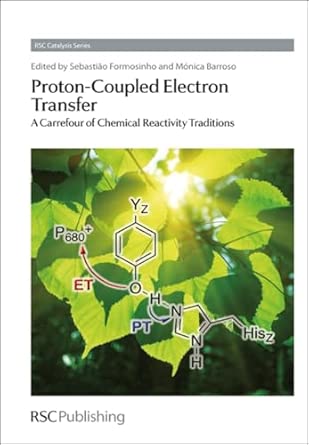
Proton-Coupled Electron Transfer
A Carrefour of Chemical Reactivity Traditions
By Sebastião Formosinho, Mónica Barroso
The Royal Society of Chemistry
Copyright © 2012 Royal Society of Chemistry
All rights reserved.
ISBN: 978-1-84973-141-6
Contents
Chapter 1 Application of the Marcus Cross Relation to Hydrogen Atom Transfer/Proton-Coupled Electron Transfer Reactions Jeffrey J. Warren and James M. Mayer, 1,
Chapter 2 A Transition-State Perspective of Proton-Coupled Electron Transfers Luis G. Arnaut, 32,
Chapter 3 Experimental Approaches Towards Proton-Coupled Electron Transfer Reactions in Biological Redox Systems Sibylle Brenner, Sam Hay, Derren J. Heyes and Nigel S. Scrutton, 57,
Chapter 4 Metal Ion-Coupled and Proton-Coupled Electron Transfer in Catalytic Reduction of Dioxygen Shunichi Fukuzumi and Hiroaki Kotani, 89,
Chapter 5 Proton-Coupled Electron Transfer in Natural and Artificial Photosynthesis M. Barroso, Luis G. Arnaut and Sebastiao J. Formosinho, 126,
Subject Index, 152,
CHAPTER 1
Application of the Marcus Cross Relation to Hydrogen Atom Transfer/Proton-Coupled Electron Transfer Reactions
JEFFREY J. WARREN AND JAMES M. MAYER
Department of Chemistry, University of Washington, Box 351700, Seattle, WA 98195-1700, USA
1.1 Introduction
Many important chemical and biological reactions involve transfer of both electrons and protons. This is illustrated, for instance, by Pourbaix's extensive 1963 Atlas of Electrochemical Equilibria. These have come to be called 'proton-coupled electron transfer' (PCET) reactions. Due to the widespread interest in this topic, the term PCET is being used by many authors in a variety of different contexts and with different connotations. As a result, a very broad definition of PCET has taken hold, encompassing any redox process whose rate or energetics are affected by one or more protons. This includes processes in which protons and electrons transfer among one or more reactants, regardless of mechanism, and processes in which protons modulate ET processes even if they do not transfer.
Mechanistic issues are central to PCET. In contrast to electron transfer (ET) and proton transfer (PT), which are two of the most fundamental and well-understood reactions in chemistry, our understanding of how protons and electrons are transferred together is still emerging. The importance of mechanism was emphasized by Njus in a biochemical context almost two decades ago: "Many [biological redox] reactions involve the transfer of hydrogen atoms (or the concerted transfer of H+ and e-) rather than electron transfer alone. This distinction is generally disregarded because H and e- are considered interchangeable in the aqueous milieu of the cell, but the focus on electrons obscures some of the general principles underlying the functioning of redox chains".
This chapter focuses on hydrogen atom transfer (HAT) reactions, which involve concerted transfer of a proton and an electron from a single donor to a single acceptor in one kinetic step (eqn (1.1)). These are one subset of PCET processes and are one type of 'concerted proton-electron transfer' (CPET).
[MATHEMATICAL EXPRESSION OMITTED] (1.1)
"Concerted" implies a single kinetic step for transfer of the two particles, but does not imply synchronous transfer. HAT is a fundamental reaction studied by physical and organic chemists for over a century, critical to combustion and free-radical halogenations, for example. More recently, it has been recognized that transition metal coordination complexes and metalloenzymes can undergo HAT reactions, and the recognition of overlap between traditional HAT reactions and PCET has stimulated much new thinking. Our focus has been to understand the key factors that dictate HAT and PCET reactivity and to build a simple and predictive model that can be used in chemistry and in biology.
In this chapter, we show that the Marcus cross relation holds remarkably well for HAT reactions in most cases. This provides important insights into HAT and allows the prediction of rate constants. We begin with an introduction to Marcus theory and the cross relation. This is followed by applications the cross relation to purely organic reactions (Sections 1.3), and then to HAT reactions involving transition metal complexes (Sections 1.4). Finally, Section 1.5 describes the intuitive picture of HAT derived from the success of the cross relation, and also emphasizes some of the weaknesses of this treatment and the questions that remain.
1.2 An Introduction to Marcus Theory
The Marcus theory of electron transfer has proven invaluable for understanding a variety charge transfer reactions, from simple solution reactions to long-range biological charge transfer. The primary equation of Marcus theory, equation (1.2), is derived from a model of intersecting parabolic free energy surfaces. When the coupling between these diabatic surfaces HAB is small, the reaction is non-adiabatic and the reaction does not always occur
[MATHEMATICAL EXPRESSION OMITTED] (1.2)
[MATHEMATICAL EXPRESSION OMITTED] (1.3)
when the system reaches the intersection (the transition state). When the coupling is sufficiently large the reaction is adiabatic and equation (1.2) reduces to equation (1.3). The pre-exponential factor A in equation (1.3), for a bimolecular reaction, is typically taken as an adjusted collision frequency. The intrinsic barrier λ is the energy required to distort the reactants and their surrounding solvent to the geometry of the products. Because electron transfer occurs over relatively long distances, with little interaction between the reagents, it is typically assumed that λ can be taken as a property of the individual reagents. λ for a reaction is then commonly taken as the average of the individual reagent λ's (the 'additivity postulate,' eqn (1.4)). In the adiabatic limit, λ for an individual reagent can be determined from the rate of the self exchange reaction (eqn (1.5)). Combining equations (1.3) and (1.4) gives the cross relation (eqn (1.6) and (1.7)), which relates the rate constant of a cross reaction, X + Y-, to the self exchange rate constants for reagents X and Y (eqn (1.5)) and the equilibrium constant KXY. The constant f is defined by equation (1.7) and is typically close to unity, unless |ΔG°| ≥ λ/4.
λXY = 1/2 (λXX + λYY) (1.4)
X + X- [??] X- + X (1.5)
kXY = √kXXkYYKXYf (1.6)
ln f = (ln KXY)2/4 ln(kXXkYYZ-2) (1.7)
Theoretical treatments of PCET reactions typically have equation (1.2) as a conceptual starting point. In Hammes–Schiffer's multistate continuum theory for PCET, the pre-exponential factor includes both electronic coupling and vibrational overlaps, and the rate is a sum over initial and final vibrational states integrated over a range of proton-donor acceptor distances. This theory has been elegantly applied to understand the intimate details of a variety of PCET reactions, but many of its parameters are essentially unattainable experimentally.
The cross relation can be written for an HAT reaction (eqn (1.1) and (1.8)). It is a very simplistic model, but it has the advantage that all of the parameters are experimentally accessible (in many cases).
[MATHEMATICAL EXPRESSION OMITTED] (1.8)
It should be emphasized that the cross relation is not a corollary of current PCET theory and that there is little...
 Wow! eBook