 Wow! eBook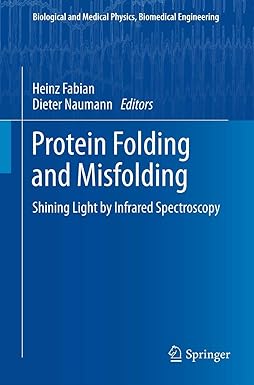
Protein Folding and Misfolding: Shining Light by Infrared Spectroscopy 2012th Edition
Author(s): Heinz Fabian (Editor), Dieter Naumann
- Publisher: Springer
- Publication Date: September 17, 2011
- Edition: 2012th
- Language: English
- Print length: 260 pages
- ISBN-10: 3642222293
- ISBN-13: 9783642222290
Book Description
Infrared spectroscopy is a new and innovative technology to study protein folding/misfolding events in the broad arsenal of techniques conventionally used in this field. The progress in understanding protein folding and misfolding is primarily due to the development of biophysical methods which permit to probe conformational changes with high kinetic and structural resolution. The most commonly used approaches rely on rapid mixing methods to initiate the folding event via a sudden change in solvent conditions. Traditionally, techniques such as fluorescence, circular dichroism or visible absorption are applied to probe the process. In contrast to these techniques, infrared spectroscopy came into play only very recently, and the progress made in this field up to date which now permits to probe folding events over the time scale from picoseconds to minutes has not yet been discussed in a book. The aim of this book is to provide an overview of the developments as seen by some of the main contributors to the field. The chapters are not intended to give exhaustive reviews of the literature but, instead to illustrate examples demonstrating the sort of information, which infrared techniques can provide and how this information can be extracted from the experimental data. By discussing the strengths and limitations of the infrared approaches for the investigation of folding and misfolding mechanisms this book helps the reader to evaluate whether a particular system is appropriate for studies by infrared spectroscopy and which specific advantages the techniques offer to solve specific problems.
Editorial Reviews
From the Back Cover
Infrared spectroscopy is a new and innovative technology to study protein folding/misfolding events in the broad arsenal of techniques conventionally used in this field. The progress in understanding protein folding and misfolding is primarily due to the development of biophysical methods which permit to probe conformational changes with high kinetic and structural resolution. The most commonly used approaches rely on rapid mixing methods to initiate the folding event via a sudden change in solvent conditions. Traditionally, techniques such as fluorescence, circular dichroism or visible absorption are applied to probe the process. In contrast to these techniques, infrared spectroscopy came into play only very recently, and the progress made in this field up to date which now permits to probe folding events over the time scale from picoseconds to minutes has not yet been discussed in a book. The aim of this book is to provide an overview of the developments as seen by some of the main contributors to the field. The chapters are not intended to give exhaustive reviews of the literature but, instead to illustrate examples demonstrating the sort of information, which infrared techniques can provide and how this information can be extracted from the experimental data. By discussing the strengths and limitations of the infrared approaches for the investigation of folding and misfolding mechanisms this book helps the reader to evaluate whether a particular system is appropriate for studies by infrared spectroscopy and which specific advantages the techniques offer to solve specific problems.
About the Author
Prof. Dr. Dieter Naumann is the head of biomedical spectroscopy at the Robert Koch Institute Berlin


