Wow! eBook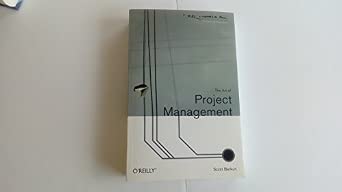
The Art of Project Management Second ed. Edition
Author(s): Scott Berkun (Author)
- Publisher: O′Reilly
- Publication Date: 6 May 2005
- Edition: Second ed.
- Language: English
- Print length: 488 pages
- ISBN-10: 0596007868
- ISBN-13: 9780596007867
Book Description
Editorial Reviews
Review
— Ioannis Cherouvim, JHUG, October 2007
About the Author
Excerpt. © Reprinted by permission. All rights reserved.
Few people agree on how to plan projects. Often, much of the time spent during planning is getting people to agree on how the planning should be done. I think people obsess about planning because it s the point of contact for many different roles in any organization. When major decisions are at stake that will affect people for months or years, everyone has the motivation to get involved. There is excitement and new energy but also the fear that if action isn t taken, opportunities will be lost. This combination makes it all too easy for people to assume that their own view of the world is the most useful. Or worse, that it is the only view of the world worth considering and using in the project-planning process.
“The hardest single part of building a software system is deciding what to build. No other part of the conceptual work is as difficult in establishing the detailed technical requirements, including the interfaces to people, to machines, and to other software systems. No other part of the work so cripples the results if done wrong. No other part is more difficult to rectify later. Therefore, the most important function that the software builder performs for the client is the iterative extraction and refinement of the product requirements.”
Fred Brooks
It s not surprising then that the planning-related books in the corner of my office disagree heavily with each other. Some focus on business strategy, others on engineering and scheduling processes (the traditional focus of project planning), and a few on understanding and designing for customers. But more distressing than their disagreements is that these books fail to acknowledge that other approaches even exist. This is odd because none of these perspectives business, technology, customer can ever exist without the others. More so, I m convinced that success in project planning occurs at the intersections in these different points of view. Any manager who can see those intersections has a large advantage over those who can t.
So, this chapter is about approaching the planning process and obtaining a view of planning that has the highest odds of leading to success. First I need to clarify some vocabulary and concepts that different planning strategies use (it s dry stuff, but we ll need it for the fun chapters that follow). When that is out of the way, I ll define and integrate these three different views, explore the questions good planning processes answer, and discuss how to approach the daily work to make planning happen. The following chapters will go into more detail on specific deliverables, such as vision documents (Chapter 4) and specifications (Chapter 7).
Software planning demystified
A small, one-man project for an internal web site doesn t require the same planning process as a 300-person, $10 million project for a fault-tolerant operating system. Generally, the more people and complexity you re dealing with, the more planning structure you need. However, even simple, one-man projects benefit from plans. They provide an opportunity to review decisions, expose assumptions, and clarify agreements between people and organizations. Plans act as a forcing function against all kinds of stupidity because they demand that important issues be resolved while there is time to consider other options. As Abraham Lincoln said, “If I had six hours to cut down a tree, I d spend four hours sharpening the axe,” which I take to mean that smart preparation minimizes work.
Project planning involves answering two questions. Answering the first question, “What do we need to do?” is generally called requirements gathering. Answering the second question, “How will we do it?” is called designing or specifying (see Figure 3-1). A requirement is a carefully written description of a criterion that the work is expected to satisfy. (For example, a requirement for cooking a meal might be to make inexpensive food that is tasty and nutritious.) Good requirements are easy to understand and hard to misinterpret. There may be different ways to design something to fulfill a requirement, but it should be easy to recognize whether the requirement has been met when looking at a finished piece of work. A specification is simply a plan for building something that will satisfy the requirements. These three activities requirements gathering, designing/specifying, and implementing are deep subjects and worthy of their own books (see the Annotated Bibliography). I ll cover the first two from a project-level perspective in the next few chapters, and implementation will be the focus later on in the book (Chapters 14 and 15).
Different types of projects
Several criteria change the nature of how requirements and design work are done. I ll use three simple and diverse project examples to illustrate these criteria:1
Solo-superman. In the simplest project, only one person is involved. From writing code to marketing to business planning to making his own lunch, he does everything himself and is his own source of funding.
Small contract team. A firm of 5 or 10 programmers and 1 manager is hired by a client to build a web site or software application. They draft a contract that defines their commitments to each other. When the contract ends, the relationship ends, unless a new contract/project is started.
Big staff team. A 100-person team employed by a corporation begins work on a new version of something. It might be a product sold to the public (a.k.a. shrink-wrap) or something used internally (internalware).
These three project types differ in team size, organizational structure, and authority relationships, and the differences among them establish important distinctions for how they should be managed. So, while your project might not exactly match these examples, they will be useful reference points in the following sections.