Wow! eBook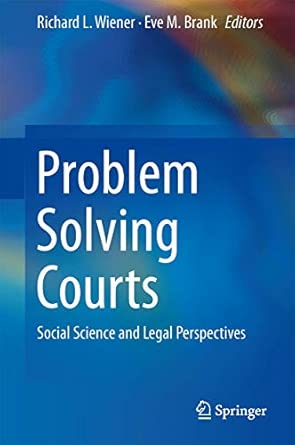
Problem Solving Courts: Social Science and Legal Perspectives 2013th Edition
Author(s): Richard L. Wiener (Editor), Eve M. Brank
- Publisher: Springer
- Publication Date: 12 July 2013
- Edition: 2013th
- Language: English
- Print length: 268 pages
- ISBN-10: 1461474027
- ISBN-13: 9781461474029
Book Description
Editorial Reviews
Review
Richard W. Bloom
PsycCRITIQUES
December 18, 2013, Vol. 58, No. 49, Article 4
From the Back Cover
Substance abuse. Child welfare. Domestic violence. Mental illness. Cases revolving around these concerns keep the court system under constant stress, often resulting in less than satisfactory outcomes. In contrast, problem solving courts offer an innovative alternate path where traditional courts leave off, an encouraging environment with the potential to benefit offenders, victims, and society alike.
Problem Solving Courts explores the concepts and practices of therapeutic jurisprudence for professionals in the legal and psychology fields. Differences from traditional criminal courts are analyzed through a number of perspectives, particularly as problem solving courts require offenders to receive rehabilitative services instead of harsher punishment. By focusing on solutions and being collaborative rather than adversarial, these courts are seen as curbing recidivism and the “revolving door” scenarios frequently associated with legal process. Coverage includes case vignettes from successful programs across the U.S. as well as Australia and New Zealand, and contributors examine training and other issues relevant to the problem solving model. Among the topics featured:
- The union of science and law in child welfare cases.
- Mental health courts: competence, responsibility, and proportionality.
- Gender issues in problem solving courts.
- Unified family courts: an interdisciplinary framework.
- Intended and unintended consequences of problem solving courts.
- Therapeutic jurisprudence in practice.
Blending basic and in-depth information across disciplines, Problem Solving Courts offers psychologists, family law specialists, family therapists, clinical psychologists, social workers, and legal and psychology practitioners a deeper understanding of this transformative aspect of the justice system.