 Wow! eBook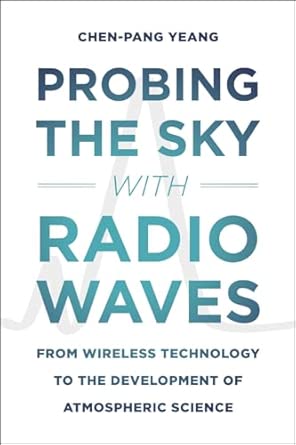
Probing the Sky with Radio Waves – From Wireless Technology to the Development Atmospheric Science
Author(s): Chen–pang Yeang (Author)
- Publisher: University of Chicago Press
- Publication Date: 9 July 2013
- Edition: Illustrated
- Language: English
- Print length: 360 pages
- ISBN-10: 022601519X
- ISBN-13: 9780226015194
Book Description
Editorial Reviews
Review
–Suman Seth, Cornell University
“Chen-Pang Yeang’s book is
the major contribution to our knowledge of how physical theory and electrical experimentation worked together to explain the movement of radio waves beyond the horizon–a compelling question in the years following Marconi’s famous experiment of 1901. Yeang clearly explains how ‘direct evidence’ for the existence of the ionosphere was ultimately provided and reminds us of how important work in classical physics continued into the exciting era of relativity and quantum mechanics. What he describes is a rare mix of physics and electrical engineering encountering the ‘field sciences.'”–A. David Wunsch, University of Massachusetts Lowell“The advent of global radio communications marked the beginning of three decades of intense theoretical and experimental studies of the ionosphere. Yeang’s work is a philosophically sophisticated examination of the interplay between theory and practice in the early years of radio science. Definitive experiments in the 1920s intentionally bounced radio waves off the ionosphere to probe its structure, and Yeang fits the history of the complex evolution of ionospheric studies into the wider contact of active sensing. . . . Highly recommended.”
— “Choice”
About the Author
Excerpt. © Reprinted by permission. All rights reserved.
Probing the Sky with Radio Waves
FROM WIRELESS TECHNOLOGY TO THE DEVELOPMENT OF ATMOSPHERIC SCIENCE
By Chen-Pang Yeang
THE UNIVERSITY OF CHICAGO PRESS
Copyright © 2013 The University of Chicago
All rights reserved.
ISBN: 978-0-226-01519-4
Contents
Acknowledgments……………………………………………………xi1 Introduction: From Propagation Studies to Active Sensors……………..1PART 1 Conceiving Long-Range Propagation, 1901-19…………………….2 Theorizing Transatlantic Wireless with Surface Diffraction……………193 The U.S. Navy and the Austin-Cohen Formula………………………….514 Synthesis with Atmospheric Reflection………………………………66PART 2 Discovering the Ionosphere, 1920-26…………………………..5 Radio Amateurs Launch the Short-Wave Era……………………………1116 From the Skip Zone to Magneto-Ionic Refraction………………………1447 British Radio Research and the Moments of Discovery………………….1808 Pulse Echo, CIW, and Radio Probing of the Ionosphere…………………215PART 3 Theory Matters, 1926-35……………………………………..9 Consolidating a General Magneto-Ionic Theory………………………..24710 Handling Microphysics……………………………………………275PART 4 Conclusion…………………………………………………11 A New Way of Seeing the World…………………………………….321Bibliography………………………………………………………329Index…………………………………………………………….349
Excerpt
CHAPTER 1
Introduction: From PropagationStudies to Active Sensors
On 26 October 2004, the Cassini Orbiter had its first close flyby of Titan,Jupiter’s largest moon. Under the control of the Jet Propulsion Laboratory(JPL) at California Institute of Technology in Pasadena, the spacecraft hadundertaken a seven-year cosmic odyssey since its launch from the KennedySpace Center in Florida. The JPL staff and participating researchers aroundthe world had waited for this day, since one of the project’s major missions—arguablyits primary task—was to explore Titan. As an exploratory platform,the Cassini boasted a dozen detectors, including two state-of-the-art camerasthat had captured stunning images of Saturn and its rings and a cadre ofspectrometers to monitor the chemical composition of any radiating celestialbody.
But Titan posed a particular challenge to the instrument designers. It is theonly satellite of the solar system possessing an atmosphere, and a thick, yellowhaze of hydrocarbons almost perpetually blocks it to cameras and spectrometers.Even the onboard Huygens probe—the landing unit that the EuropeanSpace Agency had made for exploring Titan’s surface—was not the completesolution, as it could take measurements only near its landing site. To reveal theyellow moon’s macroscopic geological characteristics, the Cassini team restedits hopes on imaging radar. Unlike cameras and spectrometers, which receivedlight, energy, or particles that emanated from the observed object, the radarbounced microwaves off the object and timed their return. This apparatus didnot disappoint the JPL staff. During the flyby, it scanned 1 percent of Titan’soverall surface and relayed the echoed signals back to earth. Three days later,JPL’s Media Relations Office proudly displayed the first radar images of Titan,which unveiled such novel features as the active surface, complex terrains,and the possible existence of lakes. The Titan radar had made its début.
The mapping of Titan’s geology signified a mode of seeing that has permeatedour world, ranging from the spectacular weather-radar images of ash outof the recently erupting Eyjafjallajõkull volcano in Iceland and the underwatersounding of the Titanic‘s debris in the North Atlantic, through the mundanealtimeters every aircraft now carries and acoustic pulse-echo devices popularamong oil-drilling stations, to the ubiquitous magnetic-resonance imaging(MRI), ultrasound, and X-ray machines that adorn modern hospitals. In noneof these endeavors do instruments passively observe and measure objects ina nonintervening manner; rather, an acoustic wave, electronic beam, electromagneticwave, or other form of energy or particle flow “pokes” the objectsand then reconstructs their properties from their modification of the flow.This is the principle of the active sensor, one of the most powerful scientificinstruments since the early twentieth century.
Instruments are never “just” instruments. Introducing a new instrument isnot simply the addition of more advanced hardware to enhance human capacity.As history shows, it often accompanies a sea change of understanding anddoing things: the telescope initiated the Scientific Revolution; the air pumpnurtured laboratory science; the thermometer pioneered quantitative experimentation;the microscope redefined diseases; the particle accelerator made”big science”; the polymerase chain reaction heralded the genetic worldview.Likewise, the employment of active sensors represents a distinct approachto probing nature, the body, and artifacts that involves not only instrumentdesign but also the making of theories and experimentation.
How did the approach of active sensing come into existence? What characterizedthis approach as it was developing? How did such a novel mode ofseeing change the meanings of experimentation and the patterns of experimentalpractice? How did it affect the standard of legitimate evidence? Howdid theories of wave or particle propagation help form and refine active sensing?What kinds of epistemic functions did these theories aim to undertake?Why did this mode of seeing prevail?
While the complete answers to these questions require an overwhelmingcomparative analysis and synthesis of all active sensors that easily go beyondthe scope of a monograph, investigation of an informative case may shed somelight on such vexing puzzles. This book examines research on radio ionosphericpropagation between 1900 and 1935. It is a story of mutual shapingbetween wireless technology and atmospheric science. After Guglielmo Marconi’sfirst successful transatlantic test in 1901, scientists were curious aboutwhy and how radio waves could propagate over such a long distance withoutthe earth’s blocking them. From 1901 to 1925, European theoreticians andAmerican engineers grappled with this problem. Its solution led to the discoveryof an electrically active region in the upper atmosphere, which theynamed the “ionosphere.”
This revelation opened a new field in earth sciences, and, with the assistanceof propagation studies, initiated a novel method of experimentationbased on manipulating waves: sending radio waves to the ionosphere and detectingtheir return. Known as “radio sounding,” this method transformed atmosphericstudies from passive observation to active experimentation, undercuttingthe traditional distinction between field and laboratory sciences.From wireless to geophysics, the emergence of studies of radio ionosphericpropagation occupies a significant position in the history of active sensing:it began this mode of seeing with electromagnetic waves and led directly toradar during World War II and various sensors in space exploratory programssince Sputnik and Apollo.
FROM PROPAGATION STUDIES TO ACTIVESENSING: EXPERIMENT AND THEORY
Similar to the emergence of some other active sensors, the history of radioionospheric propagation displays a transformation from studies of wavepropagation to development of active-sensing systems. Looking at images ordata from a lidar, radar, seismic sounder, sonar, or X-ray machine, we may assumethat the stream of energy that the instrument sends to observed objectsis a transparent medium that merely helps to illuminate the invisible, like aspotlight on a dark stage. But that is not the case. Far from being transparent,that medium is usually complex, entangles itself with imaging and measuring,attracts researchers’ attention for its own sake, and thus has a rich history.
The origin of radio ionospheric sounding attests to the importance ofwave-propagation research. What spurred radio echo-sounding probes of theionosphere in the mid-1920s was not geoscientists’ pressing need to measurethe upper atmosphere, but physicists and engineers’ desire to understand howradio waves propagated over long distances above the earth. Only after thediscovery of the ionosphere and the invention of the sounding-echo schemeduring wave-propagation research did scientists refocus from the waves to theupper atmosphere.
Along this axis of transformation, the history of radio ionospheric propagationepitomizes the challenges that active sensing has brought to our understandingof modern science and technology. In its first thirty years—fromMarconi’s wireless test to the establishment of the so-called magneto-ionictheory—which constitutes the scope of this book, such a history raises at leastthree major issues in experiment and theory: Is it possible to experiment outsidelaboratories? How do we define direct evidence? What role does theoryplay at different stages of research?
In a subsequent book, I will examine the development and ramificationof the automatic ionospheric sounders in the 1930s based on the theoreticaland experimental work on radio propagation, and the establishment of radioionospheric forecasting services around the world during World War II. Thisforthcoming work will address more closely the issues of instrumentation andtechnology in radio ionospheric research.
The issues of experiment and theory raised in the development of activesensing were embedded in a broader context of changing senses of reality atthe turn of the twentieth century. Historians have found that scientists duringthis period were increasingly concerned with the epistemic ground of variousexperiments, observations, and instruments that promised to make the invisiblevisible: Do scientific instruments uncover phenomena, or create them?What is the role of sensory experiences in the process of generating empiricalknowledge? How does one make claims about microscopic or hidden entitiesbased on macroscopic or observable effects? While the scientists’ viewson these questions diverged, they were all aware of the instrument-mediatingcharacter of scientific evidence, and the shaping force of instruments on experimentand theory.
Field Experiments and Direct Evidence
Above all, studies of radio ionospheric propagation in the early twentiethcentury broaden our historical understanding of experiment. The empiricalinvestigations on wave propagation and the ionosphere, like the researchand development relating to many other active sensors, had to take place outdoors.The scale could be as large as several thousand miles, and the objectsof interest were geophysical in nature. These outdoor measurements and testswere by no means feasible in any laboratory. Therefore, we may not be ableto understand them in terms of the laboratory studies that historians have exploredin the past. For example, measurements of wave propagation and radiosounding of the ionosphere hardly followed what historians Steven Shapinand Simon Schaffer have called the “laboratory form of life”: Control andmanipulation of material conditions and relevant variables were often verychallenging; replication was usually almost impossible; authoritative eyewitnessesof results were rare; and investigators aimed not so much to generatenovel “matters of fact” or “scientific effects” as to figure out how those scientificeffects interacted with large-scale nature.
Rather, the empirical work in this story resembled more the tradition offield sciences such as astronomy, botany, geology, geodetics, meteorology, andzoology. What characterized these sciences and radio ionospheric propagationalike were comprehensive and extensive fieldwork, careful preparationfor expeditions, meticulous collection of data, and precise instrumentation forobservations. The “Humboldtian approach” marked an apex of efforts to turnnatural history into integrated, modern field science.
Nevertheless, calling radio ionospheric propagation Humboldtian maydownplay its experimental features. Throughout the first half of the twentiethcentury, the physicists and engineers measuring wave propagation and soundingthe ionosphere frequently called their activities “experiments.” Much oftheir practice closely resembled experimentation rather than field observation:their instruments, not nature, produced the radio waves. Although theycould not control the macroscopic geophysical structures that shaped thepropagation of radio waves over distance, they could manipulate radio waves,including their frequencies, power, polarizations, and waveforms.
Such delicate control encouraged them to tinker with devices, redesignprocedures, coordinate measurements, and manipulate signals. For example,military engineers tested wireless equipment between warships, radioamateurs demonstrated long-range radio communications with coordinatedvoluntary actions all over Europe and the Americas, physicists explored scientificeffects between ground and sky at particular experimental sites, andgeoscientists acquired data from networks of observing stations (which resembledlabs) and interpreted them. These were not laboratory but ratherfield experiments in our eyes and in theirs. Instead of working indoors, theyexperimented outdoors and turned nature into a laboratory.
How credible was their empirical evidence? While wave propagation studieshad suggested the possibility of an electrically active upper atmosphere,general acceptance of the ionosphere’s existence occurred only after thesounding-echo experiments in the 1920s. Why? Many scientists believed thatthe sounding-echo experiments generated “direct” evidence for the ionosphere.But what was direct about the evidence produced by this particularapproach? Control in field experiments, I believe, offers the answer: unlikepropagation experiments, which only changed the transmitting radio waves’power and frequency, the sounding-echo tests relied on more elaborate controlof waveforms. Instead of sinusoids modulated by Morse code dots anddashes, radio waves now could be chirps, pulses, or other patterned undulations,which scientists designed so that their return, scattering, or deflectionfrom an unknown entity would exhibit their properties more clearly.
Here Nancy Cartwright and Ian Hacking’s concept of entity realism mayhelp us: a scientific object is real if we can manipulate it. Sounding-echo experimentersin the 1920s could not modify the ionosphere, yet they couldtinker with the transmitting radio waveforms as malleable signals and observethe corresponding changes at the receivers. The introduction of waveformcontrol in propagation experiments made the ionosphere seem more “real”and transformed propagation studies into active sensing.
Epistemic Status of Theories
A central desideratum of research on radio ionospheric propagation was tounderstand how radio waves traveled above the ground, across water, withinthe atmosphere, around geographical obstacles, or in any other open environmenton the earth. Through the first half of the twentieth century, scientistsand engineers proposed, elaborated, and fought over several theories: surfacediffraction, atmospheric reflection, ionic refraction, and magneto-ionic refraction.The contest between these theories spurred studies of radio ionosphericpropagation, especially up to 1930.
However, it is misleading to interpret the story as one theory replacinganother, like Hempel-style expansion of covering laws or Kuhnian paradigmchange. Scientists devised these theories for different purposes, and theyserved different functions. Although they did generate mutually incompatiblepredictions on some empirical questions, and although researchers fiercelydebated such forecasts, more often they operated within their own realms andwere either irrelevant or marginal to others.
This plurality becomes clear as we examine the epistemic status of wave-propagationtheories. At least six questions are germane here. What was atheory’s aim and function? What was its most important intellectual virtue?What was the empirical knowledge essential to the theory? What were thecentral questions it meant to answer? What was its method for tackling thesequestions? What sort of answers did scientists expect?
The two dominant theories of wave propagation between 1900 and 1920,for instance, differed in nature, even though they both attempted to explainthe possibility of long-distance radio. Consistent with Pierre Duhem’s twotypes of scientific theories, the hypothesis of surface diffraction aimed at formalrepresentation of an empirical fact, whereas atmospheric reflection proposedcausal explanations for a broader set of wireless phenomena.
Mathematical physicists worked on surface diffraction and sought a mathematicalmodel to represent long-distance propagation of radio waves alongthe earth’s curvature. Their model comprised a wave equation and a simpleboundary condition and gained a life of its own. It became more and more aplatform to develop approximating techniques in solving differential equationsinstead of a reference point for empirical observations. In other words,mathematics was replacing physics.
By contrast, radio engineers were the main explorers of atmospheric reflection.The theory’s mathematical structure was much cruder and simpler thansurface diffraction before 1919. It boasted no differential equations, no Besselfunctions, no asymptotic approximations; it worked with just naive ray tracingand geometric optics. But formal refinement was never the point. Rather,radio engineers sought to explain numerous wireless phenomena from dailypractice—not only long-distance propagation, but also diurnal, geographical,and seasonal variations of ambient noise from the atmosphere. Even thoughthe explanations that they generated were only partly quantitative, their broadbut rough theory of atmospheric reflection explained their field observationsmuch better than the precise but narrow theory of surface diffraction.
(Continues…)Excerpted from Probing the Sky with Radio Waves by Chen-Pang Yeang. Copyright © 2013 by The University of Chicago. Excerpted by permission of THE UNIVERSITY OF CHICAGO PRESS.
All rights reserved. No part of this excerpt may be reproduced or reprinted without permission in writing from the publisher.
Excerpts are provided by Dial-A-Book Inc. solely for the personal use of visitors to this web site.


