 Wow! eBook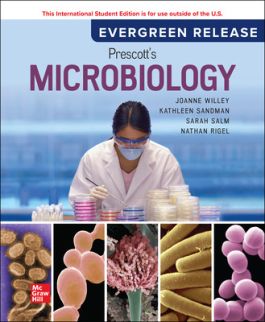
Loose Leaf for Prescott's Microbiology: 2026 Release
Author(s): Joanne Willey (Author), Kathleen Sandman (Author), Dorothy Wood (Author)
- Publisher: McGraw Hill
- Publication Date: January 8, 2026
- Print length: 992 pages
- ISBN-10: 1265217998
- ISBN-13: 9781265217990
Editorial Reviews
Editorial Reviews
About the Author
Joanne M. Willey has been a professor at Hofstra University on Long Island, New York, since 1993, where she is the Leo A. Guthart Professor of Biomedical Science and Chair of the Department of Science Education at the Donald and Barbara Zucker School of Medicine at Hofstra/Northwell.
Dr. Willey received her B.A. in Biology from the University of Pennsylvania, where her interest in microbiology began with work on cyanobacterial growth in eutrophic streams. She earned her Ph.D. in biological oceanography (specializing
in marine microbiology) from the Massachusetts Institute of Technology–Woods Hole Oceanographic Institution Joint Program in 1987. She then went to Harvard University, where she spent her postdoctoral fellowship studying the filamentous soil bacterium Streptomyces coelicolor. Dr. Willey has coauthored a number of publications that focus on its complex developmental cycle. She is an active member of the American Society for Microbiology (ASM), and served on the editorial board of the journal Applied and Environmental Microbiology for nine years and as Chair of the Division of General Microbiology. Dr. Willey taught microbiology to biology majors for 20 years and now teaches microbiology and infectious disease to medical students. She has taught courses in cell biology, marine microbiology, and laboratory techniques in molecular genetics.
Dr. Willey lives on the north shore of Long Island and has two grown sons. She is an avid runner and enjoys skiing, hiking, sailing, and reading. She can be reached at joanne.m.willey@ hofstra.edu.
Kathleen M. Sandman received her B.A. in Biology from La Salle University and her Ph.D. in Cellular and Developmental Biology from Harvard University. She was inspired to a career in science by her older brother’s experience as an organic chemist and by the developing technology in recombinant DNA in the 1970s. Her graduate work used a transposable element as a mutagen in Bacillus subtilis to study gene expression during endospore formation. She continued in the genetics of Gram-positive bacteria with a postdoctoral year studying Bacillus thuringiensis at the University of Cambridge in the United Kingdom. Another postdoctoral opportunity at The Ohio State University provided an introduction to the emerging field of archaeal molecular biology, where Dr. Sandman discovered archaeal histones and continued research in the structural biology of archaeal chromatin for about 20 years. She served the National Science Foundation as a research grant reviewer and panelist for the Life in Extreme Environments program, and has organized conference sessions on archaeal molecular biology and proteins from extremophiles. Dr. Sandman has taught microbiology to hundreds of students, at both the introductory level and in an advanced molecular microbiology laboratory.
Dr. Sandman has worked as a consultant in a variety of industries, including industrial microbiology, environmental geomicrobiology, and technical publishing. She lives with her husband in Columbus, Ohio, and has two grown daughters. She enjoys biking, fabric arts, reading, and genealogy, and can be reached at kathleenmsandman@gmail.com.
Table of contents
Part One Introduction to Microbiology
1. The Evolution of Microorganisms and Microbiology
2. Microscopy
3. Bacterial Cell Structure
4. Archaeal Cell Structure
5. Eukaryotic Cell Structure
6. Viruses and Other Acellular Infectious Agents
Part Two Microbial Nutrition, Growth, and Control
7. Bacterial and Archaeal Growth
8. Control of Microorganisms in the Environment
9. Antimicrobial Chemotherapy
Part Three Microbial Metabolism
10. Introduction to Metabolism
11. Catabolism: Energy Release and Conservation
12. Anabolism: The Use of Energy in Biosynthesis
Part Four Microbial Molecular Biology and Genetics
13. Bacterial Genome Replication and Expression
14. Regulation of Cellular Processes
15. Eukaryotic and Archaeal Genome Replication and Expression
16. Mechanisms of Genetic Variation
17. Microbial DNA Technologies
18. Microbial Genomics
Part Five The Diversity of the Microbial World
19. Archaea
20. Nonproteobacterial Gram-Negative Bacteria
21. Proteobacteria
22. Gram-Positive Bacteria
23. Protists
24. Fungi
25. Viruses
Part Six Ecology and Symbiosis
26. Exploring Microbes in Ecosystems
27. Microbial Interactions
28. Biogeochemical Cycling and Global Climate Change
29. Microorganisms in Marine and Freshwater Ecosystems
30. Microorganisms in Terrestrial Ecosystems
Part Seven Pathogenicity and Host Response
31. Innate Host Resistance
32. Adaptive Immunity
33. The Microbe-Human Ecosystem
34. Infection and Pathogenicity
Part Eight Microbial Diseases, Detection, and Their Control
35. Epidemiology and Public Health Microbiology
36. Clinical Microbiology and Immunology
37. Human Diseases Caused by Viruses and Prions
38. Human Diseases Caused by Bacteria
39. Human Diseases Caused by Fungi and Protists
Part Nine Applied Microbiology
40. Microbiology of Food
41. Biotechnology and Industrial Microbiology
42. Applied Environmental Microbiology
Appendix 1 A Review of the Chemistry of Biological Molecules
Appendix 2 Common Metabolic Pathways
Appendix 3 Microorganism Pronunciation Guide


