 Wow! eBook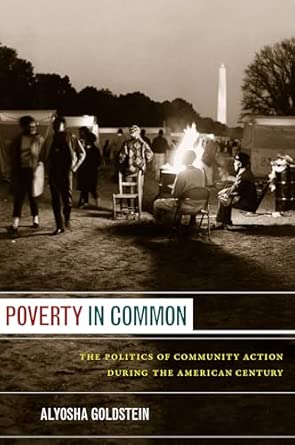
Poverty in Common: The Politics of Community Action during the American Century
Author(s): Alyosha Goldstein (Author)
- Publisher: Duke University Press Books
- Publication Date: 23 Mar. 2012
- Language: English
- Print length: 392 pages
- ISBN-10: 0822351676
- ISBN-13: 9780822351672
Book Description
Editorial Reviews
Review
“
Poverty in Common is a highly original and nuanced study of how ‘the government of poverty’ at home and abroad became central to postwar US liberalism and its distinctive precipitates of violence and reform, force and freedom, democracy and empire.”—Nikhil Pal Singh, author of Black Is a Country“
Poverty in Common is an insightful analysis of how community development figured in liberal reformist and nation-building programs in the United States during the 1950s and 1960s. As Alyosha Goldstein argues so convincingly, liberals depended on assertions of community participation and even required that oppressed populations be made to participate in a reformist agenda. Yet liberals circumscribed that participation by pushing aside pressing questions about structural inequality, entrenched racism, and the redistribution of resources. Poverty in Common offers a compelling way to think about the powerful appeal and ultimate demise of postwar American liberalism.”—Michael E. Latham, author of The Right Kind of Revolution“The book provides a fresh take on the concept and history of Community Action. A particular strong point of the book is its analysis of the international dimension of community development and how ideas of community participation guided US foreign policy in the postwar period. . . .
Poverty in Common, should be on any War on Poverty or Community Action specialist’s reading list.” — David Torstensson ― Journal of Children and Poverty“[A]nyone interested in American studies, especially scholars of radical politics, social movements, and social welfare, will be impressed by this timely and erudite volume.” — Mark Edward Braun ―
American Historical Review“Goldstein’s book is an exemplary history of mid‐twentieth-century liberalism. The emphasis on Cold War convergence between domestic and international discourse around ‘underdevelopment’ highlights the strengthening of U.S. empire during this period. Moreover, the argument that ‘the poor’ are constructed by liberals as a monolithic, foreign body in a liberal democracy is persuasive and worth considering further in current discussions of global capitalism.” — Rose Ernst ―
Political Science Quarterly“
Poverty in Common is an eloquent contribution to a vast literature that seeks to explain the persistence and spread of poverty at the heart of the most affluent nation on earth…A real virtue of the book, particularly for those who are not students of the US, is Goldstein’s careful integration of US foreign policy imperatives with its domestic policy bent.” — Elizabeth Vibert ― Labour/Le Travail“Amid a sea of historical scholarship on the evolution of modern conservatism in the United States, Alyosha Goldstein offers a provocative new interpretation of midtwentieth-century liberalism…. [T]his book should become required reading not only for scholars of the War on Poverty and 1960s liberalism but anybody engaged in questions of twentieth-century US political, policy or social movement history.” — Marisa Chappell ―
Social HistoryAbout the Author
Alyosha Goldstein is Associate Professor in the Department of American Studies at the University of New Mexico.
Excerpt. © Reprinted by permission. All rights reserved.
POVERTY IN COMMON
THE POLITICS OF COMMUNITY ACTION DURING THE AMERICAN CENTURYBy Alyosha Goldstein
Duke University Press
Copyright © 2012 Duke University Press
All right reserved.
ISBN: 978-0-8223-5167-2
Contents
ACKNOWLEDGMENTS………………………………………………………………………………………………….1INTRODUCTION “NOW, WE’RE OUR OWN GOVERNMENT”………………………………………………………………………..31CHAPTER ONE FREEDOM BETWEEN Inequality and the Democracy of “Felt Needs”……………………………………………….77CHAPTER TWO ON THE INTERNAL BORDER Colonial Difference and the Locations of Underdevelopment……………………………..111CHAPTER THREE THE CIVICS AND CIVILITIES OF POVERTY Participation, Policing, and the Poor People’s Campaign…………………155CHAPTER FOUR THE SURPLUS OF INCLUSION Poverty, Pluralism, and the Politics of Community………………………………….199CHAPTER FIVE THRESHOLDS OF OPPOSITION Liberty, Liberation, and the Horizon of Incrimination………………………………245CONCLUSION A PECULIAR FREEDOM Community and Poverty, from New Federalism to Neoliberalism………………………………..257NOTES…………………………………………………………………………………………………………..323BIBLIOGRAPHY…………………………………………………………………………………………………….357
Chapter One
FREEDOM BETWEEN Inequality and the Democracy of “Felt Needs”
Community development programs after the Second World War were concerned with identifying and cultivating local democratic initiative and neighborhood-level leadership. But tangible evidence of such activity and disposition—especially of the conciliatory type that the programs hoped to encourage—proved to be elusive. Policymakers and social scientists described the concern with this type of activity as an imperative to begin from the “felt needs” of a local community—claiming that community development “must come from within through the greatest possible participation of the people in accordance with needs determined by their values.” Although reformers in the Progressive Era conceived of the local community as the principal site for their social initiatives, not until the late 1940s did reformers consider the full participation and self-determined transformation of those who were to be reformed as integral to the success of such initiatives. A brief example from a booklet in the Libros Para el Pueblo (Books for the People) series of the División de Educación de la Comunidad (Division of Community Education; DIVEDCO) in Puerto Rico during the 1950s shows how popular will and introspection were cast during the postwar era as a dilemma for government-aligned social action.
The story in the booklet, “La Voluntad que Ignacio no Tuvo” (Ignacio’s lack of will), is simple, but skillfully enough written so as not to seem insincere or formulaic. Ignacio stares listlessly down the road and across a parched, weed-covered field, while behind him a small crowd of neighbors gathers before the beginning of a town meeting. He overhears Nico, a “nobody” like himself, complaining to the others that local farmers have no land to cultivate. “The government should bring industry to the countryside,” says Nico. But Ignacio is lost in his own thoughts and pays little attention to the conversation. He is thinking of his young son, who cried inconsolably at night before his death. He remembers his child’s awful fevers and the tears of his wife, Gabriela. He recalls that other children had been ill, too. A mangy dog drinking from the nearby town well catches his eye. A wall should be built to keep the animals away from the community’s only source of potable water, reflects Ignacio, “But who is going to take care of that?” He shrugs and tries to think of something else. The town meeting begins with Isidro—a prominent citizen and an associate of Teyo, a landowner who is also present—addressing those gathered. The well-spoken Isidro recounts his efforts to obtain government support for a new park for the town. It was difficult, but he had secured funds for the park’s construction on land to be generously donated by Teyo. It occurs to Ignacio that providing many other basic necessities would better serve the town than creating a park: “He suddenly feels the impulse to stand up and to begin to speak. He would say that the park was a good idea, but as a future project. There were more urgent problems in the community … for example, dogs drinking from the public well and the fevers and the children dying.” But fear silences Ignacio. What right did he have to challenge Isidro? Only later, after the park has been finished and Ignacio hears Isidro telling a neighbor that a public health official informed him that the town’s well was contaminated, does Ignacio profoundly regret his inaction. Returning home, he encounters Gabriela, now pregnant, who cradles a bundle of kindling. “In that moment a sudden decision awakened his sleeping will. ‘The same thing is not going to happen to this child that happened to the other. I swear it!,’ he said out loud.” But when Ignacio finally speaks there is no one there to hear him. The story ends without catharsis or confrontation, but with the possibility of inner transformation and the deferred promise of social action.
“La Voluntad que Ignacio no Tuvo” was paired with a second short story in the 1953 booklet Los Casos de Ignacio y Santiago. The other narrative is about Santiago, who, unlike Ignacio, saves his child’s life because he was able to overcome his passivity and help solve the problem of tainted communal water. As was DIVEDCO’s practice, the agency not only produced and distributed the booklet, but it also conducted a study of the booklet’s reception in the communities where it was read. Contrary to the agency’s expectations, its survey found that the vast majority of readers favored and identified with the “pessimistic” story of Ignacio’s “failure of will” rather than the supposedly inspirational tale of Santiago. Only traces of Santiago remained three years later when DIVEDCO produced the thirty-four-minute film Ignacio for community screenings. Responding to the readers’ comments, the filmmakers cut the second narrative, emphasizing instead the oppressive paternalism of local elites, the apparently passive hope for rescue by government projects, and, above all, Ignacio’s inner struggle to overcome his sense of resignation and powerlessness. A new ending, however, nudges Ignacio’s inchoate social consciousness toward civic action. The scene shows a community meeting with amateur actors and people from the rural town in which the film was shot. This time Ignacio stands and addresses his neighbors. His voice is still tentative, but he has gathered his courage to speak publicly: “I don’t know how it’s to be done, but I do know the community should consult with someone who knows [how to make sure that we have clean water]. Something has to be done about this water problem that has made everyone suffer so much.” A concluding voice-over informs the audience that “little by little, everyone began to talk. The problem had been hidden in everyone’s mind. But now, Ignacio, the illiterate one, had made it clear and urgent with his words.” Ignacio thus personifies the aims of community development in practice, first recognizing his feeling of inadequacy and then overcoming it to initiate, with others like him, community transformation.
Ignacio was indicative of emerging government concerns about local community development during the 1950s. In 1951, the US delegation to the un Social Commission presented a paper outlining a plan for community development centers. The paper maintained that the governmental agent “should not establish and run the center; he should help members of the community to learn to run it themselves as their own facility, to help them carry on the process of community self-development.” The authors warned against “the creation of formal, collective institutions,” instead recommending the development of “a cooperative individualism, functioning through informal neighborhood and community organizations.” This would enable a “decentralized democratic development” shaped by the recognition that “‘freedom is in the interstices’ between formal organizations.” For many policymakers, Puerto Rico’s divedco became the embodiment of this strategy. Describing the Puerto Rican program, Ellery Foster, a US international aid consultant, observed: “Unlike specialized programs designed by experts to help people meet particular, predetermined felt needs, this approach recruits and trains village-level workers, not as purveyors of technical knowledge, but as catalytic or leavening agents to stimulate democratic processes of discussion, planning, and cooperation, in order to identify local problems and to develop local solutions to them.” He stressed that “the 40 field workers in the Puerto Rico Community Education Program are not extension agents taking new technical knowledge to the people. Their function is to nurture the root-growth of democracy itself.” Although notions of expertise and guidance persisted, as the consultant’s comments indicate, emphasis had moved toward facilitating the self-awareness and collective action of poor communities themselves in order to more intimately connect local and national purpose. A crucial difference between the programs after the Second World War and earlier locally focused ventures was the degree to which policymakers and social scientists identified the informalities and interstices of political life, and especially the collective initiative of poor people on their own behalf, as essential for this connection.
This chapter focuses on the specificity of mid-twentieth-century community-based antipoverty initiatives, examining their continuity with and divergence from reforms of the Progressive Era. The initiatives did not emerge as part of a trajectory toward self-determination by people living in poverty, in which the concern for addressing the local circumstances of poor people that we first glimpse in late-nineteenth-century social settlements evolves into full-fledged agency in the community-based programs of the 1960s. Nor was the conception and deployment of community a stable historical object from the 1890s onward, or ultimately only a disingenuous instrument for social control. Rather, I argue that at the beginning of the twentieth century and during the three decades following the Second World War, ideas and initiatives that centered around the idiom of community became especially significant for debates about social and economic inequality.
By starting the chapter with early-twentieth-century examples from the People’s Institute in New York City and the Social Unit Organization in Cincinnati, and then returning to the work of DIVEDCO during the 1950s and 1960s, I aim to show how these moments were analogous yet distinct, how multiple tensions and uneven negotiations played out in the arena of what was called first “community organization” and later “community development,” and how and why the notion of community served competing claims and disparate purposes. I endeavor to convey how the particularities of the postwar context, which are the focus of this book more broadly, were not the result of a chronological development but a distinct episode of reconstruction and conflict among various factions of government, radicals, reformers, and poor people over the politics of belonging, autonomy, and inequality. I suggest why it was not until after the Second World War that, to varying degrees, poor people were themselves involved in the design, organization, and oversight of such programs, although many of the key features of the model for governmentally aligned community action were developed during the 1910s.
Reaching the People
During the late nineteenth century, proponents of what was then called the new liberalism began to challenge the preeminence of laissez-faire doctrine. New liberalism shifted emphasis from the classical liberal concern with protecting individuals from the encroachments of government—defending negative liberties—to advocating government as a means of increasing the scope and capacity of individual freedoms—expanding positive liberties. Thus, when the American Economic Association was established by Richard T. Ely in 1885, its founding platform declared: “We regard the state as an educational and ethical agency whose positive aid is an indispensable condition of human progress.” Citing the association’s proclamation, the historian Brian Balogh points out that “new liberals embraced a wide range of options regarding the relationship between the state and society in the late nineteenth century,” including both clearly “national statist solutions” and the delegation of “national authority to private and voluntary groups so that they, rather than the national government directly, could compel individuals to comply with policies that best served the greater good of the country.” An increasing concern with the everyday lives and local social status of the non-elite was one consequence of such delegation.
Community-based social initiatives in both the early and mid-twentieth century promoted their work as endeavors on behalf of “democracy,” although the exact meaning of that word shifted substantially from one invocation to the next. In his 1916 study Poverty and Social Progress, Maurice Parmelee announced that “the coming of the democratic society will mean the abolition of poverty. For it is inconceivable that such a society would tolerate this condition for any of its members.” For Parmelee, democracy remained an aspiration that had not yet been achieved, but its realization promised the equivalence of political and material equality. The Progressive Era theorist Mary Parker Follett argued that politics “must satisfy the needs of the people,” but she also contended that “the needs of the people are not now articulate: they loom out of the darkness, vague, big, portentously big, but dumb because of the separation of men.” American democracy accordingly required the recognition of difference and interdependence across classes and races. Follett maintained that “we can never reform American politics from above, by reform associations, by charters and schemes of government … Political progress must be by local communities.” Reformers often simplified this distinction by construing “local community” as an organic whole equal to the common “below,” rather than as a site that in turn was unevenly divided by race, class, and gender. Writing in the 1920s, the sociologist Jesse Steiner observed: “One of the striking aspects of the recent interest [since 1900] in social reconstruction has been the increasing emphasis on the community as a social unit of real significance.” Careful to respect the professional domain of social workers and other local authorities, he proposed that emphasizing “community organization means simply a greater concentration of attention on the problem of striking a proper balance between specialized agencies and the interests of the people as a whole.” Democracy would thus embody the “whole” community, establishing consensus and cooperation across classes on behalf of an ostensibly objective and impartial common good.
It was in this sense that reformers during the 1910s emphasized “neighborhood” as a means of nation building. Although class war may have considerably preoccupied and motivated Progressive reformers, it was the First World War that made “community” an arena for state intervention and decisively aligned liberal projects with government initiatives. Following several decades of protracted labor conflict with intermittent mass strikes, violent standoffs, economic instability, and the steady advance of socialism that produced nearly a million votes for Eugene V. Debs in the 1912 presidential election, the First World War marked a significant turning point. Not only did the war provide a justification for suspending hard-won labor regulations and suppressing radicals, it allowed legislators the opportunity to experiment with new forms of governance in the name of national unity and democratic revitalization. The administration of President Woodrow Wilson enlisted the support of community reformers such as John Collier in connecting local initiatives to national mobilization in what was called the war for democracy. Reformers cast poverty as a condition that made poor people inefficient citizens by artificially obstructing their participation in the larger society. In the context of war, this inefficiency presumably jeopardized national preparedness and productive capacity, as well as fundamentally undermining a collective sense of nation.
Wartime mobilization prompted the Wilson administration’s interest in local community organizing and focused government efforts on the effective and efficient use of local initiatives combined with the social and administrative expertise of reformers. The Council of National Defense launched state and local community councils in early 1918 under the slogan “every community a little democracy.” Accordingly, Henry E. Jackson, the US Bureau of Education’s special agent for community organization and a key administrator of the community councils, pronounced: “A man without a community is a man without a country. His membership in the nation depends on his membership in the local community.” This was not primarily a concern with poverty and public welfare, but an interest in how the government might better activate and use local communities in realizing the goals of public policy. However, because the federal government sought the advice and contribution of leaders of the social service profession and because targeting the whole community required addressing issues of social and economic inequality, wartime community organizing confronted—even if not as a principal consideration—the question of poverty and participated in the broader transition from charity to public welfare.
(Continues…)
Excerpted from POVERTY IN COMMONby Alyosha Goldstein Copyright © 2012 by Duke University Press. Excerpted by permission of Duke University Press. All rights reserved. No part of this excerpt may be reproduced or reprinted without permission in writing from the publisher.
Excerpts are provided by Dial-A-Book Inc. solely for the personal use of visitors to this web site.


