Wow! eBook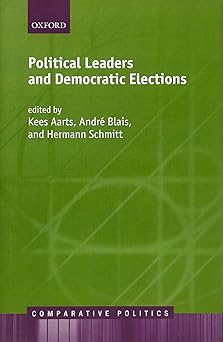
Political Leaders and Democratic Elections
Author(s): Kees Aarts (Editor), André Blais (Editor), Hermann Schmitt (Editor)
- Publisher: OUP Oxford
- Publication Date: 10 Mar. 2011
- Edition: Illustrated
- Language: English
- Print length: 254 pages
- ISBN-10: 0199259003
- ISBN-13: 9780199259007
Book Description
Political Leaders and Democratic Elections unravels and evaluates the importance of political leaders in the vote decision. Outcomes of legislative elections are typically reported in terms of party support: how many votes and seats were obtained by each party? But in fact voters are faced with three choices which must be folded into one. They must decide which party they prefer, but in doing so they also choose among the policies advocated by these parties, and among the leaders who eventually have to enact them. This simple fact raises the question of the relative weight of these dimensions in vote choice, and particularly the relative importance of leaders. Surprisingly, the question has been largely neglected in the vast literature on voting behavior. The dominant traditions in voting behavior focus on political parties and party identification, and on political issues and ideology respectively. This volume systematically assesses the role of political leaders in the vote decision in nine democracies (Australia, Britain, Canada, Germany, the Netherlands, Norway, Spain, Sweden, and the United States), over a period of up to 50 years, using election surveys. It assesses the changes in political communication (particularly the rise of televized politics) over the past decades. It explains how important political leaders are in different types of political systems. It shows that the electoral system and other political institutions do affect the share of leader evaluations in vote choice. And it shows, in contrast with popular wisdom, how unimportant characteristics of the leaders themselves, characteristics of their parties, and characteristics of their voters are for vote choice. Finally, the volume shows that voters tend to let themselves be guided by the leaders they like rather than being pushed away from those they dislike.
Comparative Politics is a series for students, teachers, and researchers of political science that deals with contemporary government and politics. Global in scope, books in the series are characterised by a stress on comparative analysis and strong methodological rigour. The series is published in association with the European Consortium for Political Research. For more information visit: www.essex.ac.uk/ecpr
The Comparative Politics Series is edited by Professor David M. Farrell, School of Politics and International Relations, University College Dublin, Kenneth Carty, Professor of Political Science, University of British Columbia, and Professor Dirk Berg-Schlosser, Institute of Political Science, Philipps University, Marburg.
The Comparative Politics Series is edited by Professor David M. Farrell, School of Politics and International Relations, University College Dublin, Kenneth Carty, Professor of Political Science, University of British Columbia, and Professor Dirk Berg-Schlosser, Institute of Political Science, Philipps University, Marburg.
Editorial Reviews
About the Author
Kees Aarts is holds degrees from the University of Amsterdam (Ba, MA) and Twente (PhD). He is Professor of Political Science at the University of Twente and scientific director of its Institute for Innovation and Governance Studies.
Andre Blais holds the Canada Research Chair in Electoral Studies and is affiliated with the Department of Political Science, University of Montreal. He studied at the Universite Laval (Ba) and at York University (MA, PhD)
Hermann Schmitt holds degrees from the University of Mannheim (Ba, Hab.), the University of Duisburg (PhD), and the Free University of Berlin (Hab.) He is Professor of Political Science at the University of Mannheim and Research Fellow at its Center for European Studies MZES.