 Wow! eBook
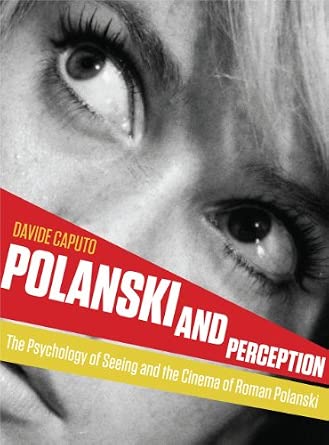
Polanski and Perception: The Psychology of Seeing and the Cinema of Roman Polanski
Author(s): Davide Caputo (Author)
- Publisher: Intellect Books
- Publication Date: 15 July 2012
- Language: English
- Print length: 208 pages
- ISBN-10: 1841505528
- ISBN-13: 9781841505527
Book Description
A new approach to a director whose contribution to cinema is often overshadowed his personal life, Polanski and Perception focuses on Roman Polanski’s interest in the nature of perception and how this is manifested in his films. The incorporation of cognitive research into film theory is becoming increasingly widespread, with novel cinematic technologies and recent developments in digital projection making a strong grasp of perceptual psychology critical to fostering cognitive engagement.Informed by the work of neuropsychologist R. L. Gregory, this volume focuses primarily on two sets of films: the Apartment trilogyof Repulsion, Rosemary’s Baby, and The Tenant; and the Investigation trilogy of Chinatown, Frantic, and The Ninth Gate. Also included are case studies of Knife in the Water, Death and the Maiden, and The Ghost.Polanski and Perception presents a highly original and engaging new look at the work of this influential filmmaker.
Editorial Reviews
Review
'A refreshing angle on Polanski's film-making and a treat for readers fascinated with film and psychology ... an engaging text which can serve as a useful introduction to the issues it discusses, such as authorship, perception, realism, modernism/postmodernism and Polanski's film-making practice ... it is difficult to find a more compelling alternative to the dominant, biography-focused interpretations of Polanski's work.'
'For me the strength of this study lay in the interdisciplinary application of theories arising from the field of neuropsychological study to theories of cinema ... These earlier sections are bound to be very useful when teaching film studies, as they offer clear illustrations of the way in which movies manipulate perception. Overall, I found the book to be very useful in exploring film's potential to realistically convey a subject's perceptual crisis at a formal level. The book offers a detailed and compelling overview of Polanski's work, and a novel way of interrogating his formal style and thematic concerns.'
'If you wish to understand the psychology behind the films of Polanski then reading Polanski and Perception will provide an enlightening perspective on the subject.' -,
'It raises some decidedly provocative questions that ... force the reader to re-evaluate their perceptions, before defiantly concluding that there are no answers. It suggests that this very absence of answers is in itself an empowering and potentially exciting state to be in and I find that I cannot help but agree.' -
'To write an original academic book on a subject that has already been approached by scholars on countless occasions may seem impossible, but Davide Caputo has successfully met this challenge...Insightful and sophisticated, Caputo's close analyses offer excellent academic readings and have the potential to serve as a reference source on Polanski.'
The book breathes fresh air into the academic corpus on Polanski's cinema and presents an engaging discussion of a significantly underrepresented aspect of this director's filmmaking: the faculty of visual perception.'
About the Author
Davide Caputo recently completed his PhD at University of Exeter, where his research focused on film and psychology. He has contributed essays and reviews to Film International.
Excerpt. © Reprinted by permission. All rights reserved.
Polanski and Perception
The Psychology of Seeing and the Cinema of Roman Polanski
By Davide Caputo
Intellect Ltd
Copyright © 2012 Intellect Ltd
All rights reserved.
ISBN: 978-1-84150-552-7
Contents
Acknowledgements,
Introduction,
Chapter 1 'Locating' Polanski,
Chapter 2 Establishing a Conceptual Framework,
Chapter 3 Schizophrenia and the City,
Chapter 4 Repulsion,
Chapter 5 Rosemary's Baby,
Chapter 6 The Tenant,
Chapter 7 Approaching the Investigations,
Chapter 8 Chinatown,
Chapter 9 A Tale of Two Doctors: Frantic and Death and the Maiden,
Chapter 10 The Ninth Gate,
Chapter 11 The Ghost: A Bridge Between Trilogies,
Chapter 12 Concluding Remarks,
Roman Polanski Filmography,
Bibliography,
CHAPTER 1
'Locating' Polanski
Polanski and Poland
Roman Polanski began his career in cinema as a young actor, most notably featuring in Andrzej Wajda's A Generation (1955). Wajda's film is credited with starting the Polish Film School, a movement that broke from the Marxist didacticism of Poland's post-war 'socialist realism', in favour of providing a more 'individualised vision' (Ostrowska, 2006: 63) of cinema. Although Polanski's early involvement with Wajda probably accounts for a large part of his early education as a film-maker, Polanski's own cinema, even his early 'Polish' output, sits uncomfortably alongside the Polish School, with his first feature, Knife in the Water, marking yet another 'break' in Polish cinema. Whilst Polanski's cinema shares, to varying degrees, Wajda's concern with the plight of the individual, the idea of cinema serving as 'psychotherapist of the Polish audience' (Ostrowska, 2006: 66) was rejected by Polanski. Even Polanski's cycle of schizophrenia-based films (what I refer to as 'The Apartment Trilogy'), although heavily concerned with psychosis, offers no therapy. Whilst the Polish School rejected the prescriptive aesthetics of the ideologically didactic post-war Polish cinema, these films were equally defined by their resistance to it. Knife in the Water, in contrast, is one of the first examples of truly post-regime Polish cinema.
Nevertheless, Polanski's cinema is certainly influenced by his direct experience of the Polish School, especially in its emphasis on the technical prowess of its film-makers. There are also indications of strong Polish cultural influences on Polanski's work, from Polish romanticism to the Theatre of the Absurd, from Gombrowicz to Grotowski. These influences are often papered-over in the analyses of Polanski's cinema, which tend to identify Polanski as a global entity; as convincingly argued by Mazierska (2007), however, examining the 'Polishness' in Polanski's cinema is indeed informative and not to be entirely overlooked. But the greatest influence on Polanski's early cinema education is, ultimately, cinema itself. Whilst studying at Lódz, Polanski was able to access a far greater range of world cinema than would have been possible for even the most passionate Polish cinephile in the mid-1950s, a special privilege that the government afforded film students (Polanski, 1984: 112), along with granting access to otherwise banned texts (if not directly, then through professors who 'carelessly' left these books scattered about classrooms [see Polanski, 1984: 80]). So whilst the influence of distinctly Polish culture on the formation of Polanski's approach to cinema should not be undervalued, it is the influence of film-makers, not only Wajda, but globally renowned directors like Carol Reed and Orson Welles, that probably most deeply informed his craft.
The only example of Polanski's early works to employ a specifically Polish set of references is When Angels Fall (1959), a film that combines historical events, mythology and the personal recollections of an old woman in order to explore the ways in which all three intermingle and inform the formation of memory. Even without dialogue, the foregrounding of these iconic Polish elements firmly established Angels as a 'Polish' text. Polanski anchors the cinematic experience to the vision of an individual: the old woman (a Polish icon in her own right), whose subjective recollection-images we are permitted to observe. Oddly, at times, these 'subjective' images move beyond her (life's) perceptual reach, to an era before her birth. Thus the film transcends its specifically Polish framework to explore the malleability of memory and the influence that popular mythology, and possibly even the state, can have on personal recollections of the past. Here we have the first hint of Polanski's concern with the manner in which perceptions are formed, a concept that dominates much of his cinema.
As Ostrowska writes, 'Polanski's scepticism towards the possibilities of direct access to memory put him in opposition to the exploring of it, the central task of Polish cinema [i.e. the Polish School] at the time' (2006: 66). Nevertheless, the most enduring strength of Angels is not specifically its Polish iconography, but its discussion of memory through the superimposition of the woman's vivid recollection-images onto the film's drab actual-image of the men's toilet in which she works. To overemphasise the 'Polishness' of When Angels Fall is to miss much of what Polanski is observing about the functioning of human memory and the manner in which each of our concepts of reality are constructed by our individual perceptual mechanisms.
The rest of Polanski's shorts are far more difficult to identify as specifically Polish, although all, save The Fat and Lean (1961), were made in Poland during Polanski's time at Lódz. Much of this is simply down to Polanski's tendency of keeping his shorts abstract and dialogue-free. Polanski's preference for dialogue-free shorts, which he nevertheless considered to be the 'correct' language of the short film, suggests a desire to move beyond fixed concepts of nation-, linguistic- or culture- based cinema towards that elusive universal language of the moving picture, that purely visual form of communication cultivated by the likes of Murnau, Chaplin and Griffith that had been all but forsaken after the birth of the talkie:
Cartoons and documentaries proved that even very short films could tell a convincing story with a beginning and an end, but to do the same with actors required a different approach. Sounds had to be used as punctuation, dialogue kept to a minimum or dispensed with altogether. As far as I was concerned, a realistic theme was out. Though hung up on surrealism, I also wanted to convey a message. The short I aspired to make would have to be poetic and allegorical yet readily comprehensible.
(Polanski, 1984: 132)
In Knife in the Water, Polanski manages to retain the allegorical element of his more abstract, silent shorts, but combines symbolic imagery with the realism offered by the inclusion of dialogue, the form he believes should be reserved for the feature film. But as soon as his characters begin to speak, an inextricable link is inevitably forged between language and the nation with which it is associated. Whilst Knife in the Water did not fit into the individual-focused Polish School, with its attempts to assume 'the role of "psychotherapist" of the Polish audience' (Ostrowska, 2006: 66) through neorealist-influenced recreations of wartime and post-war Poland, it was certainly not the sort of contemporary social(ist) realism preferred by the state. Polanski's Polish films move...


