Excerpt. © Reprinted by permission. All rights reserved.
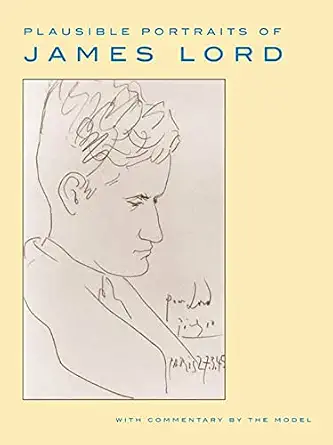
Plausible Portraits of James Lord
With Commentary by the ModelBy James Lord
Farrar, Straus and Giroux
Copyright © 2003 James Lord
All right reserved.
ISBN: 9780374281748
Dark Eros
Phase 1Peter Schielemann’s Black Eros (1971) delineates a precolonial African sexuality that was very different from its concurrent European counterpart, and even different from its later African-American emanations. As there was no separation of different phases of the precolonial African life/African psyche from other aspects of itself, sex was an integral part of everything else, such as religion, gender traditions, and social exchange; at the same time sex was not eroticism, and eroticism undergird each and every aspect of the African psyche. John Mibiti, in African Religions (1973), points out even more tellingly that eroticism is to African religion as African religion is to eroticism: one cannot exist without the other. Today, visit any urban, black Pentecostal church for three-dimensional proof, and one will quickly notice a number of erotic indexes, especially the willed confusion of the sexualized male minister with Christ-like associations in a female-dominated forum. The screams for Jesus take on additional meanings.So it should not surprise us then that the current progenitors of African essence bring eroticism to everything they touch in the asphalt jungles and concrete condos in which they find themselves. The big-city beat is black.Tina South-X in “Kitchen Tails” seductively illustrates that black suburban life needs excessive stimulation and that is what the black professional females provide as they talk about their one, best love–never their husbands. Frank Lamont Phillips’s “Sunday & Ms. Fantasy” takes us into the nonerotic/erotic mind of one Cheryl, who is sure to become the favorite table dancer in all of fiction. Jennifer Holley’s “I Want to Speak” repeats a late-night phone encounter in the recording studio, and Tim Seibles’s “Valentine’s Day” reveals that the heart is seldom the most favorite organ on erotic holidays. Rebecca Delbridge’s urban run-in with auto-eroticism in “No Turn on Red” and Jeul A. Harris’s “Black Sugar” are only emblematic of all the alleys and expressways of the African-American erogenous zones. Carole Hill Faulkner’s “Midnight Call” is as manipulatively masturbatory as Ken Norfleet’s excerpt from his novel Binghampton Bad Boy Blues is dyadically direct. Lana Williams’s ” … To the Head”; and Lurlynn Franklin’s”in the dreams of a former whore goddess” voyeuristically show female aggressiveness and shout the new urban sexuality of the forthright female. “C:Back SlashMerge” by Oktavi shows that the computer age has some personality, and Winston Benons’s “Gail & John” diary entries show us why those tomes are the most private of erotic texts. Black eroticism brings complications with its benefits, but the benefits remain worth it in Shange’s “Black Love.” Herr Reverend Schmidt (a pseudonym) of Berlin exposes us to his “Hunger” (translated from the German), which represents the real-life side of an international black Christian minister’s own purposely suppressed sexuality. Jennifer Gibson’s untitled piece and “Do Ya Got Some Blow?” by Druervonn Washington move us to erotic hip-hop rap for the first time on a high literary plane. Eunice Townsend’s “Electric Lover” reminds us that work and play must mix for sanity, and “comes: a suicide note” by Victor E. Blue reminds us, even if we have not forgotten, of the reason people wanted into the cities and out of the country in the first place. Rest and refresh yourself at the end of this first phase leading toward erotic fulfillment with “Marriage” by Cassie Granberry and Estelle Farley’s “Dessert.”These pieces illustrate that, once again, one of the frustrating things about trying to keep up with city life is that it changes too quickly to be fully captured. As Alvin Toffler convincingly showed in The Third Wave (1979), it is not change but the rate of change that drives people crazy trying to keep up. This is also why a stagnant culture hates the African-American impulse: the culture cannot keep up. What is often missed is that the same is true for black eroticism, which is the driving force of the city’s change.Kitchen TailsTINA SOUTH-X“Tell about your best love,” they squealed above wine, crackers and cheese, refrigerator humming in the background for needed sound cover.
Long draw on the champagne and editorial indexes in place.”It can only be one–that’s it–and why!”A sound-sight-and-scent check for husband-lurk, then direct eye contact with the crowd.
Statement: “Heartbeats, smells, mirrors, a scream that lasted for ten years.”
Silence from the crowd.
Then applause.DARK EROS. Copyright © 1997 by Reginald Martin. Foreword copyright © 1997 by
Continues…
Excerpted from Plausible Portraits of James Lord by James Lord Copyright © 2003 by James Lord. Excerpted by permission.
All rights reserved. No part of this excerpt may be reproduced or reprinted without permission in writing from the publisher.
Excerpts are provided by Dial-A-Book Inc. solely for the personal use of visitors to this web site.
 Wow! eBook