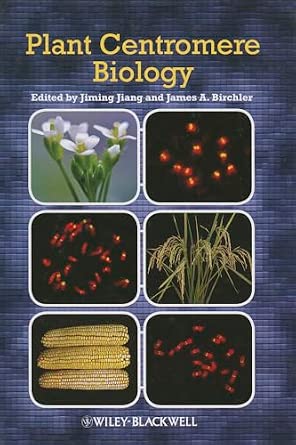
Author(s): Jiming Jiang (Editor), James A. Birchler
Publisher: Wiley-Blackwell
Publication Date: 2 April 2013
Edition: 1st
Language: English
Print length: 208 pages
ISBN-10: 1119949211
ISBN-13: 9781119949213
Book Description
Plant Centromere Biology is dedicated to plant centromere research. Chapters cover the structure of centromeres from several plant species including Arabidopsis thaliana, rice, maize, wheat and beet, while other sections cover several unique characteristics associated with plant centromeres, including classical and modern neocentromeres, centromere drive and centromere misdivision. Additional chapters are dedicated to epigenetic modification and evolution of plant centromeres, and development and application of plant artificial chromosomes.
Written by an international group of experts in the field, Plant Centromere Biology is a valuable handbook for all plant scientists working on plant genome research. Beyond the bench, it can also serve as a helpful reference tool or textbook for upper level college classes on cytogenetics or genome analysis.
Editorial Reviews
From the Inside Flap
The centromere is the chromosomal domain that is vital to the transmission and segregation of genetic materials in plants and animals. The structure and evolution of the centromere has been a mystery for decades due to its complexity of the molecular make-up. Plant Centromere Biology provides a clear and concise picture of the role of centromere biology in plant evolution, developmental processes, and biotechnology.
Plant Centromere Biology is made up of fourteen chapters that cover both classical and modern centromere research in several plant species. The centromere of model plant organisms, such as Arabidopsis, and agronomic crops, such as rice and maze, are explored to illustrate the diverse role of the centromere in plant development. New approaches and technologies continuously being applied to centromere research are fully reviewed in the text. Centromere biology has also opened the door to new advances in plant biotechnology and the volume concludes with chapters that look at the development of the latest centromere-related biotechnological accomplishments.
A timely and important collection,
Plant Centromere Biology will be a vitally important book for plant scientists, biotechnologists, and advanced students with an interest in centromere biology.
From the Back Cover
The centromere is the chromosomal domain that is vital to the transmission and segregation of genetic materials in plants and animals. The structure and evolution of the centromere has been a mystery for decades due to its complexity of the molecular make-up. Plant Centromere Biology provides a clear and concise picture of the role of centromere biology in plant evolution, developmental processes, and biotechnology.
Plant Centromere Biology is made up of fourteen chapters that cover both classical and modern centromere research in several plant species. The centromere of model plant organisms, such as Arabidopsis, and agronomic crops, such as rice and maze, are explored to illustrate the diverse role of the centromere in plant development. New approaches and technologies continuously being applied to centromere research are fully reviewed in the text. Centromere biology has also opened the door to new advances in plant biotechnology and the volume concludes with chapters that look at the development of the latest centromere-related biotechnological accomplishments.
A timely and important collection,
Plant Centromere Biology will be a vitally important book for plant scientists, biotechnologists, and advanced students with an interest in centromere biology.
About the Author
Jiming Jiang is a Professor of Horticulture at the University of Wisconsin, Madison. His research focuses on plant molecular cytogenetics, plant centromeres, potato breeding and genomics. In addition to his research activities Dr. Jiang also teaches a course on introductory cytogenetics, and he is an elected fellow of the American Association for the Advancement of Science.
James A. Birchler is Curators Professor of Biological Sciences at the University of Missouri-Columbia. His lab studies gene expression in multicellular eukaryotes at the gene and chromosomal level, using maize and Drosophila as experimental organisms. Dr. Birchler has published widely in such journals as The New Phytologist, The Plant Cell, and Genes and Chromatin, and he is an elected fellow of the American Association for the Advancement of Science.
 Wow! eBook