 Wow! eBook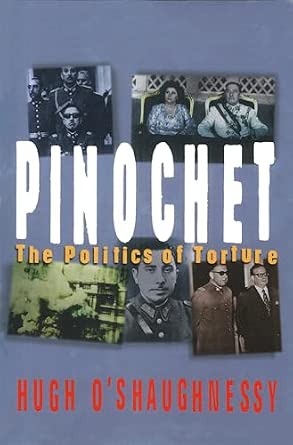
Pinochet: The Politics of Torture
Author(s): Hugh O'Shaughnessy (Author)
- Publisher: Latin America Bureau
- Publication Date: 1 Nov. 1999
- Language: English
- Print length: 190 pages
- ISBN-10: 1899365419
- ISBN-13: 9781899365418
Book Description
Editorial Reviews
From the Author
How close was the Pinochet regime to the drug trade? Is Pinochet still a member of the Catholic church or is he excommunicated? How rich has the Pinochet family become? Answers to these questions are to be found in my book. But there is still a lot more investigation which my friends and I are working on!
About the Author
Excerpt. © Reprinted by permission. All rights reserved.
Pinochet
The Politics of Torture
By Hugh O’Shaughnessy
Practical Action Publishing
Copyright © 2000 Hugh O’Shaughnessy
All rights reserved.
ISBN: 978-1-899365-41-8
Contents
I The Arrest, 1,
II The Making of a General, 9,
III Treason and Terror, 49,
IV Guns and Drugs, 119,
V Nemesis, 157,
Bibliography, 175,
Index, 177,
CHAPTER 1
The Arrest
“The Chileans will tell you with pride they are often
called the English of South America.’
Augusto Pinochet interviewed by John Lee Anderson,
The New Yorker, September 1998.
Honoured guest
‘As soon as they’ve operated on me. I’m off’
Augusto Pinochet, Condon, 1
Or 21 September 1998 General Augusto Pinochet Ugarte, lately dictator of the Republic of Chile, arrived at Heathrow Airport. Pinochet was travelling on a Chilean diplomatic passport as a former head of state, now life Senator, The red-carpet reception at the airport’s VIP suite, whose use was paid for by the Foreign and Commonwealth Office, was discreet but becoming of a foreign former president. He was spared the indignity of explaining himself to an immigration officer or having to present his luggage to customs officials.
The Independent newspaper reported the presence of Pinochet in Britain, but it was hardly big news. The General had been to Britain several times since 1990, when he had reverted from being president to merely commander-in-chief of the Chilean army: As an important arms purchaser he had been a welcome guest not just of British Aerospace, Europe’s largest arms manufacturer, but also of the Conservative governments. He had also visited Britain after the labour Party came to power in Britain in May 1997 and, while he may not have been welcomed with open arms, there was no bar to the entry to Britain of a man who a quarter of a century before had been a principal hate figure of the labour Party.
Over the next few days Pinochet’s activities were consistent with previous trips to London: he met Lady Thatcher, former prime minister, for tea. He went shopping – he was known to favour Harrods and Fortnum and Mason’s – and gave an interview to The New Yorker magazine in which he told his interviewer, John Lee Anderson, a biographer of Che Guevara, that ‘my history teacher always told me that the lives of dictators end badly.’
Were it not for the presence of his bodyguards, Pinochet could probably pass incognito in any situation in busy London. He does not fit the Stereotype of a dictator, lie is of shorter than average stature. Like Fidel Castro, he has a high voice, which he often uses in a rasping way, perhaps 10 disguise its register. It is true that in the years after the 1973 military coup his image put him well within the moustache-and Sunglasses brigade of South American dictators. (Indeed he had a lifelong penchant for wearing dark glasses.) He also maintained a well-clipped moustache and he retained more hair than many men of his age. But now, at 82 years old, he wore conservative suits instead of the military uniform he was constantly pictured inducing his regime, and his hair had turned to a respectable silver.
In the course of his visit he took medical advice about a herniated disc in his spinal column and at the beginning of October he was admitted to a private London hospital, the London Clinic. There then took place a delicate operation on a man of 82 who suffered from diabetes and who wore a heart pacemaker. Should anything have gone wrong with the procedure there was a danger that his spinal cord could have been damaged, with the subsequent risk of paraplegia or the loss of the use of his lower limbs. He would normally have been expected to remain prone in a hospital bed for some weeks while his backbone recovered. He would then return directly home to Santiago, the capital of Chile. But events were soon to take an unprecedented turn.
In the late evening of Friday 16 October 1998 two plainclothes officers of the Metropolitan Police, the force which police? London, entered Pinochet’s private hospital room, where the former dictator lay sleeping. The officers woke him and proceeded to state that they were acting in response to a Red Notice warrant issued by Interpol on behalf of the Spanish authorities, and that they were placing him under arrest on charges of the murder and torture of Spanish citizens. (There is some evidence that the Chilean authorities knew of the move in advance, but they were in tin position to move Pinochet precipitately put of the United Kingdom for fear of rendering him a paraplegic.)
The General was still under post-operative medication and in a Confused haze. While his English is poor, he seemed to understand what was happening to him. Armed policemen were posted at his mom and at the entrances to the Clinic and the General’s own bodyguards were disarmed.
Just after mid-day the new day, 17 October, the Nome Office, Britain’s interior ministry, announced the arrest to the world.
The reaction from victims of the General’s regime was immediate and euphoric. Dr Oscar Soto, the former personal doctor of Salvador Allende, the democratically-elected President of Chile deposed by Pinochet’s coup d’état of 11 September 1973, speaking to The Guardian, said: ‘It is a great triumph of justice. Pinochet must now give account for more than 3,000 deaths, exiles and tortures in the 17 years of his dictatorship.’ Newspapers in the United Kingdom and around the world carried articles written by individual Chileans exiled by the General’s regime, who spoke of their relief and feelings of vindication. Many said how the General’s sudden arrest was like having a memory box pried open after twenty-five years, to find inside the hurt and terror inspired by the events of September 1973 surprisingly intact.
As for Pinochet, if he were inclined to whimsical associations, the place of his arrest might have struck the General as particularly ironic. There had been a Clínica Londres, or London Clinic, in the Calle Almirante Barroso in Santiago. It was used by his secret police to care for their victims who had been particularly damaged by torture. In that London Clinic people were nursed back to health so as to be able to withstand further bouts of torture, and eventually, in many cases, to die.
The nature of Pinochet’s internment, the arrest of a former head of state travelling on a diplomatic passport, made it the first of its kind in Britain or in Europe. More importantly, it was an unprecedented use of international law. Prompted by the determination of one Spanish investigating judge, Pinochet’s arrest immediately established a milestone in international legal practice. A former head of state of one country (Chile) had been arrested on a warrant from a judge of another (Spain), and seized in a third territory (Britain). Under the international agreements which govern Interpol, an Interpol warrant prepared in due form virtually obliged the British Government to take action or provide good reason why it would not.
Almost immediately, Conservative politicians expressed their outrage at the arrest, Lady Thatcher leading the outcry. Chile, Lady Thatcher said, had been ‘a good friend to Britain’, giving it invaluable help in its war with Argentina over the Falklands in 1982, Pinochet had quietly authorised the Royal Air Force to have landing rights at a number of Chilean airfields during the conflict. British troops operated from Chilean territory in Tierra del Fuego and the intelligence given to the British from the Chilean radars – which in any event constantly monitor Argentine air force bases – was a great asset. It was even said by some military men that the largest single loss of British troops, when Argentine air force Mirages and Skyhawks raided Bluff Cove on 8 June 1932, had been due to the fact that Chilean radar coverage had momentarily faltered.
Certainly Pinochet genuinely liked and admired Britain. He had often remarked how he liked the civility to be found in London and the Englishman’s determination to play by the rules. I myself had written about one previous visit where he had been delighted to be able to buy ties for himself at Harrods and cat in good restaurants.
But few people were aware of the ex-dictator in their midst. After the arrest, apart from ecstatic Chile solidarity groups on the one hand, and the vehement response emanating from Lady Thatcher and members of her ex-government on the other, most people simply wondered what the furore was about.
By now, twenty-five years after the coup, millions of British people were hardly old enough to have had much of a grasp of the events which led to Pinochet’s seizing of power in Chile on Tuesday, 11 September 1973. Of the older generation, some may have remembered the Labour Parted active hostility to the Chilean dictatorship, Others may have recalled the important dockers’ unions boycott of Chilean cargoes at British ports, notably Liverpool. Others may recall the pickets which stopped the engines of the Hawker Hunter aircraft, the type which had been used to bomb Allende’s presidential palace, being returned to the Chilean air force from the Rolls-Royce plant in the Scottish town of Last Kilbride where they had been reconditioned. A few may dimly remember the unwillingness of right-thinking members of the middle class to consume Chilean wine and fruit.
From Britain’s Labour Government there was little public response to the arrest. Those who commented on the case stressed that it was a judicial, not a political, decision, and that the General had been arrested through a legally valid process. Government members made little comment and deferred to the man ultimately charged with responding to the Pinochet case, Jack Straw, the Home Secretary.
For Chile, however, and For Augusto Pinochet Ugarte personally, his arrest had an immediate effect. It punctured the military and political image of a man who was, and remains, for better or for worse, remarkable.
During and a fret his seventeen-year reign as dictator of Chile, this son of a lower middle-class family had seized supreme power for himself in a country of more than 12 million people, and struck terror into the hearts of his enemies at home and abroad. He had moulded his own country in a way few, if any, had done before him. He has also been directly, personally responsible for some of the worst human rights abuses in the post-war era. Like the majority of his comrades-in-arms he eluded justice until that October night when he awoke to find policemen at his London bedside.
The man himself, the fear and power he has commanded, and the events of his life combine ten tell a powerful story of betrayal and treachery, of opportunism and ambition. But who is this man, Augusto Pinochet? Where did he come from, and how did he end up as the central figure in the most complex case in international law of the late twentieth century?
Two days before his detention The Guardian had asked me to write a polemic drawing attention to Pinochet’s presence in London. The piece, which called for his arrest, was printed in that newspaper on 15 October 199& under a suitably incendiary title. I composed this article on Wednesday, two days before he was arrested. It was written somewhat tongue in check, and I had no expectation whatsoever that the course I advocated would be adopted within hours.
CHAPTER 2
The Making of a General
A sensitive boy
‘My maternal grandmother thought that her first grandchild had to be a child prodigy and wanted me to learn to read before I was four and so she sent me to an infants’ school.’
Augusto Pinochet, Camino Recorrido
The future dictator was born in Valparaiso on 25 November 1915, the eldest of three hoys and three girls. His father Augusto was apparently the descendant of one Guillaume Pinochet, a Frenchman who arrived in Chile in the early 18th century. Augusto senior worked as a customs agent in a British-owned trading company, Williamson Balfour, in Valparaiso, Chile’s main port. His mother Avelina Ugarte was a pious housewife with little formal education but an enormously strong will.
Since Spanish colonists had settled there in the sixteenth century, Valparaiso, the ‘Valley of Paradise’, had been the gateway to the Central Valley of Chile, the fertile heart of the country with a climate similar to that of California. During the four centuries that Spain ruled Chile as its colony, the narrow strip of land was not the most favoured part of the King of Spain’s dominions. Unlike Peru or Mexico, it contained few precious metals. Its use, if it had any, was as a source of food and other supplies for the imperial city of Lima, where the Viceroy held his court amid great pomp.
The full name given to Chile’s new capital by Spain was Santiago del Nuevo Extremo – Santiago in the Wild South. The models of the city in the Museum of Santiago today show a very unprepossessing settlement with few buildings of architectural merit. Had there been many put up they would anyway in all likelihood have been shaken down by the frequent earthquakes and tremors which characterise the region. In contrast u> the colonial splendours of Rio de Janeiro or Mexico City Chilean cities can boast only of Squat churches and palaces with mod walls thick enough to survive these frequent shakings.
About a hundred kilometres to the west of Santiago, Valparaiso was built in a vast natural amphitheatre around a sheltered harbour three miles across. Since Chile had achieved its independence from Spain in 1817, and thereby the freedom to trade with any nation, the port had prospered. There was a large colony of foreigners, many of them British, as Britain was by far Chile’s most important trading partner. The Valley of Paradise was the first big Pacific port for ships sailing between the Atlantic and the Pacific around the Straits of Magellan at the tip of South America, which before the construction of the Panama Canal in 1914 was the only sea route between the two oceans.
But by the year of Pinochet’s birth Valparaiso was experiencing a crisis of which his father, who worked in the customs house, would have been painfully aware. The Panama Canal had opened the previous year and the world’s seafarers were beginning to adjust to the new, much shorter and more convenient route.
In addition the more southerly port of Concepción, where a coal industry had been established, had long been poaching Valparaiso’s trade in hunkering ocean-going vessels, Valparaiso’s city fathers were doing their best to keep their city competitive by building vast new moorings capable of taking the world’s largest ships. They also moved to dear up rapidly after the frequent earthquakes which levelled Valparaiso even more frequently than other Chilean towns. Despite these efforts, trade withered, particularly during the Great Depression, and brought hardship to those like Pinochet’s father whose livelihood depended on buoyant trade.
According to Pinochet’s cousin Mónica Madariaga – whom he was later to appoint minister of justice – Augusto, or ‘Tito’ as he was known, was by the age of two a child with a mind of his own. His mother used to like dressing him in a sailor suit and forbade him to ear ice cream lest the suit be stained. He tolled round on the floor to get it dirty anyway. Pinochet himself recounts how one day when he was very young she went chasing him with a broom in the garden when he was suddenly stung by a bee and let out a scream. Avelina stopped, comforted the boy, and then seized the broom and gave him the clout she had been intending. A short time before she died she confessed she had always thought that her Augusto would become president ‘but I didn’t tell anyone so that they wouldn’t laugh at me’.
According to his own account, Augusto Pinochet was a sensitive child. At a young age he was taken to his first cinema to sec a silent film. It showed a gun fight and, as the pianist banged out a dramatic accompaniment, the little boy screamed. The next scene involved a railway train rushing towards the audience and Tito tried to hide under the scat, bellowing in such panic that the lights had to be turned on while his mother took, him out. ‘The only thing I wanted,’ he remarked, bias to escape from that torture chamber.’
Otherwise he played happily enough in the streets and squares of the city. Perhaps his first inspiration to become a soldier came from hearing the music of the military and naval bands in Valparaiso’s parks of watching the construction of the monument to the heroes of the battle of Iquique of 1879 during the War of the Pacific. His sister Nena recalls that he passed his time playing with his drums and Trumpets. The young Augusto had been always proud of his French connection and later developed a great admiration for Louis XIV and Napoleon. In particular he was moved by the tales of Francisco Valette, the husband of his maternal grandmother Valette went off during the First World War to help defend France from, the Germans, was wounded in battle and returned to Valparaiso in 1921.
When he was five or sis and already dreaming of becoming a Soldier he damaged his left knee in a road accident. Later a local doctor was keen to amputate. Avelina prayed to Our Lady of Perpetual Succour for a cure, promising that she would dress in coffee coloured material for fifteen years if he recovered and that he would do the same for ten years, or two years if he indeed became a soldier. A visiting German doctor disagreed with the local diagnosis and prescribed sunlight. The swollen knee was cured in weeks. The vow, Pinochet recounts in his memoirs, was kept by mother and son. The devout Pinochet was later to fix in a local church an ex voto plaque to the Virgin bearing the words:
Thank you, Mother mine
Succour me always
Ensign A. Pinochet
1936
(Continues…)Excerpted from Pinochet by Hugh O’Shaughnessy. Copyright © 2000 Hugh O’Shaughnessy. Excerpted by permission of Practical Action Publishing.
All rights reserved. No part of this excerpt may be reproduced or reprinted without permission in writing from the publisher.
Excerpts are provided by Dial-A-Book Inc. solely for the personal use of visitors to this web site.


