Wow! eBook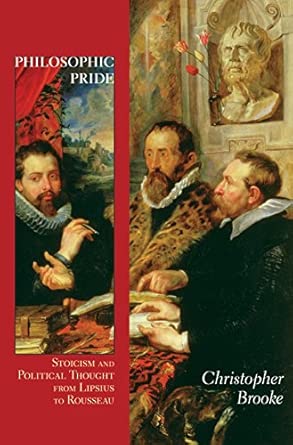
Philosophic Pride: Stoicism and Political Thought from Lipsius to Rousseau
Author(s): Christopher Brooke (Author)
- Publisher: Princeton University Press
- Publication Date: 4 April 2012
- Edition: 1st
- Language: English
- Print length: 304 pages
- ISBN-10: 069115208X
- ISBN-13: 9780691152080
Book Description
Editorial Reviews
Review
From the Inside Flap
“Remarkable for its wide historical sweep, this elegant book is a great addition to the existing literature on the philosophical history of pride. It is a rigorous, original, and flawlessly executed work on a topic of great interest. An utter joy to read.”–Frederick Neuhouser, Barnard College
“Philosophic Pride offers a fresh look at how ancient Stoic philosophy was received, adapted, criticized, and accepted, from the end of the sixteenth up to the middle of the eighteenth century. Surveying this large field with more amplitude and exactitude than anything else on offer, this book will be important for scholars of the humanities and specialists.”–Anthony Long, University of California, Berkeley
“An outstanding study of the fortunes of Stoicism in early modern moral and political thought,Philosophic Pride examines arguments for and against Stoic themes in the writings of moral and political philosophers, from Justus Lipsius to Jean-Jacques Rousseau. Brooke’s exposition of the primary sources is unfailingly lucid, and his treatment of work by other scholars is remarkable in its range.”–James Moore, emeritus professor, Concordia University
From the Back Cover
“Remarkable for its wide historical sweep, this elegant book is a great addition to the existing literature on the philosophical history of pride. It is a rigorous, original, and flawlessly executed work on a topic of great interest. An utter joy to read.”–Frederick Neuhouser, Barnard College
“Philosophic Pride offers a fresh look at how ancient Stoic philosophy was received, adapted, criticized, and accepted, from the end of the sixteenth up to the middle of the eighteenth century. Surveying this large field with more amplitude and exactitude than anything else on offer, this book will be important for scholars of the humanities and specialists.”–Anthony Long, University of California, Berkeley
“An outstanding study of the fortunes of Stoicism in early modern moral and political thought, Philosophic Pride examines arguments for and against Stoic themes in the writings of moral and political philosophers, from Justus Lipsius to Jean-Jacques Rousseau. Brooke’s exposition of the primary sources is unfailingly lucid, and his treatment of work by other scholars is remarkable in its range.”–James Moore, emeritus professor, Concordia University
About the Author
Excerpt. © Reprinted by permission. All rights reserved.
Philosophic Pride
STOICISM AND POLITICAL THOUGHT FROM LIPSIUS TO ROUSSEAUBy Christopher Brooke
PRINCETON UNIVERSITY PRESS
Copyright © 2012 Princeton University Press
All right reserved.
ISBN: 978-0-691-15208-0
Contents
Preface…………………………………………………………………ixPrologue Augustine of Hippo………………………………………………1Chapter One Justus Lipsius and the Post-Machiavellian Prince…………………12Chapter Two Grotius, Stoicism, and Oikeiosis……………………………….37Chapter Three From Lipsius to Hobbes………………………………………59Chapter Four The French Augustinians………………………………………76Chapter Five From Hobbes to Shaftesbury……………………………………101Chapter Six How the Stoics Became Atheists…………………………………127Chapter Seven From Fnelon to Hume…………………………………………149Chapter Eight Jean-Jacques Rousseau……………………………………….181Epilogue………………………………………………………………..203Notes…………………………………………………………………..209Bibliography…………………………………………………………….253Index…………………………………………………………………..273
Chapter One
Justus Lipsius and the Post-Machiavellian Prince
In his fine 1991 study of Neostoic ideology and the painting of Peter Paul Rubens, the classicist Mark Morford wrote that Justus Lipsius ‘is now little known except to students of Seneca and Tacitus and to intellectual historians of the northern Renaissance’. Given the growing number of studies devoted to Lipsius and his various legacies since Morford’s book appeared, we might want to add students of early modern political thought and some scholars of literature to his list. Outside these particular corners of the academy, however, levels of Lipsius consciousness remain fairly low. He returned to the heart of European political life, in a manner of speaking, when the Justus Lipsius Building in Brussels opened in 1995, providing a new home for the European Union’s Council of Ministers. One might have thought it appropriate that such a building be named for a distinguished Belgian political writer who argued against the excesses of patriotism and in support of a European peace based on principles of mutual toleration, and whose books circulated extensively throughout the greater part of the territory of today’s EU. According to an EU press release, however, the building was in fact named for the Brussels street that used to connect rue de la Loi and rue Belliard and had been demolished to make way for its construction.
Who was Justus Lipsius? He was born in 1547 in Overijse in Brabant. He studied at the Jesuit college in Cologne from 1559 and was for a short while, from 1562 to 1564, a novice member of the order. Having obtained a bachelor’s degree in arts, he moved to Louvain in 1564 to study law, though at this time he seems to have concentrated instead on his humanist studies, developing a reputation as an acute Latin philologist and publishing four books of Variae lectiones in 1568. In that year he joined Cardinal Granvelle’s staff and travelled through Italy to Rome, where he studied the Tacitus manuscripts in the Vatican Library. A period of migration followed. Lipsius was back in Louvain in 1570, but he left again in 1571, visiting Lige, Vienna, and Leipzig before being appointed in 1572 to the chair in history at the university in Jena, a Lutheran foundation. He returned to Cologne to marry the recently widowed Anna van den Calstere in 1573, and in 1574 he published his great edition of Tacitus and left his post at Jena to return to Louvain, where he finally completed his law degree. Moving to a chair at the new Calvinist college in Leiden in 1578, Lipsius there published his two most significant original works, the philosophical dialogue De constantia in two books in 1583 and the six books of Politica in 1589. The publication of the Politica provoked a sharp public exchange in 1590-91 with Dirck Koornhert, who had accused Lipsius of favouring the methods of the Spanish Inquisition and of Machiavellism (‘ille machiavellisat’). In the wake of this controversy, Lipsius left Leiden in 1591, reconverted to Catholicism in Mainz, and took up a chair in ancient history and Latin in Louvain the following year. His great work of this final period was his edition of Seneca, published in 1605; he also compiled two handbooks of Stoic philosophy, the Manuductio, on ethics, and the Physiologia Stoicorum, on physics; there were other works on ancient Rome, especially on its military affairs, and a new book on politics, the Monita et exempla, in 1605. Lipsius died in Louvain in March 1606; legend has it that he rejected the consolation of Stoicism on his deathbed and gestured at a crucifix, insisting ‘haec est vera patientia’.
The scholarship on Justus Lipsius as a moral and political thinker dates above all from the publication in 1914 of Lontine Zanta’s La renaissance du stoïcisme au XVIe siècle. This book charted the translation and dissemination of classical texts and the increasing use of Stoic tropes, arguments, and values in the writings of moralists of the time, and presented in its second part an anatomy of the main ideas of the Neostoic ‘triumvirate’ of Justus Lipsius, Guillaume du Vair, and Pierre Charron, whose books did much to systematise and popularise this Stoic current in the late sixteenth and early seventeenth centuries. Anthony Levi observed in 1964 that the book ‘was a pioneer work, but its assumptions about the stoicism of the moralists have today sometimes to be questioned’. That is true enough, but with a long look back it is the first part of this verdict that resonates the most. Zanta was not the first to argue for the historical and intellectual significance of Lipsius and the other Neostoics. Wilhelm Dilthey had earlier paid considerable attention to them as a part of his explorations of changing conceptions of rationality, the transformation of individual consciousness, and the development of the modern scientific worldview, and Fortunat Strowski had considered the sixteenth-century Stoic moralists in the second chapter of his classic 1907 study of Pascal’s intellectual contexts. Where Strowski offered a sketch, however, Zanta constructed a far more solid framework for the study of sixteenth-century Stoicizing moral theory in her book, paying attention in particular to the more technical Stoic works of Lipsius such as the Manuductio. She also successfully defended her work at the Sorbonne in May 1914, with La renaissance becoming the first thesis on a philosophical subject by a woman to be accepted by a French university for the degree of docteur d’État. Zanta was a significant feminist: she published her Psychologie du féminisme in 1922, for example, and campaigned for the rights of professional women in the interwar French press. She was also an inspirational figure for the young Simone de Beauvoir.
Zanta’s book helped to recover Lipsius the Christian Stoic moralist— the Lipsius above all of De constantia—forging a path along which subsequent scholars of the history of ethics would follow. Lipsius the political theorist-the Lipsius of the Politica—was by contrast comparatively neglected. J. W. Allen’s 1928 study, A History of Political Thought in the Sixteenth Century, for example, contains no mention of Lipsius or of any of the other major Neostoic authors, nor any consideration of the influence or function of ancient Stoicism concerning the political thinking of the period. Jason Lewis Saunders’s 1955 book-length study of Lipsius, the first in English, presented a biographical sketch of his writing career and detailed expositions of the main arguments of the Stoic writings on ethics and physics in De constantia, the Manuductio, and the Physiologia Stoicorum, but passed over the Politica and the other explicitly political writings altogether. It is not difficult to come up with reasons why it might have been so easy for the Politica to be substantially ignored. First, in comparison with De constantia especially, Politica appears to be a considerably less original work. The bulk of the text is made up of quotations from classical authorities, giving the work something of the feel of a commonplace book. (It was this aspect of the book that provoked Montaigne’s description of it as ‘ce docte et laborieux tissu’, and opinion differs down to the present over whether this was intended as a compliment or not.) Second, and in contrast to all three of the works that Saunders examined in his book, for example, Politica does not advertise itself as having anything in particular to do with Stoicism, making it a less attractive object of study for those interested above all in Lipsius as the protagonist in a ‘Stoic revival’. The author most frequently quoted in the Politica, for example, is Tacitus, who was no kind of Stoic; Stoicism itself is unmentioned throughout.
The scholar who did the most to draw attention to Lipsius’s political thought was the historian Gerhard Oestreich, who died in 1978 and whose final book, Neostoicism and the Early Modern State, was published posthumously. For Oestreich, Lipsius’s importance was manysided. His books, in particular De constantia and the Politica, provided the definitive statement of a political ideology that found its inspiration in a number of mostly Latin texts and foregrounded themes of power, self-inspection, discipline, toleration, and moderation. ‘Lipsius proclaimed the modern state, based on order and power, from amid the ruins caused by the religious wars’, Oestreich wrote. ‘The spirit it embodied and its exceedingly practical orientation derived from the Neostoic philosophy of the state, which was itself eminently practical’. As well as helping to give shape to this ideology, Lipsius was also a prominent propagandist for it, and Oestreich stressed his role as a popular teacher, especially during his period in Leiden; his seven hundred correspondents, scattered all over Western Europe; and the fact that his books were sixteenth-century bestsellers, going rapidly through many editions and being translated into all the major European languages. At the heart of Oestreich’s account lies a reading of the Politica, whose contents are summarised in the third chapter of Neostoicism. His epitome gives particular attention to the fourth book, on actual constitutional practice, with its discussions of religious uniformity, the rise and fall of governments, and ‘the troublesome question of prudentia mixta or “reason of state”‘, as well as to the fifth book, on military affairs, above all to its account of discipline. Indeed, Oestreich considered this book central to the interpretation of the Politica, for in his view, ‘The Leiden professor saw military force (vis) as the real foundation of the state.’
Oestreich’s claims for the historical significance of Lipsius’s project were not small. In his view, the new emphasis on discipline on the part of the writers who contributed to the Netherlands movement played a key role in the military revolution that transformed first European warfare and then the internal organisation of the European states themselves. Prince Maurice of Orange had been one of Lipsius’s students in Leiden in 1583-84, Oestreich observed, and he ‘always referred to Lipsius as his teacher.’ Neostoicism was credited with being one of the major forces behind the consolidation of absolutist ideology, to the extent that it might be said to mark the moment when the national security state came to supplant the free city republic as the focus of political theorists’ attention and loyalties. Max Weber had argued for the importance of a Protestant ethic associated above all with Calvinism for understanding the increasing intensification of processes of rationalisation in early modern Europe that helped to stabilise early capitalist relations of production, and Otto Hintze had gone on to suggest that there was an affinity between Calvinism and modern raison d’tat arguments. Oestreich offered a variation on the theme, suggesting that it might have been Neostoic ideology that had helped to spread an ethic of duty that bordered on asceticism, and that in the context of the early modern absolutist monarchies, furthermore, it made more sense to ascribe significant social and economic effects to this secular ideology than to any religious doctrine. Oestreich’s presentation of Lipsius and his interpretation of the political content of Neostoicism has been a very influential one, and his work continues to be cited down to the present (recently, for example, in Charles Taylor’s large book on the history of the possibility of a secular society). His position, however, is an increasingly awkward one. In particular, his critics are not persuaded that his argument about Lipsius’s political thought has much to do with Stoicism at all, that his grander historical claims are sound, or that the historiographical tradition within which he was working was free from the taint of National Socialist ideology.
In the introduction to his recent edition and translation of the Politica, Jan Waszink expresses scepticism about the contribution of Stoic philosophy to Lipsius’s argument. In this work, he notes, important Neostoic themes such as the reconciliation of Christian and Stoic doctrine or the desirability of suppressing the emotions do not make any noteworthy appearance; ‘[t]he Neostoic key virtue of Constantia is given no particular prominence’; and Epictetus and Marcus Aurelius are ‘entirely absent’. Indeed, Waszink canvasses the mischievous suggestion that Lipsius’s book might reasonably be considered an anti-Stoic argument, for a central claim of Stoic political theory was the identification of what was honourable (honestum) with what was useful (utile), which is one that Lipsius seems to deny. At the start of the famous discussion of ‘mixed prudence’ in 4.13, he asks whether it is ‘allowed that I mix it [prudence] a little, and add a bit of the sediment of deceit?’, and he answers that it is (‘ego puto’), ‘in spite of the disapproval of some Zenos, who only approve that straight road which leads with virtue to honour’ and who ‘do not think it permissible that Reason, given by the Gods with good intentions, is used for deceit and malice’. ‘We might of course define Lipsius’ entire body of thought as “Neostoic”,’ Waszink observes, ‘but in that case “Neostoic” must be taken as a mere synonym for “Lipsian”, rather than as a reference to the recreation of the Roman Stoa’.
With regard to Oestreich’s historical claims, Philip S. Gorski notes the biographical connection that links Maurice to Lipsius and agrees that ‘it seems reasonable to conclude that his own study of classical precedents was at least partly inspired by his mentor’. But he is sceptical about stronger claims of influence over the nature and content of the army reforms themselves, remarking that ‘the intellectual impetus for the reforms came from William Louis rather than from Maurice’ and noting that the reforms were set in motion years before 1595, when Lipsius published his compendium on ancient military affairs, De militia Romana. In line with the broader thesis of his book The Disciplinary Revolution, which defends Max Weber’s original contentions about the importance of the Reformation in shaping subsequent social transformations against the criticism of Norbert Elias and Michel Foucault, Gorski suggests that the Dutch interest in military discipline owed more to Calvinism than to any Neostoicism, and that there may ‘have been a psychological connection-an elective affinity-between their religious ethos and their military reforms because both placed so much stress on discipline, both as a value and as a practice.’
The most far-reaching—and the most disturbing—challenge to Oestreich’s argument about Neostoicism has been made by Peter N. Miller in his 2002 article, ‘Nazis and Neostoics’, which discusses the historical writings of Gerhard Oestreich and Otto Brunner. Miller contends that understanding Oestreich’s 1940 article, ‘Vom Wesen der Wehrgeschichte’ (On the Essence of Military History), ‘is vital in order to appreciate why his post-war scholarship took the shape that it did’. In that article, the young Oestreich set out a wide-ranging and interdisciplinary research agenda to bring out the way in which ‘the military in its manifold forms and expressions is ever more the guarantee of the life of the people in their conflicts with other states and peoples’. Miller’s central charge is that in his postwar work on Lipsius, Oestreich was to execute this research project without ever drawing attention to its Nazi origins and emphases, and that his transition to working on a structural history of early modern state building could be considered ‘a more or less conscious attempt to efface the ideological position-taking’ of his work in the Nazi period. ‘It is striking’, Miller observes, ‘that Oestreich’s evocation of Lipsius’s idea of discipline’, which was central to his overall interpretation of Lipsius’s political thought, ‘seems to pick up every single nuance and echo of the National Socialist language of Erziehung zum Wehrwillen‘ (that is, education of the will to war). Oestreich’s readings of Lipsius’s works were distorted and distorting. It is implausible, for example, to reduce the argument of De constantia to the claim that ‘by fighting many battles are won, but none by flight’, and in a cutting phrase Miller refers to the way in which Oestreich ‘evoked, rather than quoted’ Lipsius in the Politica. By fashioning a concept of Sozialdisziplinierung and arguing that Lipsian theory became first Dutch and then Prussian practice, Oestreich could work to ‘turn Prussia from the great European exception (militarized and bureaucratized to the hilt) into the great European exemplar— the paradigmatic modern state’.
(Continues…)
Excerpted from Philosophic Prideby Christopher Brooke Copyright © 2012 by Princeton University Press. Excerpted by permission of PRINCETON UNIVERSITY PRESS. All rights reserved. No part of this excerpt may be reproduced or reprinted without permission in writing from the publisher.
Excerpts are provided by Dial-A-Book Inc. solely for the personal use of visitors to this web site.