Wow! eBook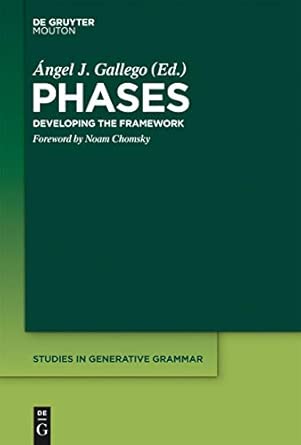
Phases: Developing the Framework: 109
Author(s): Gallego
- Publisher: De Gruyter Mouton
- Publication Date: 15 Dec. 2014
- Edition: 1st
- Language: English
- Print length: 456 pages
- ISBN-10: 3110264099
- ISBN-13: 9783110264098
Book Description
This volume explores and develops the framework of phases (so-called Phase Theory), first introduced in Chomsky (2000). The antecedents of such framework go back to the well-known notion of “cycle”, which concerns broader notions, such as compositionality, locality, and economy conditions. Within generative grammar, this idea of the cycle took a concrete form in the fifties, with Chomsky, Halle, and Lukoff’s (1955) pioneering work on stress, later on extended in Chomsky & Halle (1968), Halle & Vergnaud (1987), and further applied to morpho-phonology (Mascaró 1976 and Kiparski 1982), semantics (Jackendoff 1969), and syntax (Chomsky 1965, 1973). In recent years, several attempts have tried to refine and reformulate the cycle (Freidin 1999, Lasnik 2006, Uriagereka 2011). Such was the goal behind explorations on bounding nodes (Chomsky 1973) and barriers (Chomsky 1986), for which there is substantial empirical evidence showing how computation proceeds in a step-by-step fashion. Much work within minimalism has been devoted to investigate the nature of phases and their relevance for other areas of linguistic inquiry. Although it has been argued that phases have natural correlates at the interfaces, it is still unclear what the defining properties of these domains are, whether they can help us understand language acquisition, language variation, or language evolution. This book aims at addressing these questions, sharpening our understanding about phases and the nature of the Faculty of Language.
Ángel J. Gallego (ed.), Universitat Autònoma de Barcelona
1. Cedric Boeckx, Institució Catalana de Recerca i Estudis Avançats / Universitat de Barcelona
2. Zeljko Bošković, University of Connecticut
3. Noam Chomsky, Massachusetts Institute of Technology
4. Samuel D. Epstein, University of Michigan
5. Wolfram Hinzen, Durham University
6. Hisatsugu Kitahara, Keio University
7. Julie Anne Legate, University of Pennsylvania
8. Hiroki Narita, Waseda Institute for Advanced Study
9. Miki Obata, Mie University
10. Marc D. Richards, University of Frankfurt
11. Ian G. Roberts, University of Cambridge
12. Bridget Samuels, University of Southern California
13. Yosuke Sato, National University of Singapore
14. T. Daniel Seely, Eastern Michigan University
15. Juan Uriagereka, University of Maryland