 Wow! eBook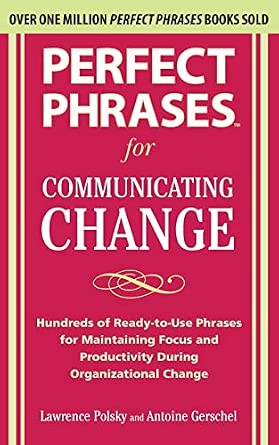
Perfect Phrases for Communicating Change
Author(s): . Lawrence Polsky (Author)
- Publisher: McGraw-Hill Education
- Publication Date: 15 Feb. 2010
- Edition: 1st
- Language: English
- Print length: 176 pages
- ISBN-10: 0071738312
- ISBN-13: 9780071738316
Book Description
THE RIGHT PHRASE FOR EVERYSITUATION . . . EVERY TIME
Employees respond to organizational change with worry, fear, and sometimeseven panic. Your job is to keep them motivated and focused―so you mustchoose your words carefully during times of upheaval.
Perfect Phrases for Communicating Change has hundreds of ready-to-use phrasesfor ensuring your employees make the transition with clarity, commitment, andskill. Learn the most effective language for:
- Articulating new company initiatives
- Responding to questions with confidence
- Easing employees’ fears
- Clarifying roles and responsibilities
- Addressing resistance and performance problems
Praise for Perfect Phrases for Communicating Change
“Perfect Phrases for Communicating Change is a wonderful book, filled with practical, solid advice, suggestions, and examples for how to communicate effectively in a time of change.”
John Krajicek, Executive Professor and Assistant Director of Business Communication Studies, Texas A&M University
“Communication during organizational change is everything. The right words at the right time can make all the difference between a successful and unsuccessful change initiative. This is a wonderful resource for finding the right words and sentiments to convey any type of change.”
Robert J. Marshak, Ph.D., author of Covert Processes at Work: Managing the Five Hidden Dimensions of Organizational Change
“Finding the right words to communicate change is challenging, even for the best of managers. In this user-friendly text, Lawrence and Antoine provide hundreds of practical phrases to better prepare managers for the task. The book is rich with insightful suggestions on change messaging considerations and construction.”
Edward Ferris, Assistant Professor, The New School for Management and Urban Policy
“In my over 20 years of running companies and corporate divisions I have seen a direct correlation between the quality of communication of my managers and their success in the business world. If you aspire to be an effective, efficient, and productive leader then I highly recommend this book. It is an outstanding reference guide and road map for pragmatic yet inspirational communication techniques.”
Mitch Pisik, President and CEO, Breckwell Products
Editorial Reviews
Review
About the Author
Antoine Greschel is a managing partner at PeopleNRG, a change management consultancy firm that specializes in optimizing “people energy” through high impact tools, programs and ideas. He was previously head of Global eLearning and Leadership Education at Aventis, a $20B pharmaceutical company, headquartered in France. He has over 15 years of experience developing award-winning programs that improve business communication and leadership within global, multi-cultural settings.
Excerpt. © Reprinted by permission. All rights reserved.
PERFECT PHRASES for COMMUNICATING CHANGE
Hundreds of Ready-to-Use Phrases for Maintaining Focus and Productivity During Organizational Change
By Lawrence Polsky, Antoine Gerschel
The McGraw-Hill Companies, Inc.
Copyright © 2010 The McGraw-Hill Companies, Inc.
All rights reserved.
ISBN: 978-0-07-173831-6
Contents
AcknowledgmentsChapter 1 Laying the Foundation for Communicating ChangeChapter 2 Perfect Phrases for Communicating a New Organizational
StructureChapter 3 Perfect Phrases for Communicating a New ProjectChapter 4 Perfect Phrases for Communicating as a New LeaderChapter 5 Perfect Phrases for Communicating a New Organizational StrategyChapter 6 Perfect Phrases for Handling Resistance
Excerpt
CHAPTER 1
Laying the Foundation for Communicating Change
The title of this book could be How to Deliver—What May Be InitiallyPerceived as—Bad News. Change at work is often hard to stomach.Employees tend to focus on what they are losing rather than the newopportunities change creates. We have written this book with that in mind andhave tried to write the phrases in a way that makes them easy to hear during astress-filled time.
In several sections, words and phrases are included that may be more empathicand soft than one might normally use. The purpose is not to force you to usethose words, but to help you remember that such an approach may make employeesmore open to the content of what you’re saying.
This also means you may not be able to use the phrases literally. For example,in some sections, there are lists of phrases that are choices. Pick the onesthat match your style and situation. Then again, some of the phrases might needto be used and repeated, changing the emphasis each time.
During change, emotions run rampant, which clouds listening. People might onlyhear the downside of the message the first time, the next time they might hearmore of the rationale, and the third time they might finally get “what’s in itfor me.” Key messages need to be repeated over and over again. If you don’t havethe luxury of repeating something so many times, use active listening skills andask back to find out how your message was received by the person you are talkingto.
In addition to providing you with phrases to use, our intention is to offer somemanagement training at the same time. Reviewing the content of phrases in anysection also serves as a checklist, inspiration, and reminder to cover certaintopics in your conversations. Rather than focus on just the words and whetherthey fit your style, focus on the content—the phrases will remind you whatis important to discuss during the turbulent times you are leading peoplethrough.
In some sections, the phrases are ordered from most simple andnonconfrontational to more direct/more confrontational. At times “or” is used tosignal you to choose the phrase that is most appropriate for you based on thesituation/person you are talking to. For example, when communicating about jobreassignment, there might be one phrase for a high performer and another for alow performer. The content in these phrases would be significantly different.
Moving from chapter to chapter, you’ll notice that some of the phrases are thesame or very similar. You will also notice that used in a different context theyhave a different feel and impact. In that spirit, look through several chaptersbefore committing to a phrase to see if there is something similar that mightwork better for you.
Launch Phase of Change
After all the hard work of deliberating and designing changes, the time forunveiling them to the organization has arrived. This usually begins with someonehigher in the organization than you announcing what is being done. Maybe it is adownsizing or merger announced through the media. Perhaps an e-mail from the CEOor a division head informs you about a reorganization. An electronic town hallmay be created with all employees in your division around the world to discussthe new enterprise resource planning (ERP) system that will change the waybusiness is done.
Whatever the case may be, you have the responsibility to explain what the changemeans to your employees. Often you don’t have all the information. Sometimes youdon’t have any information, and there is a good chance you are just as confusedand uncertain as your team is.
There are several critical elements to address in the launch of anychange—whether a reorganization, merger, new project, or new leader.
Explain the What and Why of Change
The what of change: People want to know what is happening. What is this newstructure? Who is this new person? What is the new process? At launch, there isan insatiable need to know what is going on.
People also need to know what is not changing so they have some sense ofstability within the storm. Even if you are implementing the most complexcomputer system, for example, some things will stay the same: company values,some of the people you work with, where your desk is, the customers you areservicing, or the products you are selling.
The why of change: More important, employees want to know why the changeis being made. Why is it necessary to go through all this trouble? Why is itimportant to learn all these new things? Why do we have to change when thingsare going so well? Why this decision and not another? What is not working thatneeds fixing? What better future are we trying to create? Employees want to knowwhy they are being asked to sacrifice and go through pain. That is the purposeof explaining the why. It gives people something to focus on and strive forwhile they are going through the challenges of change.
Remember, these are not children, nor is this an old-fashioned militaryoperation. They will not just do something because you said so. In fact,research of United States Navy commanders shows that even those who simply say”just do it” and act dictatorially are less effective and efficient (DanielGoleman, Working with Emotional Intelligence, 1998). Even in the armedforces they want to know why. People want the big picture. They need to knowwhy.
Remember to include all the stakeholders in your what and why message. The bestchange launch messages include all of the people impacted. Knowing why thechange is important for your customers, your colleagues, the other departments,the company, and the shareholders will give people a broader vision of what theyare doing. It will help them understand the business context and keep themfocused on key priorities.
Do It in Sixty Seconds or Less
Try it right now. Take sixty seconds and see if you can explain the what and thewhy of your change. How did it go? Traveling around the world, we have foundthat most leaders can’t do it in sixty seconds. It is hard. It takes thought,preparation, and practice.
We call it the one-minute change message. It entails finding the essence of whatis changing and why, and saying it in simple language. This is important forseveral reasons. First, employees today are swamped with communication: daysbooked with meetings; the constant ping of the BlackBerry; and innumerable chatmessages popping up on their laptops. They are also pulled in many directions.The marketplace is volatile; priorities are constantly changing. You are luckyif you can get their attention for sixty seconds! When you have their attention,you want to make the best use of it. Sixty seconds may be all that you get.
Second, saying your message in one minute or less will force you to focus on keyinformation. During change, there is so much information to share. Having aone-minute message will help employees weed through the information and hearwhat is really important.
Third, you are going to answer many questions and address many issues withemployees. If you have to think through and create a response each time, youwill never sound like you know what you are talking about.
Finally, change is filled with emotions. When people are emotional, theirhearing gets clouded. They need to hear things over and over so that the messagegets past the emotions and sinks in. When you have your prepared sixty-secondchange message in your back pocket, you are ready to provide employees with thekey information they need to keep the big picture in mind.
Be Available to Talk to People
Leaders tell us one of the biggest challenges during change is dealing with allthe employee questions, concerns, fears, and stress. Employees tell us thattheir biggest challenge during change is that they have all these questions,concerns, and fears and not enough access to leaders to get these addressed.This plays out often by leaders retreating to their offices to do e-mails andemployees finding busywork to do rather than face the challenges of the change.
The tension of this situation is like a rubber band held between two fingers.The analogy works like this: There is a tension for the rubber band pulling inboth directions. The employees on one side are pulling away because they want torun away and avoid the challenges. And the leaders on the other side are pullingaway because they want to run away from all the employee issues. The only answeris for the leader side of the rubber band to move closer to the employee side.Leaders need to talk, listen, and connect before employees get too stressed andthe rubber band goes flying. This is the only way to dissipate the tension.
In order to talk, listen, and connect, you must find ways to be available. Youare the voice and face of the company, like it or not. A major employeecomplaint we hear is that leaders are not available to discuss the changes. Torespond, you must be available, perhaps by stopping by their cubes, putting anagenda item on your monthly staff meeting, or creating Web conferences. Findsome way to simply check in regularly with employees, asking, “How are thechanges going?” “What obstacles are you running into, and what can we do toremove them?” “What’s the biggest fear out there this week?” Even asking “Howare you?,” can lead to a productive conversation. Take the time to listen andrespond.
One last point: Many companies stop here. They spend a lot of energy and moneylaunching the change. They fly around the world, create pretty posters anddocuments, and think they are done. This is wishful thinking. The main work ofcommunicating change comes after the launch.
Execution Phase of Change
Now that the hard work of launching the change has occurred, the execution mustbegin. The execution phase is the longest and most challenging. It is filled notonly with hard work but also with resistance. The main work of the executionphase involves performance management, handling resistance, and teamwork. Eachof these areas has its own special needs. Below are our suggestions for handlingeach.
Performance Management
Two of the core challenges of executing change are that employees don’t knowwhat to do next or don’t want to do what they know they need to do next. Goodperformance management addresses both challenges.
Clarifying Their Roles
Employees need to know what will be expected of them in the new environment.While this may seem obvious, we rarely see it done well. Much can beaccomplished without spending a lot of time creating complicated jobdescriptions. There are four key questions to discuss:
What will employees be doing?
What will employees not be doing?
Whom will employees be working with to get the job done?
How will employees be measured?
In the “what employees will be doing” part of the conversation, discuss the maincategories of work. This helps employees focus on their key priorities, whichcould be their involvement in a new project or an overview of their new roles.It does not need to include the detailed minutia of everyday responsibilitiesbut rather can offer a broad overview. Often the details have not been workedout yet, and you cannot wait for those to be worked out to discuss the role. Inthe meantime, plow ahead, resolving to accept the ambiguity of the situation.
The “what employees will not be doing” discussion includes old responsibilitiesthat no longer need to be done and anything that they will be passing off to anew person to handle. This part of the conversation prevents unnecessary workand conflicts. We have seen new computer systems rolled out but employeescontinued to produce and submit old reports for months because no one told themto stop! Also, with a change of structure or leadership, who does what maychange. This can cause conflict between two people who both believe they areresponsible for a task. Clarifying responsibilities upfront will go a long wayto prevent conflict and lost time.
Within this discussion of roles, you need to clarify “who they will be workingwith to get the job done.” This may be simple if they know and like theircolleagues. It becomes more challenging when they don’t like their newteammates, or when they are working with new people. Part of the challenge isthe time it will take to get up to speed—they need to build newrelationships in short order. Also, you need to help them break away from oldrelationship patterns while acknowledging that these old relationships areinvaluable. This can all be accomplished through communication and coaching.Just don’t underestimate the amount of time or energy it may take.
The final part of the discussion is about how employees will be measured. It iscritical that these measures reinforce the goals of the change. Much of theanxiety about change revolves around not knowing how people will be viewed inthe new world. Measures are a communication tool. They communicate to employeeswhat is important. You can have the best one-minute change message explainingthe what and why of change. However, if your measures are not consistent withthat message, you are chasing your tail.
How will the new leader really notice employees’ contributions to the team? Willtheir contributions in this new project be included in their annual reviews?Taking the time to explain this will relieve employees of the anxiety of theunknown, eliminate contradictions, and enable them to focus on their jobs.Additionally, you must make sure that their bonus system is in line with thesemeasures. For example, we had a customer who was assigned the change of leadinga new project that would take a significant amount of her time. However, herbonus was not adjusted accordingly. She was being paid on all her workexcept this project. It was no surprise she was apathetic and resentfultoward the new project.
Articulate Short-Term Goals
Given the need to clarify employees’ roles, a problem may exist in that oftenthings are in such a state of flux even the leaders don’t know the full plan andare unsure what to do first. Often they will wait, and wait, and wait, hopingthat things get clearer or the need for the change passes. This, of course, is arecipe for stalled change.
Leaders need to set short-term goals. These goals may be daily, weekly, ormonthly, but they help keep employees moving forward. As discussed earlier,mired in the confusion and emotion of the change, employees and leaders wouldjust as soon put the work off. Setting simple daily or weekly goals makes thechange manageable and keeps momentum going forward.
Creating Agreements
In clarifying roles, we frequently used the word discuss. The reason issimple. Telling people to do something is one thing. Getting them to agree to doit and be committed to doing it is quite another.
It is critical to get employee buy-in to the roles and goals. In the simplestcase with a positive, functioning employee, this can done by simply asking,”What do you think about these ________ (goals/roles)?” Then listen to andrespond to the comments. End the conversation by saying something like, “This isa team effort. I need your commitment that you will make these happen. I committo you that I will support you. Can you give me your commitment?” For employeeswho are more resistant and have other issues, this may be a much longerdiscussion. See Chapter 6 for more assistance.
Responding to Mistakes/Fault Tolerance
With change comes learning. With learning come mistakes. Antoine’s first bosswas famous for saying, “Only those who don’t work don’t make mistakes!” This isespecially true during change. We have to be willing to learn new skills, trynew approaches, and so on. And that doesn’t happen without a certain level ofrisk-taking. Companies and leaders who are willing to acknowledge, rather thanpunish, employees who make mistakes while trying something new tend to do betterwith change. Nothing does more to discourage change than blaming people formistakes and finding scapegoats for whatever happens to go wrong.
Before talking to someone who has made a mistake, think about the impact yourstatement will have on that employee’s willingness to take risks in the future.
Celebrating Success
Leaders in our Executing Change classes often struggle with how much positivereinforcement to give to their teams. They say, “Aren’t people paid to do theirjob—why do I have to tell them they are doing it right?” “If they havebeen doing well for a long time, won’t positive reinforcement seem patronizing?””Don’t we want to keep them trying to do even better?”
During high-stress situations, such as implementing change, when the pressure ison and results are critical, people need to know that they are on the righttrack and that their leaders are on their sides.
Find small things that are going right and tell your employees. Be specific. Itwill go a long way to support success during the stress of executing change.Don’t worry about being too positive. We have never worked for or consulted withan organization where people have said, “We get too much positive reinforcementaround here!”
Teamwork
Executing change successfully requires teamwork between leaders and employeesand between employees. Change is easier to accomplish and less stressful wheneveryone is working together.
Getting Input from Team Members
During change, leaders often get stuck between wanting to involve employees andneeding to make quick decisions. We have seen instances of under-involvement andover-involvement—each has its risks. When considering how much input toget for a new idea, process, or procedure, consider these questions:
Do you have the technical knowledge to make a good decision? The less youknow, the more you need to involve employees.
How important is it that employees be committed to the solution? The moreimportant this is, the more employee involvement is needed.
What is the time line? The answers to the first two questions have to betempered by the reality of the time line.
Communicating Common Goals and Shared Rewards
Organizations can’t achieve change goals without leaders creating and explainingthe specific team goals and team rewards accordingly. Employees need helptranslating change goals such “we want to become the market leader” intospecific goals for their department, whether it is information technology oraccounting. The CEO of a pharmaceutical company set a goal of “breaking downsilos,” but he never had the discipline to get his team (the function heads)together to share their goals and discuss overlaps and interdependencies. As aresult, this goal was never achieved.
(Continues…)
(Continues…)Excerpted from PERFECT PHRASES for COMMUNICATING CHANGE by Lawrence Polsky, Antoine Gerschel. Copyright © 2010 by The McGraw-Hill Companies, Inc.. Excerpted by permission of The McGraw-Hill Companies, Inc..
All rights reserved. No part of this excerpt may be reproduced or reprinted without permission in writing from the publisher.
Excerpts are provided by Dial-A-Book Inc. solely for the personal use of visitors to this web site.


