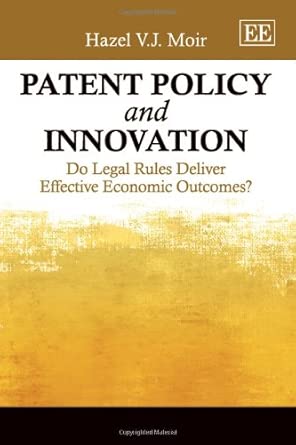
Patent Policy and Innovation: Do Legal Rules Deliver Effective Economic Outcomes?
Author(s): Hazel V.J. Moir (Author)
Publisher: Edward Elgar Publishing Ltd
Publication Date: 29 Mar. 2013
Language: English
Print length: 256 pages
ISBN-10: 0857932780
ISBN-13: 9780857932785
Book Description
This empirical study uses a scientifically selected sample of patents to assess patent quality. The careful evaluation of the assumptions in alternative economic theories about the generation and diffusion of new knowledge demonstrates that the height of the inventive step is critical to effective and efficient patent policy.
The book provides a practical introduction to the policy rules affecting the grant of patents, particularly the rules making the inventive step so low. It also offers insights into interactions between examiners and applicants during the patent application process. Finally, the book compares how the rules about inventiveness operate in the USPTO, the EPO and the Australian Patent Office, gives new insights into business method patenting and offers suggestions for raising the height of the inventive step.
Patent Policy and Innovation will appeal to academics researching in the patent field, economists, innovation and industry policy advisors, patent policy makers, NGO policy advisors and patent practitioners.
Editorial Reviews
Review
‘Just how inventive are inventions? More to the point, just how inventive are the inventions covered by patents? Not very, according to Hazel Moir, and there is no reason to doubt her conclusions. She has spent years in painstakingly analysis of dozens of business method patents in Australia and elsewhere. She finds. . . [t]hey are no more than strategic devices intended to annoy and disrupt commercial competition and confuse the market. . . Hazel Moir is a patent expert beholden to no patent theory and no patent interests. In consequence, her research is fresh and inspired. Her conclusion – that patents describe and protect obvious combinations of old ideas and trivial variations – may not be confined to business methods. It is a conclusion that demands the consideration of policymakers.’ — Stuart Macdonald, Aalto University, Helsinki, Finland
‘This book presents a compelling attack on the patent system. Thoughtfully analyzing the existing empirical literature and providing her own painstaking study of business method patents, Hazel Moir explains how it is that. . . patents have spread geographically and technologically, with increasingly broad rights becoming ever-easier to obtain. Bravely and persuasively, she recommends policymakers tackle one of the most vexing issues in patent law: the quantum of new knowledge that ought to be required to make an invention worthy of protection.’ — Rochelle Dreyfuss, New York University, School of Law, US
‘Hazel Moir’s book deserves to become a classic. Between its covers one will find writing of great clarity and data that reveal the real world costs of the patent system. After reading Moir’s analysis, one wonders what the actual social benefits of the patent system might be. This is evidence-based analysis at its best.’ — Peter Drahos, Australian National University and Queen Mary, University of London, UK
‘This book presents a compelling attack on the patent system. Thoughtfully analyzing the existing empirical literature and providing her own painstaking study of business method patents, Hazel Moir explains how it is that, despite the intuitions of economists, social scientists, lawyers, judges, and even some inventors, patents have spread geographically and technologically, with increasingly broad rights becoming ever-easier to obtain. Bravely and persuasively, she recommends policymakers tackle one of the most vexing issues in patent law: the quantum of new knowledge that ought to be required to make an invention worthy of protection.’ — Rochelle Dreyfuss, New York University, School of Law, US
About the Author
Hazel V.J. Moir, Centre for Policy Innovation, Research School of Social Sciences, ANU College of Arts and Social Sciences, Australian National University
 Wow! eBook