 Wow! eBook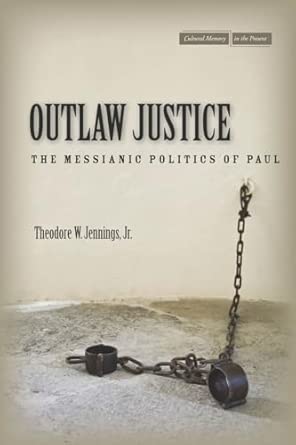
Outlaw Justice: The Messianic Politics of Paul
Author(s): Theodore W. Jennings Jr. (Author)
- Publisher: Stanford University Press
- Publication Date: 17 April 2013
- Edition: 1st
- Language: English
- Print length: 256 pages
- ISBN-10: 0804785163
- ISBN-13: 9780804785167
Book Description
This book offers a close reading of Romans that treats Paul as a radical political thinker by showing the relationship between Paul’s perspective and that of secular political theorists. Turning to both ancient political philosophers (Plato, Aristotle, and Cicero) and contemporary post-Marxists (Agamben, Badiou, Derrida, and Žižek), Jennings presents Romans as a sustained argument for a new sort of political thinking concerned with the possibility and constitution of just socialities.
Reading Romans as an essay on messianic politics in conversation with ancient and postmodern political theory challenges the stereotype of Paul as a reactionary theologian who “invented” Christianity and demonstrates his importance for all, regardless of religious affiliation or academic guild, who dream and work for a society based on respect, rather than domination, division, and death. In the current context of unjust global empires constituted by avarice, arrogance, and violence, Jennings finds in Paul a stunning vision for creating just societies outside the law.
Editorial Reviews
Review
About the Author
Excerpt. © Reprinted by permission. All rights reserved.
OUTLAW JUSTICE
The Messianic Politics of Paul
By Jr. Theodore W. Jennings
Stanford University Press
Copyright © 2013 Board of Trustees of the Leland Stanford Junior University
All rights reserved.
ISBN: 978-0-8047-8516-7
Contents
Acknowledgments……………………………………………………ixIntroduction: Getting Ready to Read Romans……………………………1First Part of Romans……………………………………………….13First Phase: The Unjust Social Order (1:18–3:20)………………………30Second Phase: The Coming of Messianic Justice (3:21–5:21)………………59Third Phase A: Before and After (6:1–7:6)…………………………….99Third Phase B: The Great Transition (7:7–8:39)………………………..111Fourth Phase: Divine Promise and Improvisation (9:1–11:36)……………..139Fifth Phase: The Corporate Improvisation of Justice in the Now-Time
(12:1–15:13)………………………………………………………176Coda……………………………………………………………..215Bibliography………………………………………………………233Index…………………………………………………………….239
Excerpt
CHAPTER 1
First Part of Romans
1. Making Connections (1:1–17)
We are going to read a letter written nearly two thousand years ago,from someone of whom we know very little, to people of whom we knoweven less. It is not addressed to us. We are, in a sense, accidental readers.Jacques Derrida has pointed out, in his work The Postcard, ways in whichtexts generally have this character, one that he identifies as a certain destinerrance,that is, a certain straying (errance) from its (intended?) destination.Like a postcard, it permits itself to be read by those to whom itwas not sent and thus escapes from its presumed author’s control orintention, from the direction in which it had been sent. The straying of thisparticular postcard from author and (intended) reader is largely thehistory of Christianity itself. The writer knew nothing of us and ourcircumstances, our culture, our language. He wrote to people of whom hepresumably knew something, but we don’t know much of whathe knew. Like any letter writer, he could suppose that they knew someof the same things and had certain common perceptions of their world andof the ways that world was changing. Despite the often fruitfullabors of scholars, we know far less than we would like to know aboutthe emergence of early Christianity in the complex Greco-Roman cultural,religious, and political world within which Paul was writing. Wehave very little in common either with the writer or the readers. Weare not only reading someone else’s mail; we are almost unimaginably farfrom a shared culture or worldview, let alone community. Any interpretation,therefore, is going to be severely limited. Readers of biblical textsroutinely forget how little we know or can know. This paucity ofknowledge will prevent any reading, including this one, from being definitive,from putting an end to the possibilities of reading. Nevertheless,we will forge ahead in an attempt to glean what we can from thisancient document that has been so important to the shaping of the history ofWestern Christianity and culture.
It is a letter. It has a sender and an addressee, and the writer isseeking to convey something to the readers that bears upon their situation.It is not a treatise that can be divorced from its particular occasion orcircumstance. Still less is it a summary of Paul’s theology. But itdoes have a certain coherence, an argumentative “flow” that will require thatwe see the parts in relation to the whole rather than treat theparts as stand-alone reflections on particular themes.
As we shall see, the basic themes of the text as a whole are prefiguredin the way the writer introduces himself and his intentions to the readers at the verybeginning. In his Time That Remains, the radical political thinkerGiorgio Agamben attempted to clarify the letter by focusing attention upon its firstten words. While such a procedure may be somewhat exaggerated (andAgamben himself deals with far more of this text and of Pauline textsgenerally than such a restriction might suggest), it is basically correctin sensing that much of what is essential to the text as a whole isalready prefigured at the beginning. Accordingly, we will have to linger overthe first few words—the introductory section—if we are to makesense of the letter as a connected argument.
Paul, slave of messiah Joshua
Already, before we begin, we are thrown into hidden perplexities. Whois Paul? Why does he call himself a slave? What sort of messianic liberatorcould even have slaves? What sort of slave could be attached to amessiah? What is happening here?
First, the name “Paul.” Since the writing of the Acts of the Apostlessome decades after Paul’s death, everyone knows that the writer who callshimself Paul had also been known as Saul. (This information isnot, however, found in the writings ascribed to Paul.) What does itmean that one who had been called Saul calls himself Paul? Some havesuggested that this is a name change that reflects the conversion of one whohad been a Jew (Saul) to one who has now become a Christian. Otherssuggest that he had had both a Jewish name (Saul) and a gentile or Romanname (Paul), for he was not only a Jew (and indeed a Pharisee,as he himself claims in Philippians 3:5) but also a citizen of Rome (asActs suggests). In addressing gentileRomans, he would naturally use his Roman name.
Agamben points to another possibility that actually makes more sense ofthe messianic politics that we will be exploring: the name Paul means”small” “or insignificant.” It thus corresponds to the self-designationof Paul as a slave, here and in other letters as well. Agamben writes:”The substitution of ITLσITL by ITLπITL signifies no less thanthe passage from the regal to the insignificant, from grandeur tosmallness—paulus in Latin means “small, of littlesignificance,” and in 1 Corinthians Paul defines himself as “the least[elachistos] of the apostles” (Agamben, Time 9).
The notion that the writer would call himself insignificant seems to bein considerable tension with his apparent assertiveness, especially in suchtexts as the letters to the Corinthians and Galatians where heseems to make much of his own authority. Since Nietzsche, it has beencommonplace to notice the sometimes irritating self-assertion of this writer.Indeed, Nietzsche could say of Paul that “his lust was forpower; Paul is the priest striving for power—he only had use forideas, teaching, and symbols with which to tyrannize over the masses and toorganize mobs” (Antichrist § 42). But is this view justified by the textsthemselves?
We may recall that Saul is a noble name, the name of the first king ofIsrael, the kingly name of Saul’s own tribe of Benjamin. If the writer hasexchanged a noble and even kingly name for one thatemphasizes insignificance and even slavehood, what would this mean?
It would mean that he is, in this at least, profoundly consistent withwhat he himself describes as the pattern of a certain messianic politics.In Philippians, writing to a community that he seems to have knownwell and with which he was on very good terms, he encourages them toadopt a policy, a common perspective, and approach to one another thatPaul attributes to the messiah: “Have this perspective thatalso characterized the messiah Joshua, who though he was in the form ofGod, did not count equality with God a thing to be grasped but emptiedhimself, taking the form of a slave” (Philippians 2:6–7a).
Notice that this messianic policy is one that renounces privilege andpower and goes so far as to take the form of a slave. Why slave? Thereis nothing in what we know of Jesus/Joshua that suggests that he hadthe legal status of a slave. The nearest that he approaches the statusof a slave is in his being executed by means of crucifixion at the handsof the military government of the empire, for this was a form of executionoften imposed upon rebellious slaves. It is perhaps no accident, then,that Paul mentions both slave and cross together in speaking of themessianic policy he enjoins upon his readers in Philippi in the passage justquoted. In that letter also, he had introduced himself as “slave of themessiah.”
Has the writer, in taking to himself the name or nickname of Paul takento heart this messianic polity and politics? This seems to be the likeliestexplanation. The messianic policy that Paul had recommendedin Philippians and that he seems to have adopted for himself is onethat is otherwise attested in the later depictions of the policy of theone called the messiah in the narrative that came to be called Gospels. Forthere he is recalled as saying that those who would be the greatestshould make themselves to be the servant or slave of the others(Mark 10:43–44). And certainly the messianic aspirations included a reversal ofworldly status as suggested by Luke’s version of the words of Mary: “Hehas brought low the high and has exalted the low” (1:52).
That “Saul” should become low also accords with Paul’s own account ofhimself as having inherited and embodied a certain religious privilege: anIsraelite, of the tribe of Benjamin, a Pharisee (Philippians3:5). But all of this he views as of no account compared to what he hasdiscovered in the messianic mission into which he has been summoned. Thus,he may describe himself, as Agamben has noticed, as “the least”of the apostles (1 Corinthians 15:9). In so doing he is simplyimitating once again what he describes as God’s policy in the world:”God chose what is foolish in the world to shame the wise, God chose what isweak in the world to shame the strong, God chose what is low anddespised in the world, even things that are not, to bring to nothing thingsthat are” (1 Corinthians 1:27–28).
Accordingly “Paul,” the one of no account, is the name he has chosenfor himself to signify his being incorporated into this messianic politics.It is therefore not surprising that he calls himself a slave, even ifthis is a slave of the messiah. But we should also pause here to recallthat “slave” designated a social-economic and political reality within the RomanEmpire generally and also within Rome itself. The empire was constitutedas an economy and polity based on slavery. Its economic, political, andmilitary power depended upon slavery. The majority of the population ofRome would have been slaves. This was true of all urban areas and of thegreat plantations upon which the privilege of the Roman ruling class depended.A principal means of acquiring slaves was war—the defeated who were notkilled were enslaved.
A slave was one who had lost all personal identity, whose existence wascompletely determined by the whim of the master. It is quite possible thatthe majority of those to whom Paul addressed himself were in fact slaves.But Paul was not one. He ascribes to himself this lowly status as agesture of solidarity with the dregs of the social order. Like his messiah,he identifies with the abjected masses of the Roman Empire.
Yet this downward social mobility, this identification with the lowest,is not situated within a static social stratification but within a forcefield so far identified with the word messiah. This name points to theuprising of the oppressed, enslaved, and impoverished and to thebringing down of the high and mighty, the powerful and the privileged. Thisreversal distinguishes a “messiah” from a king or emperor.
To say that one is a slave of the messiah is already to rupture language fromwithin. It is to say that which ordinary language will not allow. It is togive voice to a mind-bending paradox of explosive social potential. We willsee that this resort to paradox as provocation to thinking differently orotherwise is something characteristic of this letter.
Called apostle having been separated for the glad announcement[euangelion] of God (which [God] promised before throughhis prophets in holy writings)
The messianic slave is called apostle. Paul’s “identity” is entirelydetermined by the vocation into which he is summoned. Here it seems thatKrister Stendhal is correct to say that this calling rather than what hasbeen termed Paul’s conversion is entirely determinative (7–23).In certain respects Paul remains who he has always been (a Pharisee, anIsraelite, and so on), but he is called to represent the divine message orannouncement. Paul does not leave off being a Judean any more than heasks gentiles to leave off being gentiles. He is the Israelite (or as hehimself says in Philippians 3:5, “Hebrew of Hebrews”) who is called torepresent the astonishing announcement of the God of Israel, anannouncement that is directed to those who are not of Israel.
All that may be getting ahead of ourselves at the moment, for theparadox here lies in the juxtaposition of the being separated (a termthat refers to that which is put aside for sacrifice) with thepublic mission of representing a public announcement. Thus, Paul is setapart or reserved for the divine reality that is itself extendedoutward to include all the nations.
Euangelion here is itself a political term. It refers to anannouncement by the authorities that is put forward as good news forthe populace in general. Examples might include the declaration of victory inwar, a tax cut, or an especially good harvest. It is the announcementof something that would cause general rejoicing among the public. As such,the proclamation has a sort of performative force in that it bringsabout what it says: a tax holiday or a proclamation of peace, forexample. Thus, as glad announcement it also makes glad; it brings about oraims to bring about the rejoicing that marks it as “good” news.
Here, however, this happy proclamation comes not from some governmentofficial but from God. It concerns something that this God, the God ofIsrael, had promised long before. That it is precisely the Godof Israel whose proclamation is at stake is evident in that it issomething promised in the prophets of Israel and contained in the holywritings of that people.
Thus, Paul is that Israelite, that Pharisee, who now is set apart inorder to represent the public announcement of Israel’s God. What isthe content of this public announcement, and why should itoccasion general or universal rejoicing?
About his son, from the seed of David according to the flesh, butdesignated son of God in power according to a spirit of holiness through aresurrection from the dead
The phrase is a bit elliptical, but I believe we can make sense of itby filling in a few blanks that will restore a certain parallelism. Thedivine son was designated or claimed to be of the seed of David in accordancewith the “flesh.” For Paul, flesh generally designates either opposition to God(and hence to spirit) or weakness (and so, lack of power). We shall seelater that these apparently divergent meanings are in fact closely related.The opposition of spirit and flesh is a theme that Paul will stronglyemphasize in this text. He will say that “the mind that is set onthe flesh is hostile to God” (8:7). And he will contrast this to spirit”that raised Joshua from the dead” (8:11).
It therefore seems reasonable to suppose that the designation of theson as seed of David in accordance with the flesh comes from hostility toGod, a hostility exposed through a resurrection from thedead. What is missing here is something that Paul has elsewhereindicated is the whole content of his message. Writing to those inCorinth, he had maintained, “I decided to know nothing among you butJoshua messiah, the crucified” (1 Corinthians 2:2).
Thus, the designation of the messiah as son of David does not refer tosome supposed genealogical information (in the narratives written muchlater, in which we find genealogies, care is taken not to makehim into a biological son of David). It can only refer to the crossitself—to the designation of this Joshua asa (pretended) king of the Judeans and as one in rebellion against theempire.
This verdict of the empire, executed through the crucifixion of amessianic pretender who threatened the “peace,” is, however, overturnedthrough the power of life-giving spirit through the return to life of theexecuted. The resurrection of the dead is first and foremost the returnof the executed (as is also clear in the book of Daniel). The rule ofthe empire, and indeed the efficacy of any regime of law, depends upon thedeath penalty. Jacques Derrida, reading Walter Benjamin’s “Critique ofViolence” and citing Immanuel Kant, emphasizes the dependence of the ruleof law on the penalty of death: “When one tackles the deathpenalty, one does not dispute one penalty among others but law itselfin its origin, in its very order” (“Force of Law” 276). The point is thatlaw and death are inextricably bound together. Death is the “or else” of law,without which law does not have the force of law.
But what happens when the efficacy of the death penalty is abolishedthrough a resurrection to life of one of those who had been executed? Theviolence essential to the existence of the state, of any state, maybe robbed of its power to intimidate, to exact obedience. Already herewe may glimpse something of the radicality of Paul’s messianic politics, a radicalitywhose power may be pertinent even today. We shall return to this. But Paulis writing about a particular state power, a particular legalorder, that of the Roman Empire, which depended upon the efficacy ofmilitary execution by means of the cross to ensure the obedience of thepeoples caught up in its embrace. If the instrument of imperial coercionis rendered inoperative through a resurrection of the executed, can theempire still stand?
(Continues…)
(Continues…)Excerpted from OUTLAW JUSTICE by Theodore W. Jennings Jr.. Copyright © 2013 by Board of Trustees of the Leland Stanford Junior University. Excerpted by permission of STANFORD UNIVERSITY PRESS.
All rights reserved. No part of this excerpt may be reproduced or reprinted without permission in writing from the publisher.
Excerpts are provided by Dial-A-Book Inc. solely for the personal use of visitors to this web site.


