 Wow! eBook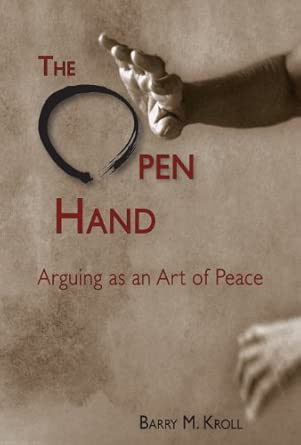
Open Hand: Arguing as an Art of Peace
Author(s): Barry M. Kroll (Author)
- Publisher: Utah State University Press
- Publication Date: 1 Nov. 2013
- Language: English
- Print length: 160 pages
- ISBN-10: 0874219264
- ISBN-13: 9780874219265
Book Description
Kroll cultivates a bodily investigation of noncombative argument, offering direct pedagogical strategies anchored in three modalities of learning-conceptual-procedural, kinesthetic, and contemplative-and projects, activities, assignments, informal responses, and final papers for students. Kinesthetic exercises derived from martial arts and contemplative meditation and mindfulness practices are key to the approach, with Kroll specifically using movement as a physical analogy for tactics of arguing.
Collaboration, mediation, and empathy are important yet overlooked values in communicative exchange. This practical, engaging, and accessible guide for teachers contains clear examples and compelling discussions of pedagogical strategies that teach students not only how to write persuasively but also how to deal with personal conflict in their daily lives.
Editorial Reviews
Review
"After reading, I am encouraged, and I think other compositionists might be as well, to write and develop work that not only talks or theorizes about contemplative practices but also provides transparent examples of how these practices (or concepts) may be enacted practically and critically."--Rachel Griffo, Composition Studies
About the Author
Excerpt. © Reprinted by permission. All rights reserved.
THE OPEN HAND
Arguing as an Art of Peace
By BARRY M. KROLL
Utah State University Press
Copyright © 2013 University Press of Colorado
All rights reserved.
ISBN: 978-0-87421-926-5
Contents
Acknowledgments............................................................vii1. Clapping In.............................................................12. Reframing and Deliberative Argument.....................................303. Attentive Listening and Conciliatory Argument...........................604. Mediating and Integrative Argument......................................895. Bowing Out..............................................................114Appendix 1: Photographic Illustrations of Movement Sequences...............139Appendix 2: Three Student Papers...........................................149References.................................................................164About the Author...........................................................169Index......................................................................171
CHAPTER 1
CLAPPING IN
What is the sound of one hand?Hakuin Ekaku (1686–1768)
"Let's begin," I'd say, and all of us would clap our hands three times, inunison, twice softly followed by a louder third clap. In my course Arguingas an Art of Peace, I opened class sessions by "clapping in" with students,a ritual that signaled the beginning of our work for the day. I introducedthis practice on the first day of the semester, evoking a few looks of confusionand concern. Arguing as an Art of Peace fulfilled the first-yearseminar requirement in the College of Arts and Sciences, so the studentswere all freshmen, taking one of their first college courses, and clappingin wasn't quite what they were expecting. But I had their attention andseized the opportunity to introduce some features of the course.
Quite a few things about this course would, I said, be different frommost of their other college classes. I explained that I had learned aboutthe clapping-in ritual from my exposure to Japanese martial arts, wheresessions often begin with two or three claps. The practice probably hasroots in Shinto, the indigenous religion of Japan, in which clappingthe hands at a shrine alerts the deities to one's presence. The gesturealso awakens the clapper to the present moment. In our case, clappingwould serve as a call to attention and an announcement that our workwas about to begin (no invoking of deities, for better or worse). It was anunusual ritual for my students, drawn from an unfamiliar context, andthe fact that we were clapping to start each class suggested, I hoped, myinterest in new and different approaches. It also indicated the degree towhich I would be drawing on Asian arts, ideas, and practices to defamiliarizeour work on arguing and provide fresh perspectives from a non-Westerntradition. The martial connection was suggestive too becausewe would be learning some movement sequences drawn from Chineseand Japanese martial arts, focusing on arts of the "open hand." And thenotion that a clap provides a wake-up call resonated with the emphasison mindful awareness that would permeate the course. When theyclapped in that first day, students were performing a ritual that anticipatedmany aspects of their seminar, Arguing as an Art of Peace.
First-year seminars at Lehigh are small classes, usually offered in thefall semester when students are making the transition from high schoolto college. Each seminar focuses on a topic of inquiry in the arts andsciences and, in most cases, includes intensive writing. The project forstudents in my seminar was to explore how arguing could be conductedwith an open hand, as an art of peace. I used the images of an openhand and closed fist to represent, metonymically, different approachesto the arguments that occur when people disagree with one another.In this course, I explained, we would be exploring the kinds of intensedisagreements that arise when people have differing views, values, orgoals, and when they have a stake in how those differences get resolved.Hence, our focus would be on argumentative conflict, situations inwhich one could form a combative fist or offer an open palm.
CLOSED FIST, OPEN HAND
The semiotics of fist and palm are complex and multivalent: a closed fistcan be used to defend oneself or to protect good causes in peril, whereasan open palm can signal resignation or suggest appeasement. Becauseour work in Arguing as an Art of Peace would focus on the open hand, itwas important to explore that symbol's function as a signifier of peacefulintentions ... but not a sign of passive submission. Figured against thefist of power and victory, the open hand can all too readily be construedas weak or acquiescent. I wanted to present another option, based on adifferent conception of the open hand.
I encouraged students, therefore, to think about an open hand notsimply as a gesture of peaceful intent but also as an instrument of contact,a way to connect with an opposing force and, ultimately, control it.In a conflict, this open hand provides a way to establish a connectionwith an adversary in order to receive aggressive energy and redirect it.This hand is neither belligerent nor passive, neither confrontationalnor submissive, yet it has within its reach elements of both assertivenessand receptivity. The hand that connects and controls lies at the heartof a number of Asian martial arts; the one I know best is the Japaneseart of aikido. In aikido, one responds to an opposing force by blending,repositioning, redirecting, or spinning around it—all the while stayingin contact, using an open hand. While there are no kicks, punches,or hard blocks in aikido, its movements involve, nonetheless, a certainamount of forcefulness combined with yielding or acquiescence,creating a dynamic response to an unfolding encounter. The goal is toresolve conflicts nonviolently, protecting everyone (even one's opponent)from harm. That is why aikido is called an art of peace, a phrase Ihave appropriated and applied to a mode of argument based on similargoals and tactics.
THE AIM AND SCOPE OF THE BOOK
Over the course of six semesters, from 2007 through 2012, I taught a versionof my first-year seminar on the topic of arguing as an art of peace.Although I will regularly refer to the course in what follows, that course isin fact a composite of six seminars. While the class was substantially thesame in terms of structure and projects, the activities changed to someextent each time I taught it. In a sense, the course is a fictional construct,yet it is, nevertheless, an accurate and responsible representation of whatArguing as an Art of Peace became as it developed over several years.
I decided to write about the experience of teaching the coursebecause I believe that my curriculum, class activities, and pedagogicalapproach are sufficiently different from traditional ways of teachingargument to merit consideration. The course I will be presenting differsfrom most others I've encountered in the following respects:
It includes rhetorical tactics and modes of arguing that differ fromtraditional approaches, offering alternatives to the familiar thesis-supportpatterns of arguing that many college students know from priorexperience.
It encourages students to analyze interpersonal conflicts along witharguments about controversial public issues, grounding the study ofrhetoric in the experiences of real people in real conflicts in the situationsthey encounter in their lives.
It emphasizes Asian practices and modes of analysis that expand theusual Western approach to composition pedagogy.
It employs a kinesthetic modality of learning, encouraging students toexplore the art of arguing by practicing martial movements.
It incorporates contemplative practices and meditative arts as ways tocultivate awareness and equanimity in the midst of conflict.
This account is based on my classroom experience, primarily, so thefocus is on projects, activities, assignments, informal responses, andfinal papers—a focus that will appeal, I hope, to college teachers, especiallythose who have an experimental attitude and are willing, perhapseven eager, to try something different. Although I touch on some theoreticalissues and refer to the work of scholars who have influenced mythinking, I have avoided a comprehensive review of the literature aswell as extensive citations, believing that they would detract from mypurpose. That goal is to present readers with enough details about mycourse, Arguing as an Art of Peace, to pique their interest and expandtheir options for teaching argumentation to college students.
SOME KEY INFLUENCES
When I reflect on the origins of my interest in an open-hand approachto arguing, I go back to the 1970s, when I was a new doctoral studentat the University of Michigan. I recall that when I arrived in Ann Arborin 1973, students in my graduate program were talking about a book,Rhetoric: Discovery and Change, which had been published a few yearsbefore, in 1970, by three Michigan professors: Richard Young, AltonBecker, and Kenneth Pike. I read their work with interest and excitement,particularly the chapter on Rogerian argument, in which theauthors posit the need for a "new rhetoric." The vision for the Rogerianproject was to "develop a rhetoric that has as its goal not skillful verbalcoercion but discussion and exchange of ideas" (Young, Becker, andPike 1970, 8). Young, Becker, and Pike claimed that the times (the late1960s and early 1970s) required a new approach to argument: "Perhapsnever before in our history," they say, "has there been such a need foreffective communication, but the old formulations of rhetoric seeminadequate to the times" (8–9). This call for a new rhetoric resonatedwith my observations and experiences: American society was indeeddivided, with a great deal of intense argumentation but little hope, itseemed, of bridging those divisions or fostering cooperation. But nearlyfour decades later, has the situation changed appreciably? DeborahTannen's analysis of contemporary conditions suggests that it has not.
In The Argument Culture, Tannen describes the prevalence of a "pervasivewarlike atmosphere that makes us approach public dialogue, andjust about anything we need to accomplish, as if it were a fight," portrayinga culture in which people approach issues with "an adversarial frameof mind" (Tannen 1998, 3). This approach assumes that "opposition isthe best way to get anything done":
The best way to discuss an idea is to set up a debate; the best way to covernews is to find spokespeople who express the most extreme, polarizedviews and present them as "both sides"; the best way to settle disputes islitigation that pits one party against the other; the best way to begin anessay is to attack someone; and the best way to show you're really thinkingis to criticize. (Tannen 1998, 3–4)
Although Tannen calls attention to the excesses of the argument culture,she refrains from rejecting tactics of the closed fist completely. Asshe recognizes, assertive approaches are sometimes warranted: "Thereare times when we need to disagree, criticize, oppose, and attack—tohold debates and view issues as polarized battles" (Tannen 1998, 26).The problem, in Tannen's view, is "the ubiquity, the knee-jerk nature, ofapproaching almost any issue, problem, or public person in an adversarialway." "What I question," she says, "is using opposition to accomplishevery goal, even those that do not require fighting" (8).
My project, like Tannen's, is an attempt to moderate, not invalidate,the emphasis on tactics of arguing with a closed fist; whereas she pointsto the excesses of adversarial argument, I want to focus on some promisingalternatives to it: tactics of reframing, attentive listening, and mediating.My approach—like that of Young, Becker, and Pike—assumes that awriter can enter a dispute with intentions that differ from those that prevailin an argument culture, where goals are usually conceived in termsof winning and losing, defending and defeating, supporting and critiquing,and so forth. Instead, I want to explore what it means to argue forcommon concerns, shared values, mutual benefits, respectful listening,and joint problem solving. My project is not about rejecting the closedfist but rather about recognizing the possibilities of the open hand thatconnects and controls.
When I first began to experiment with courses that emphasized alternativemodes of arguing, starting in the late 1990s, I structured my syllabiaround three projects, each representing a way to expand traditionalargument: I called them the deliberative, conciliatory, and integrativeapproaches. These three approaches continued to play a key role asI developed the writing projects for Arguing as an Art of Peace. Thus,the first project in the course—the subject for chapter 2—involves makinga deliberative argument. The concept of deliberative argumentation is asvenerable as Aristotle's Rhetoric and as current as contemporary writingcourses, often appearing in the guise of proposal arguments or problem-solutionessays. Although my approach has some distinctive elements, itis nonetheless consistent with certain aspects of both conventional andmore experimental conceptions of deliberation, with links to work onthe rhetoric of inquiry as well as the rhetoric of cooperation. Thus myapproach is broadly compatible with a conception of deliberative argumentas a process of inquiry or a rhetoric of reason, a search for the bestanswers to pressing questions. In The Shape of Reason, one of the mostthoughtful textbooks in this tradition, John Gage says that in the "contextof argumentative writing in college," the word argument "does not meana verbal battle between opponents, each of whom desires to silence theother. It means, instead, the search for reasons that will bring about cooperationamong people who differ in how they view ideas but who neverthelessneed to discover grounds for agreement" (Gage 2006, 43). InGage's view, as in my conception of deliberative rhetoric, argumentativewriting "may be seen as a process of reasonable inquiry into the best groundsfor agreement between a writer and an audience who have a mutual concern toanswer a question" (43; italics in original). In the unit on deliberative argument,students in Arguing as an Art of Peace would learn how to reframedisputes so that the focus was on problems or questions that drew writersand readers away from contentious argumentation and into mutualinquiry, a search for what Gage calls "grounds for agreement."
In his more theoretical account of a rhetoric of reason, JamesCrosswhite describes argumentation as "the practice of a very tenuoushope that people can settle their conflicts nonviolently, that they can actdifferently from the way they otherwise would because they can openthemselves to the dialogues that arguments are" (Crosswhite 1996, 47).While I share this hope, I worry that Crosswhite defines deliberativeargument too narrowly, so that it becomes an idealized form of argumentativerationality. In his view, argument is not simply conflictualdisagreement but rather a process in which interlocutors are alreadywilling to be part of a cooperative rational discussion, one designed toresolve the disagreement through a series of claims, challenges, and supportingreasons. Crosswhite says that argumentation requires "a respectfor one's interlocutor, a modesty or willingness to change on the partof the initiator of the argument, and the renunciation of violence by allparties." If these conditions do not obtain, "it could be argued that argumentationdoes not take place" (174). Crosswhite believes that unlessargumentation is separated from the everyday understanding of "havingan argument," which is usually understood as "something like havinga fight" (43), there's a chance that students will view "'rational' argumentationor 'scholarly' argument as continuous with the attempts atdiscursive domination that are so familiar in everyday life" (43). WhileI understand this concern, my strategy has been to focus on the continuitiesbetween everyday disputes and argumentation about social issues;rather than urging students to avoid deeply conflictual arguments, Ihave tried to teach them how to respond to high-intensity conflicts inways that maximize opportunities for communication and cooperation.
At the same time my project shares certain features with a rhetoricof inquiry, it also aligns itself with more experimental work ondeliberative argument, such as the innovative conception developed inDennis Lynch, Diana George, and Marilyn Cooper's article "Momentsof Argument: Agonistic Inquiry and Confrontational Cooperation."Not only do I share their concern that students have learned "to arguevigorously and even angrily, but not think about alternatives, or listen toeach other, or determine how their position may affect others" (Lynch,George, and Cooper 1997, 61), but I also embrace their goal of teachingargument in a way "that prepares students to participate in seriousdeliberations on issues that face all of us everyday" (62; italics added). Asmy discussion of the complexities of the open hand—marked by thedynamic interplay of yin and yang, as I explain later—suggests, I am,like Lynch, George, and Cooper, working out a way of "reconceivingargument that includes both confrontational and cooperative perspectives,a multifaceted process that includes moments of conflict andagonistic positioning as well as moments of understanding and communication"(63). At the same time, I am particularly interested incooperative perspectives on argument because of my focus on disputesand intensive conflicts. For that reason, my work stretches in the directionof the approach that Josina Makau and Debian Marty develop inCooperative Argumentation, in which they aim to teach students "not toavoid disagreement, but rather to develop tools for confronting disagreementpeacefully, ethically, and effectively" (Makau and Marty2001, 8). For Makau and Marty, "Cooperative argumentative practice"involves a "process of reasoned interaction intended to help participantsand audiences make the best assessments or the best decisionsin any given situation" (87). I draw on a number of Makau and Marty'sideas in the chapters that follow.
(Continues...)Excerpted from THE OPEN HAND by BARRY M. KROLL. Copyright © 2013 University Press of Colorado. Excerpted by permission of Utah State University Press.
All rights reserved. No part of this excerpt may be reproduced or reprinted without permission in writing from the publisher.
Excerpts are provided by Dial-A-Book Inc. solely for the personal use of visitors to this web site.


