 Wow! eBook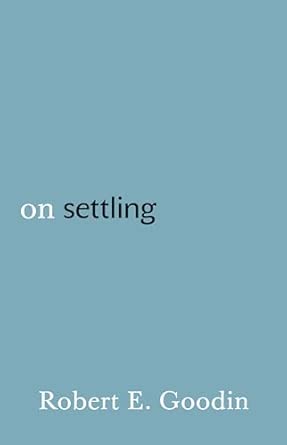
On Settling
Author(s): Robert E. Goodin (Author)
- Publisher: Princeton University Press
- Publication Date: 18 Sept. 2012
- Language: English
- Print length: 128 pages
- ISBN-10: 0691148457
- ISBN-13: 9780691148458
Book Description
Editorial Reviews
Review
“Goodin’s
On Settling may be an economical 74 pages plus footnotes and index but, intellectually speaking, is no mere hors d’oeuvre.”—Chris Wallace, Canberra Times“Goodin’s gentle little book is brimming with intelligence, sense, and humanity, and he makes a lot of progress toward understanding a concept that has received far too little attention.”
—Cass Sunstein, New Republic“I found this book highly rewarding. Due to its use of history and ordinary language, it is accessible to specialists and non-specialists alike. . . . Goodin gives readers a well-grounded starting point for a conversation on settling–one that I hope is continued.”
—Harrison P. Frye, Political Studies Review“Mr. Goodin’s
On Settling is a brief and gentle meditation on a subject that is larger and more controversial than it may at first seem.”—Daniel Akst, Wall Street Journal“This little book is an exercise in settling, not only a discussion of it, for Goodin has a lot more wisdom to share than he can capture in seventy-four pages. But the result of his effort is a manifestly important and worthy contribution to philosophical reflection, and no less so because it settled for being simply that rather than aspiring to say the first or last word on the subject.”
—David Schmidtz, Notre Dame Philosophical ReviewsFrom the Inside Flap
“This is a profound book by one of our very best social philosophers. It is a must-read in the age of unrealistic expectations and unyielding demands by extremists. It speaks both to our personal lives and to our public lives, as citizens and voters. Above all, one wishes our public leaders would heed it.”–Amitai Etzioni, author ofThe New Golden Rule
“Settling is not addressed at length anywhere in philosophy, but after reading this book one wonders ‘why not?’ Engaging, elegant, and edifying, this terrific book shows the importance of settling, and the varieties of settling that people routinely engage in.”–Cheshire Calhoun, Arizona State University
“This is an intellectually stimulating and entertaining book on a neglected subject: the value of settling. Clearly and accessibly written, it should appeal to a wide range of readers.”–Catherine Lu, McGill University
From the Back Cover
“This is a profound book by one of our very best social philosophers. It is a must-read in the age of unrealistic expectations and unyielding demands by extremists. It speaks both to our personal lives and to our public lives, as citizens and voters. Above all, one wishes our public leaders would heed it.”–Amitai Etzioni, author of The New Golden Rule
“Settling is not addressed at length anywhere in philosophy, but after reading this book one wonders ‘why not?’ Engaging, elegant, and edifying, this terrific book shows the importance of settling, and the varieties of settling that people routinely engage in.”–Cheshire Calhoun, Arizona State University
“This is an intellectually stimulating and entertaining book on a neglected subject: the value of settling. Clearly and accessibly written, it should appeal to a wide range of readers.”–Catherine Lu, McGill University
About the Author
Excerpt. © Reprinted by permission. All rights reserved.
On Settling
By Robert E. Goodin
PRINCETON UNIVERSITY PRESS
Copyright © 2012 Princeton University Press
All right reserved.
ISBN: 978-0-691-14845-8
Contents
Acknowledgments……………………………………………….viiINTRODUCTION………………………………………………….1ONE * MODES OF SETTLING………………………………………..5Where This Is Heading………………………………………….5Settling Down…………………………………………………7Settling In…………………………………………………..17Settling Up…………………………………………………..20Settling For………………………………………………….25Settling One’s Affairs…………………………………………27Settling On: The Master Notion………………………………….27TWO * THE VALUE OF SETTLING…………………………………….30Settling as an Aid to Planning and Agency………………………..31Settling, Commitment, Trust, and Confidence………………………37Settling the Social Fabric……………………………………..44THREE * WHAT SETTLING IS NOT……………………………………51Settling Is Not Just Compromising……………………………….52Settling Is Not Just Conservatism……………………………….57Settling Is Not Just Resignation………………………………..60FOUR * SETTLING IN AID OF STRIVING………………………………63Settling in Order to Strive…………………………………….64What Strivings Require Settling, and Why…………………………66When to Switch between One and the Other, and Why…………………68CONCLUSIONS…………………………………………………..74Notes………………………………………………………..75References……………………………………………………93Index………………………………………………………..107
Chapter One
Modes of Settling
Let us begin descriptively, by familiarizing ourselves with some of the many and varied facets of settling. In the end, what I am interested in is the practices represented rather than the words that are employed to describe them. But perhaps the best way to approach that task is by surveying the various different contexts in which that term is employed.
Philosophically, of course, it would be wrong to presuppose that anything very much can necessarily be read off the quirks of language alone. The fact that the same word happens to pop up in all these different connections does not necessarily mean that it is actually the same concept that is at work on each occasion. There is no a priori reason to suppose that we will necessarily be able to provide a coherent account that unifies all those various usages. That is something to be shown, not something to be presumed from the start. Still, these will serve as the descriptive materials on the basis of which subsequent chapters’ attempts at a philosophical synthesis and normative evaluation will proceed.
Where This Is Heading
I will argue that there is an important respect in which all of these forms of settling do indeed form a tolerably coherent whole. Inevitably, that analysis cannot accommodate absolutely every facet of every form of settling. Nonetheless, it manages to accommodate the great bulk of them.
What is central to settling, I shall argue, is a notion of fixity. I shall demonstrate this through analysis of the various forms of settling surveyed below. But for a quick overview, lexicography is a good place to start, as is always the case with any conceptual analysis.
Notice, therefore, that “fixity” is a feature that reverberates across the plethora of definitions offered by the Oxford English Dictionary for the adjective “settled”:
Of mental states, purposes, habits, etc.: Fixed, firmly embraced or implanted.
Of a matter in dispute …: Determined, decided, enacted or agreed upon.
Of a truth, a principle: established, placed beyond dispute.
Of affairs, an institution …: Established on a permanent footing and under fixed conditions or regulations.
[Of residence: h]aving a fixed abode.
Of a person: Established in life, esp. by marriage; brought into a regular way of life
Of an estate or property: Secured to a person by a legal act or agreement; held by a tenant for life under conditions defined by the deed.
Thus, for example, settlements of disputes—whether in the law courts or battlefields—bring them to an end, and on determinate terms. The Act of Settlement of 1701 settled the English Crown upon the Hanovers—thus fixing the line of succession. Immigration law offers the notion of a “settled domicile”—a fixed residence. A “settled intention” is one that you intend to remain fixed, at least for a time.
Nothing is fixed forever. Settled intentions can be revisited and revised. People can move away from domiciles where they had previously been settled. Middle-class do—gooders settle in settlement houses, intending to remain for a time—but only for a time.
Nonetheless, the phenomenology of settling is such that, once something is settled, it stays settled, at least for a while. Or at least people intend (or maybe just presume) it to be settled for a time—and, crucially, they proceed with their other planning on that basis. That, I shall go on to argue in chapter 2, is a major source of the value of “settling” in our lives.
Those are the sorts of claims that I hope to sustain through a closer examination of the many varieties of “settling” to which I now turn: settling down, settling in, settling up, settling for, settling one’s affairs. All centrally involve a notion of “fixity (at least for a time)” that is characteristic of “settling on.”
Settling Down
In various places—Australia, New Zealand, and South Africa among them—we are accustomed to thinking of ourselves as “settler societies.” The colonial experience in those places was self-consciously one of “peopling” the place. That was done, furthermore, with the aim of creating a society as similar as circumstances allowed to the one the settlers had left behind—pushing aside, in the process, such people as were already there.
Here, for example, is how Charles Darwin described his 1835 visit to a mission settlement on New Zealand’s Bay of Islands:
At length we reached Waimate; after having passed over so many miles of uninhabited useless country, the sudden appearance of an English farm house and its well dressed fields, placed there as if by an enchanter’s wand, was exceedingly pleasing…. At Waimate there are three large houses, where the Missionary gentlemen … reside…. On an adjoining slope fine crops of barley and wheat in full ear, and others of potatoes and of clover were standing; but I cannot attempt to describe all I saw; there were large gardens, with every fruit and vegetable which England produces…. All this is very surprising when it is considered that five years ago, nothing but the fern here flourished.
That is the sort of “stamping your mark on the place,” as best you are able, that is associated with self-consciously settler societies.
“To colonize” is, on Dr. Johnson’s definition, “to plant with inhabitants; to settle with new planters.” And for Dr. Johnson, like Hobbes before him, it is a defining feature of a “colony” that it is “a body of people drawn from the mother-country to inhabit some distant place.” John Stuart Mill corrected him, pointing out that that is not true of all colonies. It was hardly true, for example, of the colony that was British India, only a very small fraction of whose inhabitants were drawn from Britain.
Still, Dr. Johnson’s description is perfectly apt as a characterization of that subset of colonies that came to be known as “settler societies.” Those really were a matter of (in Seeley’s title) “the expansion of England”— send out Englishmen to settle distant vacant lands, and “where Englishmen are there is England.” According to the laws of England as set out in Blackstone’s Commentaries, “If an uninhabited country be discovered and planted by English subjects all the English laws are immediately there in force. For as the law is the birthright of every subject, … wherever they go they carry their laws with them.” According to The Law of Nations as set out by Vattel, where “a nation takes possession of a distant land, and settles a colony there, that country, though separated from the … mother-country, naturally becomes part of the state, equally with its ancient possessions.”
Those settler societies are different, too, in one other crucial respect. To return to the “expansion of England” refrain (although the basic principle generalizes perfectly well beyond the English): where there are Englishmen, there is a right of self-government. Mill thought it a matter of principle that colonies “composed of people of similar civilization to the ruling country” are “capable of, and ripe for, representative government” of their own, at some suitably early date.
Whether as a matter of principle or pragmatics, settlements at some distance were inevitably administered through highly imperfect mechanisms of communication, command, and control. In the process, they invariably acquired substantial powers of self-rule, de facto if not de jure. Jeremy Bentham went “so far as to compare the difficulties that Spain faced ruling over its colonial possessions with those of governing the moon: ‘It has its Peninsular part and its Ultramarian part! It has its earthly part: it has its lunar part.'” Thus, for one reason or another and in one way or another, settler societies initially created in the image of their mother countries typically came to operate quite independently of them.
We might even follow Carole Pateman in thinking of this in terms of a “settler contract.” As she elaborates:
When colonists are planted in a terra nullius, an empty state of nature, the aim is not merely to dominate, govern, and use but to create a civil society. Therefore, the settlers have to make an original-settler-contract…. So in a settled colony the terra nullius vanishes; a civil society is developed as colonists plant themselves, husband the land, and create modern political institutions.
And since the fiction of terra nullius was a crucial prerequisite for legitimating settlement and empowering the settlers to craft that new contract, it is inevitable that under the terms of this settler contract “the original inhabitants and their societies are of no account and it is as if they no longer exist. They and their lands exist only if expressly recognized by the new state.” Thus, all too often, “settlement” was just a polite name for conquest (an issue to which I shall return in my discussion of “settling up” below).
Such is the way with settler societies. The experience of settlement, however, is hardly confined to those very special cases of self-consciously settler societies. Settlers of precisely that sort shaped various other places as well. Conspicuously among them were, of course, the United States and Canada.
In the 1584 charter that became the founding document of the Virginia Colony, Queen Elizabeth I not only granted Sir Walter Raleigh rights of exploration. Elizabeth’s charter further stipulated that “the said Walter Ralegh, his heires and assignee, … shall goe or trauaile thither to inhabite or remaine, there to build and fortifie.” Similarly, in the 1603 Charter of Acadia, the founding document of French Canada, King Henry IV
ordered, commissioned, and established the Lord of Monts … to people and inhabit the lands, shores, and countries of Acadia, and other surrounding areas, … to there settle and maintain himself in such a way that our subjects will henceforth be able to be received, to frequent, to dwell there, and to trade with the savage inhabitants of the said places.
There is no mystery as to why those early monarchs were so keen that settlement should follow exploration. Settlement (“possession”) is the only way in which a prince can secure title to lands, both legally and pragmatically. Legally, “the act of discovery is sufficient to give a clear title of sovereignty only when it is accompanied by actual possession,” which is why Grotius denied that the Portuguese had any claim to the East Indies. And in practice, it is hard to hold on to a territory unless you have people settled there who are prepared to defend it. Thus, for example, “[i]n 1655 England wrested Jamaica from the Spaniards and encouraged … buccaneers to settle there as a defense against the island’s recapture.”
The apogee of this process of settling in subsequent US history was, of course, the Homestead Act of 1862. That statute permitted an individual to purchase, at a deeply discounted price, a tract of public land “for his or her exclusive use and benefit.” It did so, however, only on the strict condition “that said entry is made for the purpose of actual settlement and cultivation.” Under the terms of the Homestead Act, it was precisely that settling on the land that was taken to confer title to the land. Homesteaders were legally required genuinely to settle—to remain on the land for five years—before the transfer of title in the property would be effected.
[I]f, at any time … before the expiration of the five years aforesaid, it shall be proven, after due notice to the settler, … that the person … shall have actually changed his or her residence, or abandoned the said land for more than six months at any time, then and in that event the land so entered shall revert to the government.
But that was merely the most famous US example of a process that had been going on far more widely and for far longer. It is quite common for settlers initially to squat on lands not their own, and then after a time to seek to regularize their status there; in that way, illegal squatters eventually become (or anyway seek to become) legal tenants, proprietors, or owners of the property on which they had once been squatters. You find that still happening in various illegal settlements around the world today, on the fringes of Third World cities and in the Occupied Territories of the West Bank. You find that in nineteenth-century Australia where, when the claims of illegal occupiers were recognized, squatters suddenly became landed gentry and the so-called squat-tocracy gained legal title to vast tracts of inland Australia.
You also find the same phenomenon, on a more modest scale, in earlier periods of US history. Among the earliest of white settlers, the typical pattern was first to occupy the land and only later to seek to acquire legitimate title to it. A report of early colonial practice in the Carolinas, for example, describes how
the method has hitherto often been for men to settle themselves upon a piece of ground, improve it, build, raise stock, plant orchards, and make such commodities, which being sold, procur’d them slaves, horses, household-goods and the like conveniences; and after this was done, in seven or eight years they might begin to think it time to pay the Lords something for their land.
The Pre-emption Act of 1841 regularized this practice, specifying that any person who “has made or shall hereafter make a settlement in person on … public lands … and who shall inhabit and improve the same, and who has or shall erect a dwelling thereon, shall be … authorized to” purchase that land at a knockdown price.
Nor was this focus on settlement confined to North America in the colonial period. It also characterized virtually all of Latin America, from not long after the Spanish and Portuguese conquests. As early as 1534, the king of Portugal was giving large tracts of land in Brazil to donatários specifically on the condition that they “defend and settle the land.” One of the first initiatives of newly independent Mexico was the enactment from 1823 onward of a suite of laws and regulations “to grant vacant lands in their respective territories to empresarios, families, or private persons, whether Mexicans, or foreigners, who may ask them for the purpose of cultivating or inhabiting them.” Those grants were made on the explicit proviso that the petitioner begin to occupy or cultivate the land within two years. Some seven hundred such grants were made in relatively short order.
Organized waves of migration of that sort, deliberately devoted to settling some foreign lands or frontier territories, are themselves only one special case of a much more general phenomenon, however. Stepping back from that, recall that the experience of “settlement” played a crucial role in the social evolution of the human species as a whole.
Some ten thousand years ago, “with the development of settled agriculture and the conscious production of foodstuffs, man first acquired the basic ability to increase his resource base.” The significance of this cannot be overestimated. “Prior to this …, man lived in communal groups or bands, taking from nature what could be killed or gathered. The limits of man’s livelihood were fixed by a resource base upon which he could not yet improve. He could only live within its biological constraints.” With the development of settled agriculture, that fundamentally changed. As one Nobel laureate in economics writes, “This transition … from hunting/gathering to settled agriculture has been termed the Neolithic Revolution … and has correctly been compared in importance to the Industrial Revolution. Both … witnessed marked increases in man’s control over nature.”
Indeed, many would say that the shift from wandering hunter-gatherer to settled agricultural modes of existence marked the true foundation of human society. As Rousseau remarks in his Discourse on the Origins of Inequality,
Everything … begins to change its aspect [as] men, who have up to now been roving in the woods, by taking to a more settled manner of life, come gradually together, [and] form separate bodies … united in character and manners. … In consequence of seeing each other often, they could not do without seeing each other constantly…. Each one began to consider the rest, and to wish to be considered in turn; and thus … value came to be attached to public esteem…. As soon as men began to value one another, and the idea of consideration had got a footing in the mind, every one put in his claim to it, and it became impossible to refuse it to any with impunity. Hence arose the first obligations of civility even among savages; and every intended injury became an affront; because … the party injured was certain to find in it a contempt for his person, which was often more insupportable than the hurt itself.
(Continues…)
Excerpted from On Settlingby Robert E. Goodin Copyright © 2012 by Princeton University Press. Excerpted by permission of PRINCETON UNIVERSITY PRESS. All rights reserved. No part of this excerpt may be reproduced or reprinted without permission in writing from the publisher.
Excerpts are provided by Dial-A-Book Inc. solely for the personal use of visitors to this web site.


