 Wow! eBook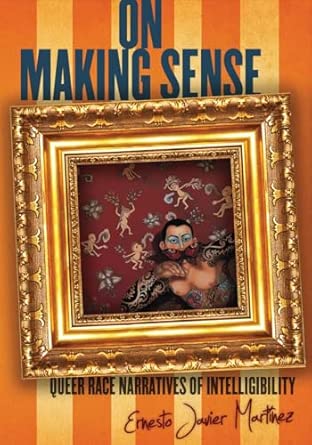
On Making Sense: Queer Race Narratives of Intelligibility
Author(s): Ernesto Javier Martínez (Author)
- Publisher: Stanford University Press
- Publication Date: 31 Oct. 2012
- Edition: New
- Language: English
- Print length: 216 pages
- ISBN-10: 080478339X
- ISBN-13: 9780804783392
Book Description
Editorial Reviews
Review
“I submit that it is both brilliant and as near to flawless as I can imagine a book to be. It is a book that is both theoretical and pedagogical in the most generous sense of both terms for it refuses to shy away from the thorny, complex theoretical problems of identity while remaining crystal clear in its assertions . . . It is, in my modest estimation, hard not to walk away from this book without having learned something substantial about the flawed social world we inhabit and the need to continue to address the misguided logic upon which it has been built and rebuilt. I can envision this book having an impact on the work of scholars of race and sexuality, but also on classrooms of graduate and even undergraduate students.”–John Riofrio “
Journal of American Studies““In this innovative book, Martínez reads literary texts and performances by queer Latina/o and Asian American writers and artists to reveal them confronting the historical and present injustice of their having been denied the capacity to know and be known. . . . This book moves cultural theory forward a step toward enabling material changes in oppressive social structures. . . . Recommended.”–R. R. Warhol “
CHOICE““In trenchant and often inspired readings, Ernesto Martínez boldly critiques the ways that the work of queers of color are often mis-read and roughly handled by practitioners of Queer Theory. While recommitting himself to progressive ‘Queer’ intellectual practice, Martínez vigorously resists ‘de-socialized, ‘ ‘dis-embodied’ tendencies within the increasingly institutionalized and scholastic practice of Queer Studies.
On Making Sense represents nothing less than a much needed generational shift in the practice of Queer Studies itself.”–Robert F. Reid-Pharr “The Graduate Center, City University of New York, Author of Once You Go Black: Choice, Desire, and the Black American Intellectual““Martinez’s unique approach to the politics of identity makes his project markedly refreshing and indispensable in its goal to responsibly make sense of experience in struggles for social justice . . . It is quite clear that queer of color critique has an important new interlocutor in Ernesto J. Martínez. Anyone invested in moving the enterprise forward would be remiss to overlook
On Making Sense for how it endeavors to make sense in crucial and responsible ways.”–Richard T. Rodríguez “GLQ: A Journal of Lesbian and Gay Studies““On the whole, Ernesto Javier Martinez’s book makes a salient point that will warm the hearts and raise the hopes of a wide range of audiences, beginning with constituencies in the global north invested in decolonializing justice as idea and practice, and including constituencies of resistance to hegemonic and/or imperializing theories anywhere in the global south. The aforesaid point – namely that a realist turn in theories of experience and subjectivity decolonizes their subjects, who might especially be queer and persons of color – is refreshing and salutary, after decades of captivity in post-modern and poststructuralist theory.”–Nandini Bhattacharya “
Journal of Intercultural Studies““Through nuanced, eloquent, and accessible close textual analyses that are thoughtfully situated in relation to key critics (particularly those in Latina/o literary studies),
On Making Sense unearths new insights into literary narratives of queer people of color in the United States, from the ways that less obvious spatial logics organize knowledge to the political potential of community members’ and outsiders’ perspectives on queer subjects for creating solidarity across difference.”–Yufang Cho “National Political Science Review“About the Author
Excerpt. © Reprinted by permission. All rights reserved.
ON MAKING SENSE
Queer Race Narratives of IntelligibilityBy Ernesto Javier Martínez
Stanford University Press
Copyright © 2013 Board of Trustees of the Leland Stanford Junior University
All right reserved.
ISBN: 978-0-8047-8339-2
Contents
Acknowledgments………………………………………………………….xiIntroduction: On the Practice and Politics of Intelligibility…………………11. Morrison and Butler on Language and Knowledge…………………………….232. Dying to Know in Baldwin’s Another Country……………………………….453. Queer Latina/o Migrant Labor……………………………………………774. Shifting the Site of Queer Enunciation…………………………………..1125. Cho’s Faggot Pageantry…………………………………………………137Notes…………………………………………………………………..161Bibliography…………………………………………………………….183Index…………………………………………………………………..195
Chapter One
MORRISON AND BUTLER ON LANGUAGE AND KNOWLEDGE
Language remains alive when it refuses to “encapsulate” or “capture” the events and lives it describes…. The violence of language consists in its effort to capture the ineffable and, hence, to destroy it, to seize hold of that which must remain elusive for language to operate as a living thing. Judith Butler, Excitable Speech
Your answer is artful, but its artfulness embarrasses us and ought to embarrass you. Toni Morrison, The Nobel Prize Lecture in Literature
BEYOND “RACE FATIGUE”: A PROLOGUE ABOUT OUR TIMES
“Everything that I am about to say in this essay has already been said.” This is the strategic concession deployed by the literary critic Hiram Perez in his courageous 2005 critique of Euro-American queer theory, a subversively bifid acquiescence gesturing toward what we may want to call the phenomenon of “race fatigue” operating within feminist and queer theory circles today. This race fatigue comes in at least two forms. On the one hand, there is the fatigue of a certain kind of feminist or queer academic who feels, as Perez notes, “disgruntled” about the persistent appeal to be in conversation with intellectuals and writers of color, to not misuse their ideas, and more importantly to elaborate antiracist, non-Eurocentric scholarship. This disgruntlement can have various manifestations, as is the case when queer theorists like John Champagne dismiss such perceived injunctions as theoretically naive and emotionally manipulative or when early feminist scholars like Mary Daly simply do not respond to the perception that women of color have been misused. On the other hand, there is the fatigue of primarily intellectuals and writers of color who, faced with a laundry list of erasures and distortions, express grief and anger at the persistent lack of reciprocity, not to mention a profound sense of exhaustion at having to perform, time and time again, the spectacle of the angry person of color obsessed with questions of race and racism.
What is striking about Perez’s performative utterance is that it registers a record of exhaustion for which there are at least two seemingly incommensurable understandings. Yet, how do we resolve the problem for which “race fatigue” is, perhaps, only a symptom? If scholars are indeed tired (albeit for significantly different reasons) of concerns being raised about race and racism in the work of white feminist and white queer scholars, how do we move productively through such differently justified exhaustion? What tools are at our disposal in order to address a problem that is as pervasive (according to many scholars) as it is unsubstantiated (according to many others)? Will “theory” remain a “racialized” domain, with the obvious privileges of Eurocentric whiteness in American society limiting our capacity to say what we mean and to be heard clearly?
Feminist theorists of race have been especially conscious of these questions, reminding us that if assertions of advancement (with regard to race and racism) often rest on the “inclusion of racial difference,” then as a matter of critical assessment the methods and circumstances of incorporation “need to be carefully scrutinized.” In the context of struggle over the role of minority intellectual production in feminist and queer theory, I argue that closer attention should be paid to the use of writers of color in projects that employ antirealist assumptions regarding language, identity, and knowledge. I utilize as a primary case study a prominent scholar who straddles feminist and queer theory, Judith Butler, and reflect upon her peculiar misuse of Toni Morrison’s Nobel Lecture in Literature. By contrasting the theories of language and narrative developed by Morrison in her Nobel lecture with their misappropriation by Butler in Excitable Speech: A Politics of the Performative, I show how Butler selectively cites Morrison to support claims about the indeterminacy of language that are curiously at odds with Morrison’s understanding of language and social reference. In fact, as I argue, Butler’s use of Morrison is a form of aggressive theoretical misappropriation that is symptomatic of a certain antirealist tendency in contemporary scholarly culture.
My discussion of Morrison and Butler builds on Roderick Ferguson’s “queer of color critique” as a critical reading practice—turning toward African American literature as a crucial archive of negotiation and launching from that nexus a new interrogation, not of liberalism and Marxism, as Ferguson does, nor of canonical sociology and the distortions of African American lived reality that Ferguson argues it accomplished, but of some of the most taken-for-granted approaches in feminist and queer theory today, antirealist approaches that proclaim antiracist intent and applicability, but converge with racist logics. Deploying queer of color critique in this manner suggests a recalibration of our most basic presuppositions regarding identity and language, not the least because we can now point to several ways in which antirealists distort, in the most predictable manner, some of our writer’s most important and nuanced decolonial contributions.
Echoing an extensive record of apprehension and critique expressed by feminists of color such as Barbara Christian and Deborah McDowell, bell hooks and María Lugones, Chandra Mohanty and M. Jacqui Alexander, and Linda Martín Alcoff and Paula Moya, I raise questions with respect to how racialized minorities are represented in antirealist projects, especially those projects informed both by poststructuralist theories of linguistic reference (particularly the belief in the radical indeterminacy of language) and by postmodernist skepticism toward identity categories. I argue, drawing on feminist theorists Paula Moya and Shari Stone-Mediatore, that these projects have recurring interpretive limitations (not to mention regulatory effects) that cannot be overcome without relinquishing some core antirealist commitments. Moya has pointed out that “women of color are often called on in postmodernist feminist accounts of identity to delegitimate any theoretical project that attends to the linkages between identity (with its experiential and epistemic components) and social location.” To demonstrate her point, she examines the work of Butler and of Donna Haraway, showing not only how these two theorists misuse Cherríe Moraga’s words “without attending to her theoretical insights,” but also how they “employ her work at key moments in their arguments to legitimate their respective theoretical projects.” Similarly, Shari Stone-Mediatore has engaged Joan W. Scott’s influential 1991 essay “The Evidence of Experience”—an essay that advocates a rigid, a priori skepticism toward experience-based knowledge—to reveal its reliance on a series of telling misreadings of Samuel Delany’s 1988 memoir, The Motion of Light in Water. According to Stone-Mediatore, Scott lodges an unfounded accusation of naive empiricism against Delany, a charge that selectively misreads his words in order to manufacture proof of poststructuralism’s timely and unique importance. Far from being a minor example for Scott’s argument, Delany becomes what Janet Halley recently referred to as “Scott’s ‘set text’—the text that she reads and rereads at least three times in the course of the essay.” Set up through a series of close readings as the earnest but ultimately naive subaltern who deploys experience in uncomplicated ways, Delany’s presence becomes functional—his blackness, gayness, and use of personal experience come together to form the decisive evidence for Scott’s avant-garde critique of experience. The academic ripple effects of Scott’s argument, rooted in such a misreading, should be cause for concern, in part because white queer scholars like John Champagne have been, in effect, authorized by it to cast doubt on and minimize the identity-based knowledge generated by people of color, but also because scholars of color writing on race in the wake of antirealism have been placed in the awkward position of genuflecting to a body of work that has, in several instances, undermined the importance of ethnic minority intellectual production.
The antirealist theorists mentioned here (e.g., Butler, Haraway, Scott, Champagne) are all white scholars engaged in promoting theoretical propositions based in traditions of scholarship that have not taken the lives and experiences of people of color or the legacies of colonialism as core concerns. By contrast, the writers of color they have misread (e.g., Delany, Moraga, Morrison, Hemphill, Riggs) emerge from cultural and intellectual traditions predicated on the tenet that race and colonialism are constitutive of the categories of modern knowledge production. Rather than imputing racist motives to these well-respected white scholars, however, I suggest that there is a recurring racial logic and racist significance to these erasures that requires further investigation. Quite independent of (white) identities or any presumed (racial) motives, these patterns of erasure and misappropriation reflect a racial logic grounded in the supposition that writers of color are less theoretically astute. Independent of any intentional motives, these misappropriations also carry a powerful racist significance: the ideas of thinkers of color are suppressed and subordinated to the ideas of white theorists. Tacit presuppositions that reflect a larger cultural economy of race are embedded in the claims of leftist scholars who are quick to find fault with, impute naiveté to, dismiss, or subsume under their own views the ideas of people of color. In fact, these precedents have a history and a geography, described by Mignolo, Grosfoguel, and others by the phrases “coloniality of knowledge” and “geopolitics of knowledge.” Knowledge claims, including the antirealist claims of queer theory, are based in traditions and practices that as a matter of course take Europe, the West, and the unmarked categories of white existence as an unacknowledged starting point, dismissing as naive or crude anything that departs from that familiar terrain. The result is a necessary misreading, misappropriation, or dismissal of traditions taking off from incompatible points of origin. The examples set by Butler, Haraway, and Scott are illustrative, pointing to the propensity of certain theoretical projects to undermine the insights of writers of color, even as they proclaim a desire to think complexly alongside their work.
A focus on antirealist presuppositions and the interpretive skepticism toward identity and experience that they encourage affords a more capacious account of the pervasiveness of this racial logic. As Moya has argued, scholars across a range of identities can find themselves ill prepared to engage insights produced by writers of color when those insights are grounded in claims concerning identity and experience. Presumed to be always already naive and essentialist, any claims based in identity and experience must be aggressively justified, if not immediately rejected. Interrogating background beliefs and theoretical assumptions, then, may offer new ways to explore relations between Eurocentrism and racism by excavating pernicious presuppositions informing even the most seemingly progressive modes of thought.
If certain theoretical projects consistently invoke people of color in ways that suppress their insights, that isn’t just an interpretive misfire (one scholar misreading another), for it influences what and whom we value. To explore the racist significance and racial logic of such misappropriations, I turn to Morrison’s realist and decolonial observations concerning language and social reference and then trace how these views are misleadingly appropriated, enlisted into Butler’s theoretical project through a series of partial readings. The nature of the misreading is important to note, for it is not simply an interpretive error in need of revision. On the contrary, Butler’s misreading obscures the challenge that Morrison’s ideas pose to Butler’s antirealism. The misreading also has the effect of discrediting scholars of color working within the field of critical race theory, since Butler justifies her framework (through Morrison) in order to critique critical race theory’s purportedly dangerous naivete. Reading Morrison’s theory of language and reference against Butler’s antirealism helps us to understand the significance of knowledge grounded outside the traditions of colonial modernity, and it illustrates the forms of talking past each other that can result when such traditions encounter Euro-centered theoretical projects.
MORRISON ON LANGUAGE AND SOCIAL KNOWLEDGE
In the introductory remarks to her Nobel Lecture in Literature, Morrison asserts that narrative has never been “merely entertainment” for her, that in fact she conceives of narrative in a much more robust fashion, as “one of the principal ways” in which knowledge about our shared social world is pursued and acquired. To illustrate and add nuance to this point, Morrison proceeds to address her audience not in a traditional lecture format but by telling a story. The story Morrison begins to tell, however, is not the same one she ends up narrating at the end of her lecture, and it is precisely the staged relationship between these two stories, the seamless rendering of one into the other, that appears central to what Morrison wants to communicate about the dialogic work and indexical nature of telling stories.
The story Morrison begins to narrate as part of her lecture is of an old, black woman whose “reputation for wisdom is without peer” and who is visited one day by young people who “seem to be bent on disproving her clairvoyance and showing her up for the fraud they believe she is.” Knowing that she is blind, the children enter her home with malicious intent and ask a question, the answer to which, we are told, “rides solely on her difference from them.” One of the children asks, “Old woman, I hold in my hand a bird. Tell me whether it is living or dead.” The blind woman—assessing the encounter to be one born of hostility, precisely because “she is blind and cannot see her visitors, let alone what is in their hands”—responds by recasting the cruel question as a problem for the children, themselves, to remain accountable for: “I don’t know whether the bird you are holding is dead or alive, but what I do know is that it is in your hands. It is in your hands.” Such is the initial parable that provides Morrison with an occasion to reflect on “what (other than its own frail body) that bird in the hands might signify.” Choosing to read the bird as language and the woman as a practiced writer, Morrison considers the significance of understanding language as “a living thing over which one has control” and for which all human beings can be said to be responsible (through their own practices of narration).
Among the claims Morrison makes based on this parable, the overwhelming emphasis is on the misuse and abuse of language. Morrison goes on, for example, to speak candidly about the misuse of language by the state in order to censor or by the powerful in order to demean and control. In fact, she comments on various methods of misusing language. She writes, “Whether it is obscuring state language or the faux language of mindless media; whether it is the proud but calcified language of the academy or the commodity-driven language of science; whether it is the malign language of law-without-ethics, or language designed for the estrangement of minorities, hiding its racist plunder in its literary cheek—it must be rejected, altered and exposed…. Sexist language, racist language, theistic language—all are typical of the policing languages of mastery, and cannot, do not, permit new knowledge or encourage the mutual exchange of ideas.” This emphasis on various misuses of language is not, of course, intended as a description of the totality of what language can be. For Morrison, language can also be put to more productive purposes. Still, the emphasis on the entrenched misuse of language in this first half of her lecture does have enhanced thematic salience precisely because of its relationship to the parable on which it is based and the way the children in that parable have viciously used language in order to assail and insult the blind woman.
Midway through Morrison’s lecture, however, a crucial and unexpected shift in perception is dramatized for her audience, and it is done in a way that fundamentally inflects all of Morrison’s previous comments about language and violence. In short, Morrison asks her audience to question the veracity of the initial parable—the tone in which it was narrated, the feelings it invoked, the perspective from which it was told. She does so by staging a dialogic encounter between a new group of visitors, in an undisclosed place and time, visitors who—”once upon a time,” after having listened to the story of the children and the old woman—ask the following set of challenging and provocative questions:
Who are they, these children? What did they make of the encounter? … Suppose nothing was in their hands. Suppose the visit was only a ruse, a trick to get to be spoken to, taken seriously as they have not been before. A chance to interrupt, to violate the adult world, its miasma of discourse about them. Urgent questions are at stake, including the one they have asked: “Is the bird we hold living or dead?” Perhaps the question meant: “Could someone tell us what is life? What is death?” No trick at all, no silliness. A straightforward question worthy of the attention of a wise one. An old one. And if the old and wise who have lived life and faced death cannot describe either, who can?
(Continues…)
Excerpted from ON MAKING SENSEby Ernesto Javier Martínez Copyright © 2013 by Board of Trustees of the Leland Stanford Junior University. Excerpted by permission of Stanford University Press. All rights reserved. No part of this excerpt may be reproduced or reprinted without permission in writing from the publisher.
Excerpts are provided by Dial-A-Book Inc. solely for the personal use of visitors to this web site.


